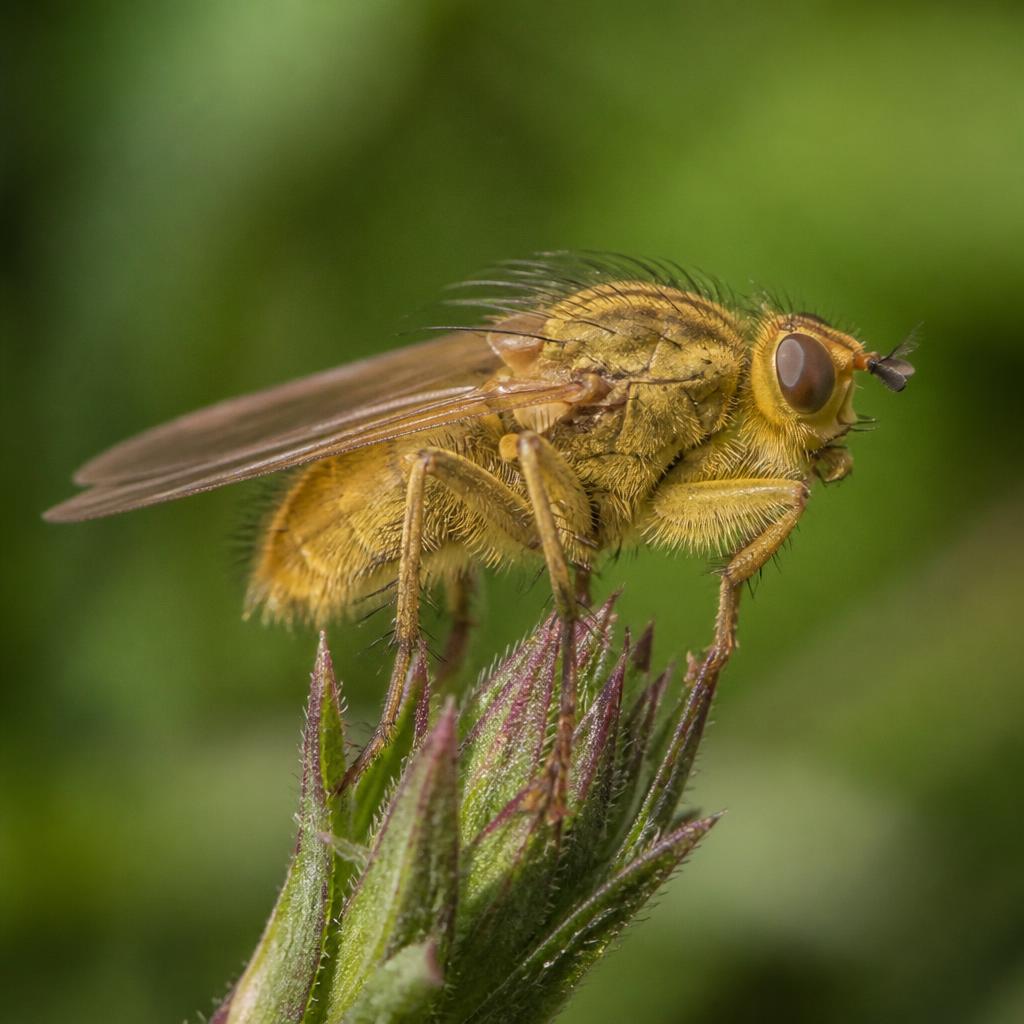
Fly
Yellow Dung Fly
Scathophaga stercoraria
Biology
Scathophaga stercoraria, commonly known as the yellow dung fly, belongs to the family Scathophagidae within the order Diptera. Adults exhibit sexual dimorphism, with males ranging from 5–11 mm and displaying prominent golden-yellow setae, especially on the legs and abdomen, while females are slightly smaller (4–8 mm) and possess a duller olive-brown to grayish coloration. The life cycle comprises four stages: egg, larva (3 instars), pupa, and adult. Females deposit approximately 200–300 eggs, typically in batches of 10–30, on fresh bovine or equine dung pats, favoring those deposited within 15–24 hours. Larval development within the dung pat is rapid, completing in 7–14 days at optimal temperatures of 20–25°C, after which third-instar larvae burrow into the surrounding soil (up to 5 cm deep) to pupate. Pupation lasts 10–20 days, and the entire life cycle can be as short as 3–4 weeks under ideal summer conditions, allowing for multiple overlapping generations annually.
Behaviour
Adult yellow dung flies exhibit both predatory and reproductive behaviors centered around fresh dung. Males are aggressively territorial, fiercely defending dung pats and engaging in aerial combat with rival males to secure mating opportunities. Mating typically occurs on or near fresh dung, with males often guarding females post-copulation to prevent further inseminations, a behavior known as 'mate-guarding.' While adult flies are primarily entomophagous, preying on smaller Diptera (e.g., muscids, calliphorids) attracted to dung, larvae are saprophagous, feeding on the decomposing organic matter within the dung. Dispersal of adults is localized, generally within a few hundred meters of breeding sites, driven by the presence of fresh dung. Their impact on public health is negligible, as they are not known vectors of human pathogens, but large aggregations can contribute to local nuisance levels around livestock operations and occasionally intrude into rural structures.
Habits
Yellow dung flies are obligate synanthropic species, closely associated with pastured livestock, particularly cattle and horses, due to their reliance on fresh dung for breeding. Adults congregate conspicuously on or immediately adjacent to fresh dung pats, often within minutes of deposition, with males arriving first to establish territories. They exhibit diurnal activity rhythms, with peak foraging and mating activity during warmer daylight hours. Harborage preferences outside of breeding cycles include vegetation surrounding pastures and stable areas, where they rest and seek shelter. Infestation signs primarily involve the visible presence of numerous adults swarming fresh dung pats, particularly in sunny, open areas. While primarily an outdoor pest, conducive conditions for indoor presence include open doors and windows in rural dwellings located near pastures, attracting them as occasional invaders seeking shelter or straying indoors. Heavy indoor aggregation is rare, typically limited to isolated individuals.
Control methods
- 1Manage manure — spread, compost or remove regularly
- 2Drain wet pasture areas where dung accumulates
- 3Install screens and door sweeps in farm buildings
- 4Use UV light traps in stables and dairy parlours
- 5Apply residual to fly resting surfaces in barns
- 6Encourage natural dung-beetle activity in pasture
Tailored to Yellow Dung Fly
IPM Procedure Checklist
Inspection
- Locate breeding sites: drains, decaying matter, moist organics
- Use tape-over-drain tests and UV/light traps to confirm
- Map dumpster, grease and floor-drain hot-spots
Identification
- Confirm Yellow Dung Fly (Scathophaga stercoraria) — not a look-alike
- Note life stage and risk level: Low
- Capture clear photos and samples for the record
Action Thresholds
- Tolerate low-level activity outside sensitive zones
- Act if activity moves indoors or near food
- Review threshold seasonally with the client
Prevention
- Clean drains with enzymatic foam to remove biofilm
- Manage trash, recycling and grease daily
- Screen windows, doors and air curtains at entries
Control Methods
- Manage manure — spread, compost or remove regularly
- Drain wet pasture areas where dung accumulates
- Install screens and door sweeps in farm buildings
- Use UV light traps in stables and dairy parlours
Monitoring & Evaluation
- Service monitors on schedule and trend captures
- Re-inspect for Yellow Dung Fly activity at follow-up
- Adjust tactics based on data; report findings to client