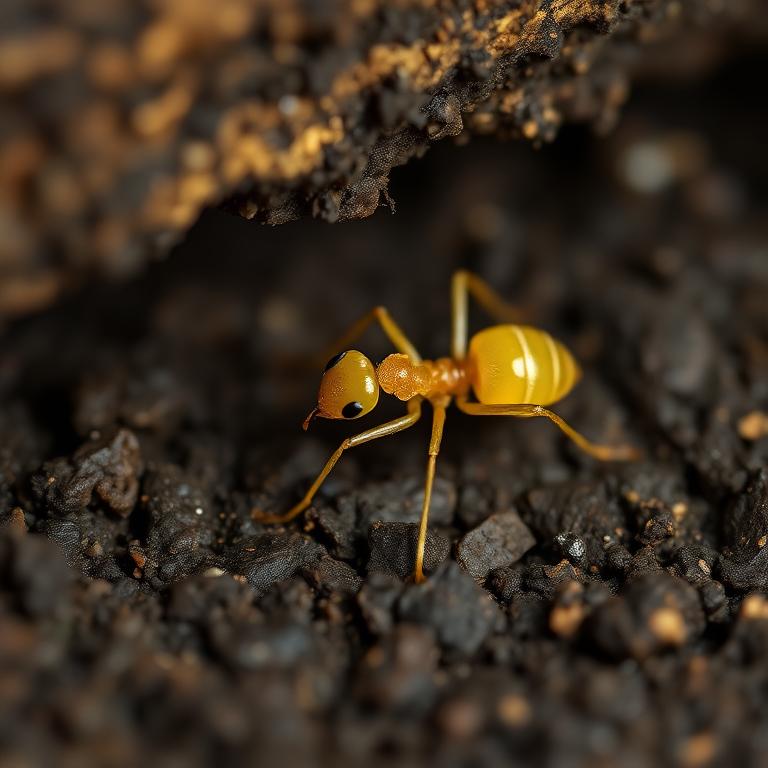
Ant
Yellow Ant
Lasius claviger
Biology
Yellow ants — also called larger yellow ants or, from their scent, citronella ants — are pale yellow to yellowish-brown Lasius workers 3–4 mm long with small eyes, a single-node waist and no sting. Crushed workers release a distinct lemon or citronella odour from mandibular gland compounds, which is the quickest field confirmation. Colonies are subterranean and can be very large, with mating flights typically in late summer and autumn, often after rain, when thousands of dark alates emerge together.
Behaviour
These ants live almost entirely underground and forage rarely if ever on the surface, feeding on honeydew from root-feeding aphids and mealybugs that they tend and shelter in their own nest chambers. They do not seek human food, do not bite or sting meaningfully, and cause no structural damage. Homeowner contact is almost always the swarm event: alates emerging from cracks in a basement slab or foundation wall in large numbers, which is alarming and routinely misreported as a termite swarm.
Habits
Nests are in moist soil beneath slabs, sidewalks, patios, stones, logs, and against foundation footings, sometimes with piles of fine excavated soil pushed up through slab cracks or basement floor joints. Conducive conditions are damp soil against or beneath the foundation, cracked slabs, and unsealed expansion joints. Inspect basements and crawl spaces for soil push-out and alate wings, confirm the citronella odour, and rule out termites before recommending treatment — in most cases sealing and reassurance are the correct answer.
Control methods
- 1Confirm identification by the citronella odour and rule out termites
- 2Seal slab cracks, expansion joints and foundation gaps where alates emerge
- 3Improve drainage and reduce soil moisture against the foundation
- 4Vacuum emerging alates — they cannot survive or breed indoors
- 5Remove logs, stones and debris on soil next to the structure
- 6Treat only if swarms recur indoors; targeted dust into the emergence void
Tailored to Yellow Ant
IPM Procedure Checklist
Inspection
- Follow trails to nests, food and moisture sources
- Inspect wall voids, slab edges and exterior soil
- Place non-repellent monitors at trail crossings
Identification
- Confirm Yellow Ant (Lasius claviger) — not a look-alike
- Note life stage and risk level: Low
- Capture clear photos and samples for the record
Action Thresholds
- Tolerate low-level activity outside sensitive zones
- Act if activity moves indoors or near food
- Review threshold seasonally with the client
Prevention
- Seal entry cracks, utility penetrations and weep holes
- Eliminate honeydew-producing pests on landscape plants
- Store food in sealed containers and clean spills promptly
Control Methods
- Confirm identification by the citronella odour and rule out termites
- Seal slab cracks, expansion joints and foundation gaps where alates emerge
- Improve drainage and reduce soil moisture against the foundation
- Vacuum emerging alates — they cannot survive or breed indoors
Monitoring & Evaluation
- Service monitors on schedule and trend captures
- Re-inspect for Yellow Ant activity at follow-up
- Adjust tactics based on data; report findings to client