Spider
Wolf Spider
Lycosidae
Biology
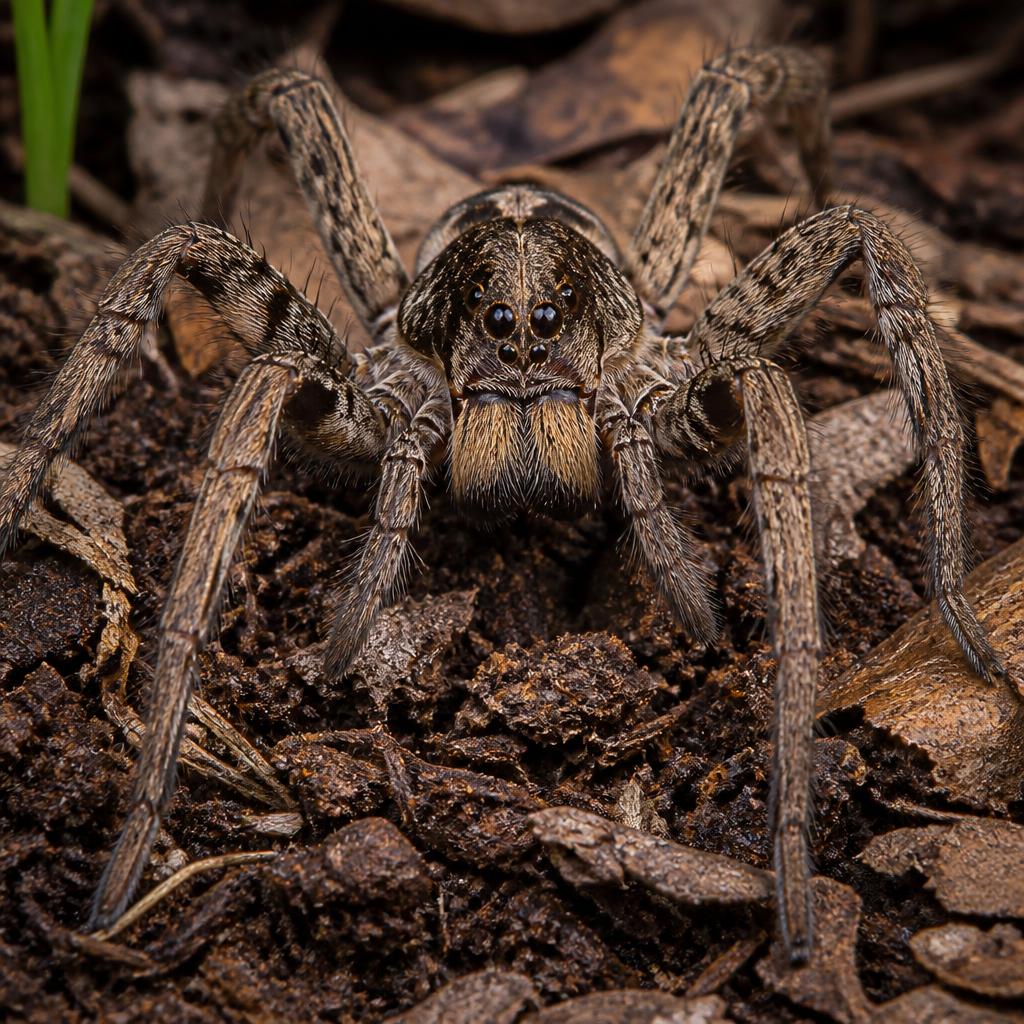
Wolf spiders, members of the family Lycosidae, are medium to large arachnids, typically ranging from 10 to 35 mm in body length (excluding legs). Their robust, hairy bodies are often camouflaged brown, grey, or black. A key diagnostic feature is their characteristic eye arrangement: eight eyes arranged in three rows, with four small eyes in the bottom row, two very large median eyes, and two medium-sized posterior eyes on the carapace, providing excellent all-around vision. Females exhibit unique reproductive behaviors, attaching a spherical egg sac to their spinnerets and carrying it until the spiderlings hatch, after which the young clamber onto their mother's back and remain there for several days to weeks, undergoing their first molt before dispersing. Their lifespan generally ranges from 1–2 years, with some larger species living up to 3 years, thriving in a wide range of temperate and tropical environments.
Behaviour
Wolf spiders are predominantly nocturnal hunters, actively foraging on the ground for prey rather than constructing webs to capture it. Their sophisticated vision, combined with acute tactile sensing via leg setae, allows them to detect and ambush insects, other spiders, and even small vertebrates. While generally solitary, their dispersal mechanisms include ballooning as spiderlings, facilitated by silk threads carried by the wind, enabling colonization of new areas. These spiders do not exhibit aggressive behavior unless provoked; however, a bite, though rarely medically significant, can be painful due to their robust chelicerae. Their presence indoors is typically accidental, as they are not pests of structures or public health concern, but their large size and rapid movements can cause alarm.
Habits
Wolf spiders prefer harborage in natural ground litter such as leaf debris, under rocks, logs, firewood piles, and in burrows, which they may excavate or co-opt from other organisms. Their foraging patterns involve active patrolling of their territory, often covering significant distances in search of prey. Seasonal movements commonly bring them indoors during cooler autumn months, seeking shelter and overwintering sites, particularly in basements, crawlspaces, and ground-level rooms. Conducive conditions for their presence include cluttered perimeter landscaping, high moisture areas, and abundant ground-dwelling insect populations. Pest management professionals should look for signs such as sightings of actively hunting spiders, especially at night, or the characteristic sight of females carrying egg sacs or spiderlings on their backs, confirming their presence rather than an incidental wanderer.
Control methods
- 1Reduce harborage: leaf litter, stones and mulch by foundation
- 2Seal door sweeps and basement gaps
- 3Glue boards in garages and basements
- 4Outdoor lights to yellow LEDs to reduce prey
- 5Vacuum interior corners and edges
- 6Spot residual along entry points
Tailored to Wolf Spider
IPM Procedure Checklist
Inspection
- Inspect undisturbed corners, voids and stored items
- Identify webs, egg sacs and prey debris
- Note conducive insect prey populations
Identification
- Confirm Wolf Spider (Lycosidae) — not a look-alike
- Note life stage and risk level: Low
- Capture clear photos and samples for the record
Action Thresholds
- Tolerate low-level activity outside sensitive zones
- Act if activity moves indoors or near food
- Review threshold seasonally with the client
Prevention
- Reduce clutter and seal cracks around the structure
- Switch exterior lights to yellow / sodium to reduce prey
- Install door sweeps and screen vents
Control Methods
- Reduce harborage: leaf litter, stones and mulch by foundation
- Seal door sweeps and basement gaps
- Glue boards in garages and basements
- Outdoor lights to yellow LEDs to reduce prey
Monitoring & Evaluation
- Service monitors on schedule and trend captures
- Re-inspect for Wolf Spider activity at follow-up
- Adjust tactics based on data; report findings to client