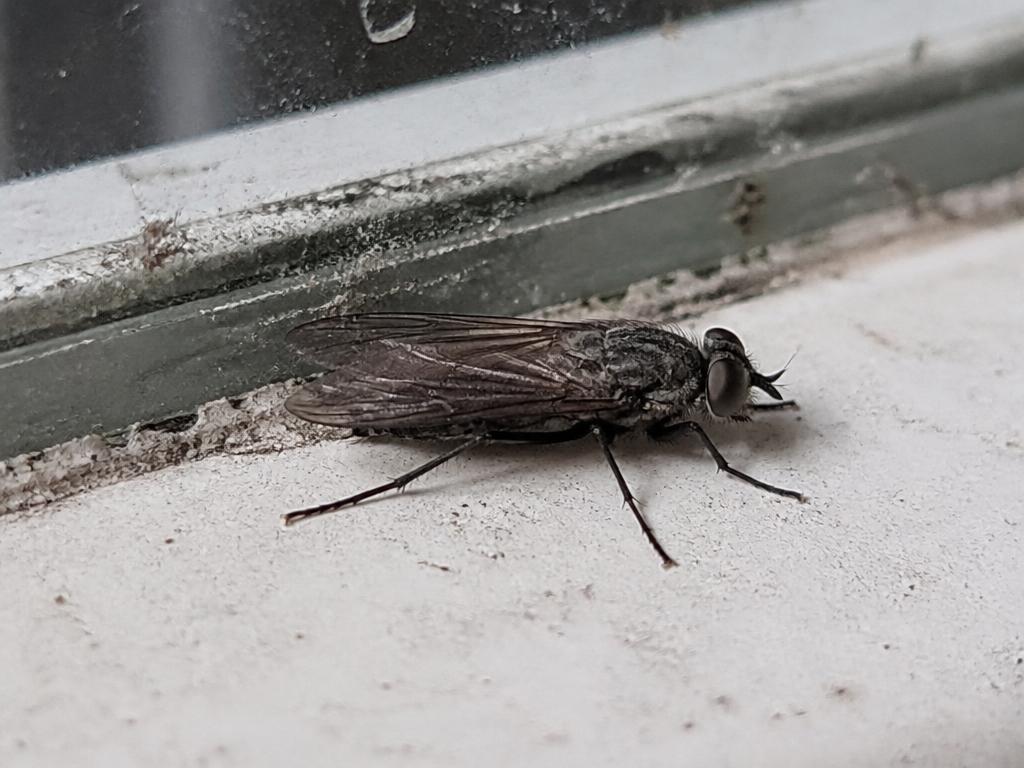
Fly
Window Fly
Scenopinus fenestralis
Biology
Scenopinus fenestralis (family Scenopinidae) is a slender, flattened, dull black fly 3-6 mm long, with a small head, reduced wing venation, and a habit of walking slowly rather than flying. Females lay eggs in dry, dust-laden accumulations of organic debris. Larvae are exceptionally long, thin, and worm-like, pale white with a distinctly segmented appearance, and are often mistaken for small worms rather than fly larvae. Larval development is slow — commonly 6-12 months and occasionally longer — passing through numerous instars before pupating in the same debris.
Behaviour
Adults are weak fliers strongly drawn to light, so they are almost always noticed crawling on windowsills and glass, giving the species its name. They do not bite, feed on food, or damage fabric. The larvae are predatory and beneficial: they hunt carpet beetle larvae, clothes moth larvae, mites, and other small arthropods living in accumulated lint, hair, and debris. As a result, a persistent window fly presence is best interpreted as an indicator that a hidden fabric-pest or bird/rodent-nest food source exists somewhere in the structure.
Habits
Larvae occur in undisturbed dust and detritus: under carpet edges, in attic insulation, wall voids with old bird or rodent nests, beneath floorboards, in bird lofts, and in stored fabrics and animal bedding. Adults appear indoors from late spring through summer. Conducive conditions include long-undisturbed accumulations of hair, feathers, lint, and dead insects, along with the presence of the fabric pests the larvae prey upon. Well-vacuumed, nest-free structures rarely produce them.
Control methods
- 1Locate and remove old bird or rodent nests in voids and attics.
- 2Vacuum thoroughly under carpet edges, baseboards, and stored fabrics.
- 3Inspect for and treat the underlying carpet beetle or clothes moth source.
- 4Reduce dust and lint accumulation in attics and utility spaces.
- 5Seal gaps around windows where adults migrate into living areas.
- 6Use sticky monitors at windowsills to gauge activity levels.
Tailored to Window Fly
IPM Procedure Checklist
Inspection
- Locate breeding sites: drains, decaying matter, moist organics
- Use tape-over-drain tests and UV/light traps to confirm
- Map dumpster, grease and floor-drain hot-spots
Identification
- Confirm Window Fly (Scenopinus fenestralis) — not a look-alike
- Note life stage and risk level: Low
- Capture clear photos and samples for the record
Action Thresholds
- Tolerate low-level activity outside sensitive zones
- Act if activity moves indoors or near food
- Review threshold seasonally with the client
Prevention
- Clean drains with enzymatic foam to remove biofilm
- Manage trash, recycling and grease daily
- Screen windows, doors and air curtains at entries
Control Methods
- Locate and remove old bird or rodent nests in voids and attics.
- Vacuum thoroughly under carpet edges, baseboards, and stored fabrics.
- Inspect for and treat the underlying carpet beetle or clothes moth source.
- Reduce dust and lint accumulation in attics and utility spaces.
Monitoring & Evaluation
- Service monitors on schedule and trend captures
- Re-inspect for Window Fly activity at follow-up
- Adjust tactics based on data; report findings to client