Ant
Velvety Tree Ant
Liometopum occidentale
Biology
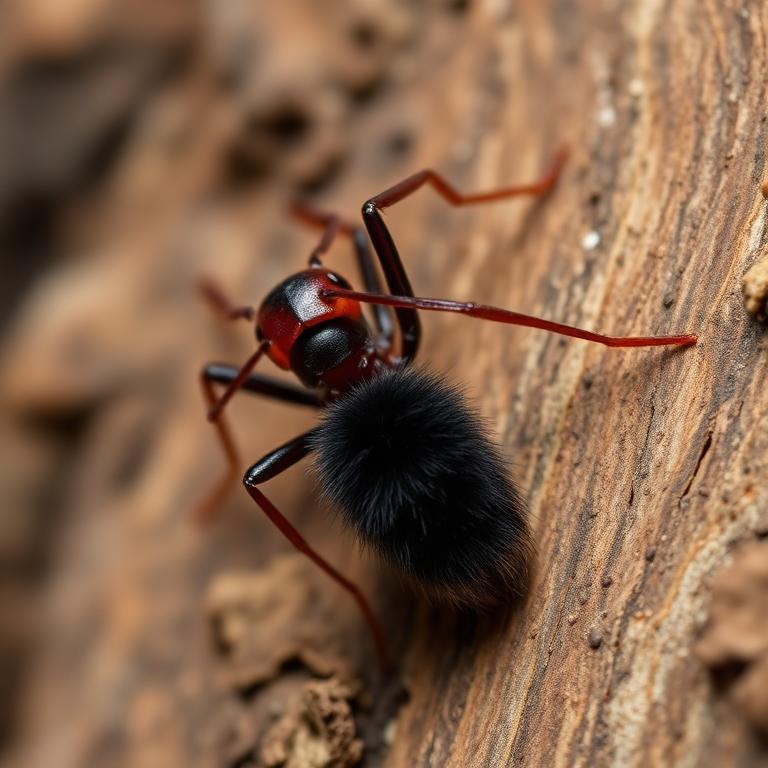
Velvety tree ants are strikingly marked workers 2.5–5.5 mm long with a dark brown to black head, a red or reddish-brown thorax, and a velvety black gaster covered in fine dense hairs. Colonies are large — often tens of thousands of workers — polydomous, and centred on a parent nest in a hollow or decayed tree with satellite nests in nearby trees and structures. Alates swarm in late spring and summer, and colonies can persist in the same tree for many years.
Behaviour
Workers are fast, aggressive and highly defensive, biting readily and emitting a strong pungent odour when crushed, often described as similar to but sharper than odorous house ants. They tend aphids and scale heavily for honeydew and also scavenge insects. Structurally they matter because they excavate galleries in soft, damp or decayed wood — insulation, wall voids, decking and framing — producing damage that is regularly misdiagnosed as carpenter ant activity, along with the same coarse frass fallout.
Habits
Parent nests are in dead limbs, hollow trunks, stumps and decayed heartwood, particularly oak, sycamore, cottonwood and conifers; satellite nests move into wall voids, subfloors, attics, insulation, decks and firewood adjacent to those trees. Foraging trails run along branches touching the roof, along utility lines, and up foundation walls. Conducive conditions are overhanging limbs, decayed or moisture-damaged wood, stored firewood, and honeydew-producing trees. Inspect at night with a torch, follow trails back along branches and wires to the parent tree.
Control methods
- 1Trace night-time trails back to the parent nest tree
- 2Prune branches and vegetation touching the roof and walls
- 3Remove decayed wood, stumps and stored firewood near the structure
- 4Repair moisture-damaged framing that allows gallery excavation
- 5Treat satellite nests in voids with a labelled dust, plus exterior baiting
- 6Distinguish from carpenter ants — control strategy and nest sites differ
Tailored to Velvety Tree Ant
IPM Procedure Checklist
Inspection
- Follow trails to nests, food and moisture sources
- Inspect wall voids, slab edges and exterior soil
- Place non-repellent monitors at trail crossings
Identification
- Confirm Velvety Tree Ant (Liometopum occidentale) — not a look-alike
- Note life stage and risk level: Moderate
- Capture clear photos and samples for the record
Action Thresholds
- Trigger action when monitor counts trend up
- Re-evaluate weekly during active season
- Document trigger criteria in the IPM plan
Prevention
- Seal entry cracks, utility penetrations and weep holes
- Eliminate honeydew-producing pests on landscape plants
- Store food in sealed containers and clean spills promptly
Control Methods
- Trace night-time trails back to the parent nest tree
- Prune branches and vegetation touching the roof and walls
- Remove decayed wood, stumps and stored firewood near the structure
- Repair moisture-damaged framing that allows gallery excavation
Monitoring & Evaluation
- Service monitors on schedule and trend captures
- Re-inspect for Velvety Tree Ant activity at follow-up
- Adjust tactics based on data; report findings to client