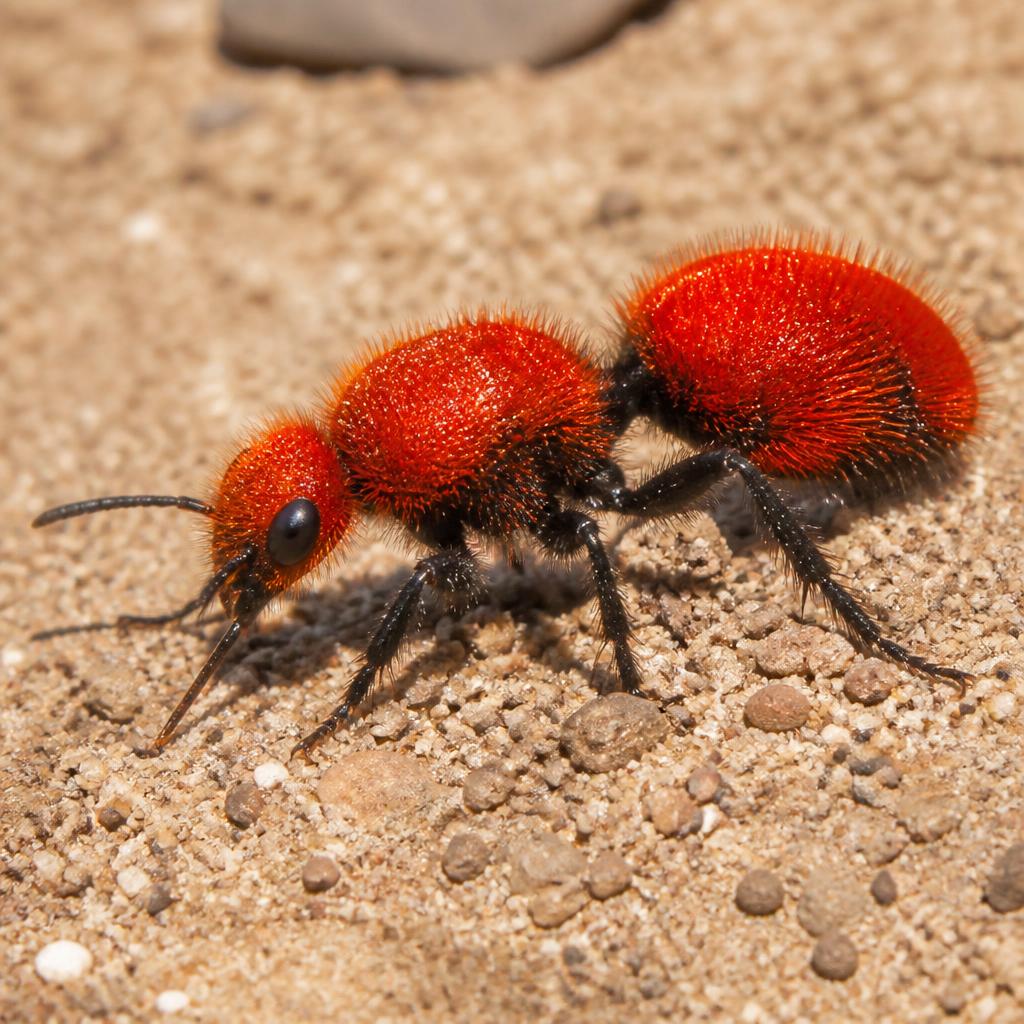
Stinging Insect
Velvet Ant (Cow Killer)
Dasymutilla occidentalis
Biology
Dasymutilla occidentalis, commonly known as the Eastern Velvet Ant or Cow Killer, is not an ant but a wingless wasp belonging to the family Mutillidae (velvet ants). Females measure 15–25 mm in length and are distinguished by their striking aposematic coloration: dense, velvety pile of bright red-orange on the thorax and abdomen, contrasting with black legs and antennal segments. Males are winged, possess similar coloration but with less dense pile, and are significantly smaller, typically 10–18 mm. The life cycle involves complete metamorphosis (egg, larva, pupa, adult), with eggs laid inside the cocoons of host Hymenoptera—primarily ground-nesting bees and wasps, but sometimes bumblebees or cicada killers—with larval development occurring within and consuming the host larva or pupa. A single generation typically develops per year, with adults emerging from late summer to early autumn, and longevity is relatively short, often a few weeks for males and several months for females.
Behaviour
Velvet ants are solitary insects; females exhibit crepuscular or nocturnal activity patterns, though they may be seen during the day, particularly after rainfall or in areas with high host populations. Their dispersal is limited for flightless females, primarily relying on crawling to locate host nests. Communication between sexes largely relies on pheromones, with males using a characteristic zigzag flight pattern to locate receptive females. As ectoparasitoids, larvae consume the host's immature stages. Females are not aggressive but are highly defensive; when threatened, they produce a distinct stridulatory 'squeaking' sound as a warning before delivering an exceptionally potent sting, rated as one of the most painful insect stings (Level 3 or 4 on the Schmidt pain index), intended to deter predators, not to kill. The structural impact of velvet ants is negligible, and they pose no public health threat beyond their sting.
Habits
Female D. occidentalis primarily harbor in loose soil, under leaf litter, or beneath debris in sandy areas, open fields, meadows, and lawns, particularly in environments conducive to their ground-nesting hymenopteran hosts. Their foraging patterns involve methodically crawling along the ground surface, utilizing chemoreceptors on their antennae to detect the presence of host burrows or cocoons. Infestations are generally not concentrated but rather scattered individuals; their detection is often incidental, with homeowners encountering them while gardening or walking barefoot. Conducive conditions include well-drained, sandy soils and undisturbed grassy areas where host bee and wasp populations thrive. Signs of their presence are limited to the sighting of the distinctive adults; larval development occurs cryptically within host nests, making active infestation detection challenging for pest management professionals.
Control methods
- 1Avoid handling — they do not run from threats
- 2Wear closed-toe shoes in sandy yards and play areas
- 3Address host bee/wasp ground nests to reduce numbers
- 4Spot-treat with residual insecticide if abundant near walks
- 5Maintain dense turf to discourage ground-nesting hosts
- 6Educate children to recognize and avoid them
Tailored to Velvet Ant (Cow Killer)
IPM Procedure Checklist
Inspection
- Survey interior and exterior for evidence and conducive conditions
- Document findings with photos and a site map
- Place monitors to confirm activity
Identification
- Confirm Velvet Ant (Cow Killer) (Dasymutilla occidentalis) — not a look-alike
- Note life stage and risk level: Moderate
- Capture clear photos and samples for the record
Action Thresholds
- Trigger action when monitor counts trend up
- Re-evaluate weekly during active season
- Document trigger criteria in the IPM plan
Prevention
- Exclude entry points and harborage
- Improve sanitation and moisture control
- Modify habitat around the structure
Control Methods
- Avoid handling — they do not run from threats
- Wear closed-toe shoes in sandy yards and play areas
- Address host bee/wasp ground nests to reduce numbers
- Spot-treat with residual insecticide if abundant near walks
Monitoring & Evaluation
- Service monitors on schedule and trend captures
- Re-inspect for Velvet Ant (Cow Killer) activity at follow-up
- Adjust tactics based on data; report findings to client