Ant
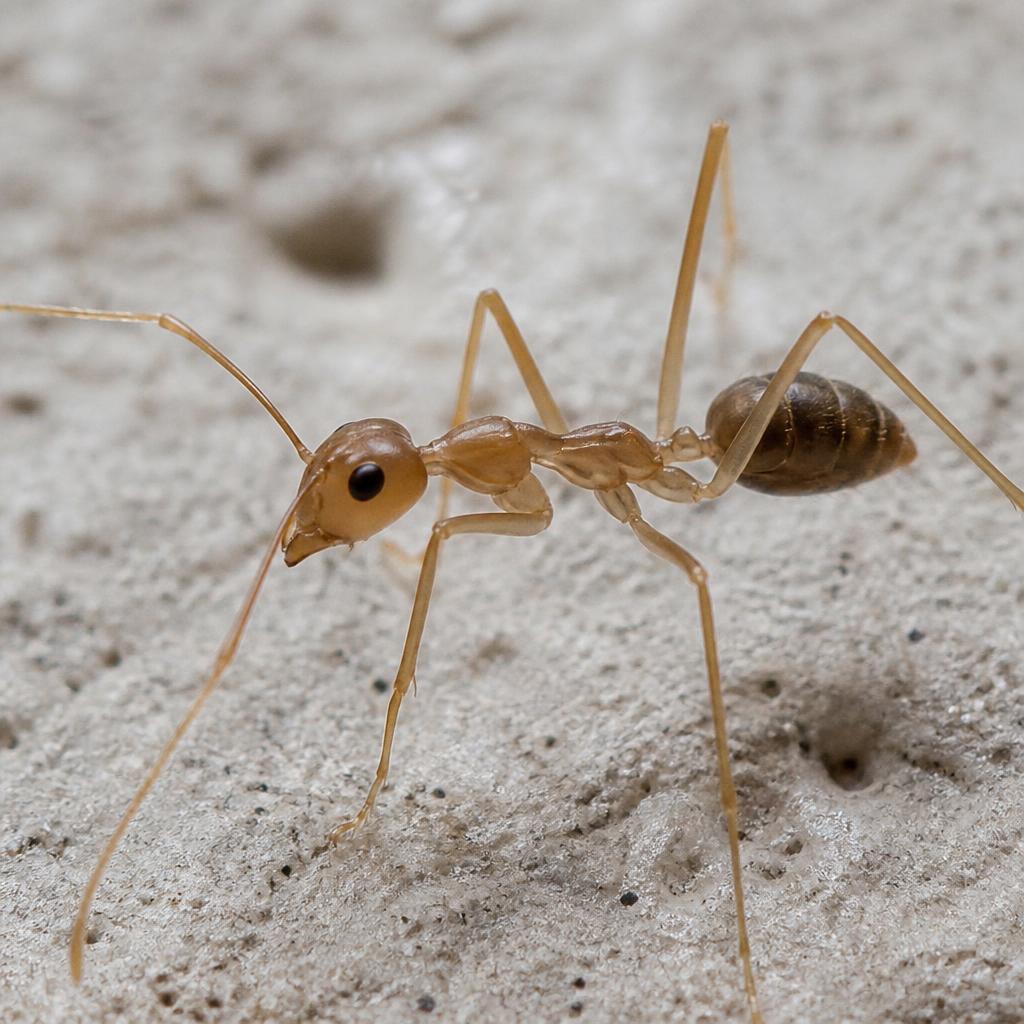
Tawny Crazy Ant
Nylanderia fulva
Biology
Nylanderia fulva, commonly known as the Tawny Crazy Ant, is a small formicid ranging from 2.2 to 3.0 mm in length, characterized by its reddish-brown coloration and unusually long, slender legs and antennae, the latter consisting of 12 segments without a club. This species exhibits polymorphic worker castes, though the differences are subtle. Colony reproduction primarily occurs through budding, leading to the formation of massive polydomous and polygynous supercolonies containing hundreds of thousands of queens and billions of workers, allowing for rapid geographic expansion. A typical lifecycle from egg to adult worker takes approximately 20-30 days under optimal conditions (around 28-32°C and 70-80% RH), with queens capable of laying thousands of eggs daily for several years.
Behaviour
The Tawny Crazy Ant is characterized by its exceptionally erratic, non-trailing foraging behavior, with individual workers moving in seemingly random patterns at high speeds, hence the 'crazy' moniker. This species is highly opportunistic and omnivorous, feeding on a wide range of carbohydrates (nectar, honeydew from sap-feeding insects) and proteins (insects, small vertebrates, pet food). While not possessing a functional sting, they can bite and spray formic acid as a defensive mechanism or to subdue prey. Their aggressive swarming behavior often leads to competitive displacement of native arthropod species, including fire ants, fundamentally altering local ecosystem dynamics and food webs.
Habits
Nylanderia fulva exhibits remarkable adaptability in harborage selection, colonizing diverse sheltered environments both indoors and outdoors, including rotten wood, leaf litter, under rocks, within discarded items, and densely packed electrical equipment. Foraging patterns are largely nocturnal, though they are active during the day in shaded or overcast conditions, covering vast areas in search of resources. Conducive conditions for infestation primarily include high moisture, abundant food sources, and suitable nesting sites with minimal disturbance. Technicians should look for their characteristic 'swarming' activity across surfaces, especially on electrical components like circuit breakers, pumps, and HVAC units, as well as the presence of honeydew-producing insects on vegetation.
Control methods
- 1Non-repellent residual perimeter band (10 ft)
- 2Bait stations along trails and harborage
- 3Seal electrical boxes and outdoor junctions
- 4Remove ground debris, leaf litter and stones
- 5Coordinate treatments with neighbors over wide area
- 6Professional treatment for established supercolonies
Tailored to Tawny Crazy Ant
IPM Procedure Checklist
Inspection
- Follow trails to nests, food and moisture sources
- Inspect wall voids, slab edges and exterior soil
- Place non-repellent monitors at trail crossings
Identification
- Confirm Tawny Crazy Ant (Nylanderia fulva) — not a look-alike
- Note life stage and risk level: High
- Capture clear photos and samples for the record
Action Thresholds
- Zero-tolerance: act on first confirmed sighting
- Notify client and document the trigger event
- Prioritize health and regulatory risk in the plan
Prevention
- Seal entry cracks, utility penetrations and weep holes
- Eliminate honeydew-producing pests on landscape plants
- Store food in sealed containers and clean spills promptly
Control Methods
- Non-repellent residual perimeter band (10 ft)
- Bait stations along trails and harborage
- Seal electrical boxes and outdoor junctions
- Remove ground debris, leaf litter and stones
Monitoring & Evaluation
- Service monitors on schedule and trend captures
- Re-inspect for Tawny Crazy Ant activity at follow-up
- Adjust tactics based on data; report findings to client