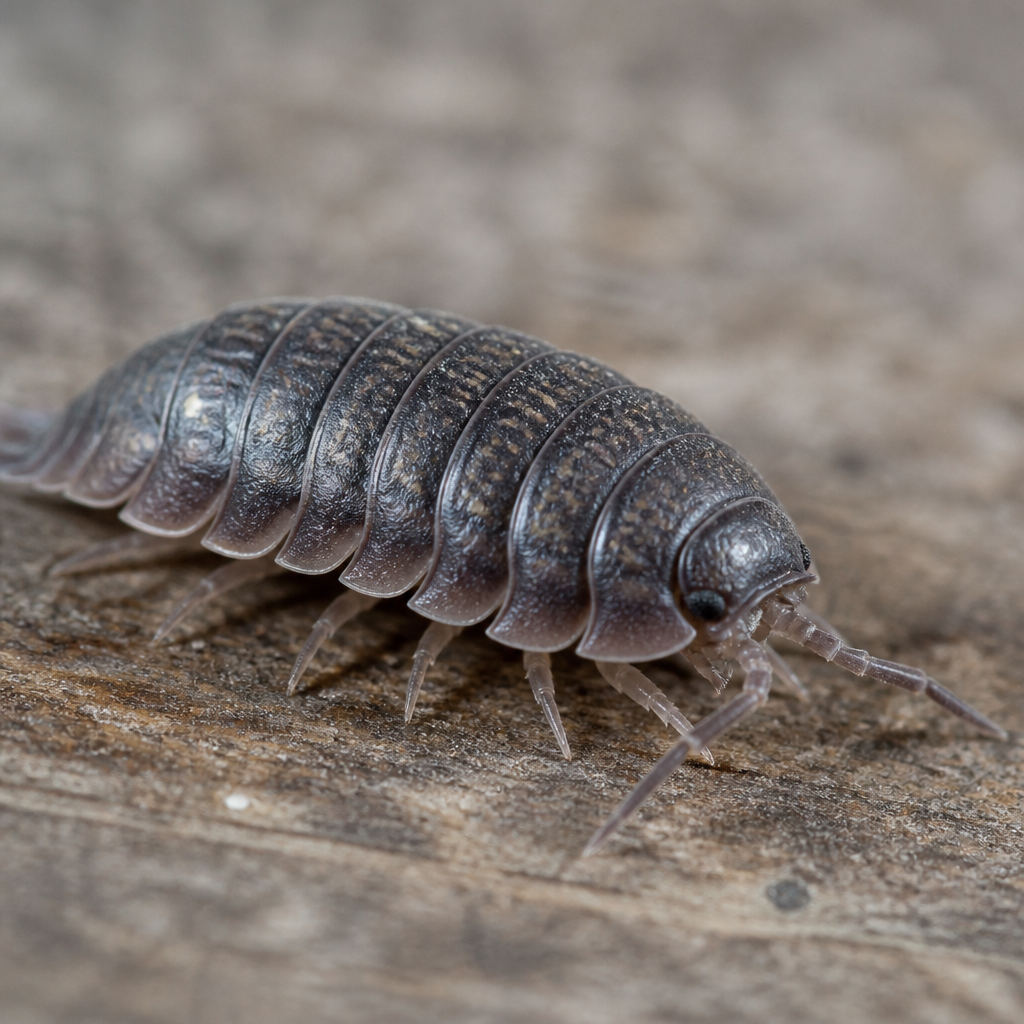
Occasional Invader
Sowbug
Porcellio scaber
Biology
Sowbugs, *Porcellio scaber*, are common terrestrial isopods belonging to the suborder Oniscidea, not insects. Adults typically measure 12–15 mm in length, characterized by a flattened, oval, segmented body (dorsoventrally compressed) and distinct antennae, seven pairs of robust legs, and two terminal uropods that project noticeably from the posterior. Reproduction occurs sexually; females carry 20–200 eggs in a fluid-filled brood pouch, or marsupium, for 3–7 weeks before releasing live young, sometimes producing multiple broods per year. Their respiratory system, consisting of gill-like pseudotrachea, necessitates high relative humidity (above 70%) for survival, making them highly susceptible to desiccation. Sowbugs can live 2–3 years under optimal humid conditions, developing through several molts after hatching.
Behaviour
Primarily nocturnal detritivores, *P. scaber* are active during nighttime hours to forage, minimizing exposure to desiccating conditions and predators. They are social, often found aggregated in groups, which helps conserve moisture and provides a degree of protection. Dispersal is typically limited and localized, driven by moisture gradients and food availability. Communication involves chemical cues, though complex social structures are absent. Their diet consists almost exclusively of decaying organic matter—leaves, wood, fungi, and sometimes young plant roots or seedlings if other food is scarce—playing a key role in nutrient cycling. Sowbugs exhibit a defensive 'freeze' response when disturbed, but, unlike pillbugs, cannot voluntarily roll into a perfect ball; they are harmless to humans and structures, posing no public-health threat or property damage.
Habits
Sowbugs preferentially harbor in cool, dark, and damp locations during daylight hours, such as under rocks, logs, leaf litter, mulch, potted plants, landscape timbers, and in crawl spaces or basements with high humidity. Foraging patterns involve short, exploratory movements from their harborage, often within a few meters, targeting rich sources of decaying organic matter. Seasonal movements are minimal, though increased indoor migration can be observed during prolonged periods of heavy rain or drought, as conditions outdoors become unfavorable. Conducive conditions for infestations include excessive moisture, poor drainage, heavy organic debris accumulation around foundations, and cracks or gaps in foundation walls. Technicians should look for aggregations in damp areas, frass (excrement consisting of digested organic matter), and the presence of live or dead individuals, particularly in basements, crawl spaces, and ground-level bathrooms.
Control methods
- 1Remove leaf litter, mulch and debris from foundation perimeter
- 2Reduce irrigation near building edges; fix drainage issues
- 3Seal gaps at door thresholds, weep holes and utility penetrations
- 4Run dehumidifiers in basements and crawlspaces
- 5Apply residual perimeter insecticide band if pressure persists
- 6Vacuum stragglers indoors — desiccation kills them quickly
Tailored to Sowbug
IPM Procedure Checklist
Inspection
- Inspect exterior perimeter for entry pathways
- Note moisture, mulch and ground-cover near foundation
- Identify aggregation sites on warm walls
Identification
- Confirm Sowbug (Porcellio scaber) — not a look-alike
- Note life stage and risk level: Low
- Capture clear photos and samples for the record
Action Thresholds
- Tolerate low-level activity outside sensitive zones
- Act if activity moves indoors or near food
- Review threshold seasonally with the client
Prevention
- Seal foundation cracks, weep holes and utility penetrations
- Pull mulch and vegetation back from the structure
- Improve drainage and reduce exterior moisture
Control Methods
- Remove leaf litter, mulch and debris from foundation perimeter
- Reduce irrigation near building edges; fix drainage issues
- Seal gaps at door thresholds, weep holes and utility penetrations
- Run dehumidifiers in basements and crawlspaces
Monitoring & Evaluation
- Service monitors on schedule and trend captures
- Re-inspect for Sowbug activity at follow-up
- Adjust tactics based on data; report findings to client