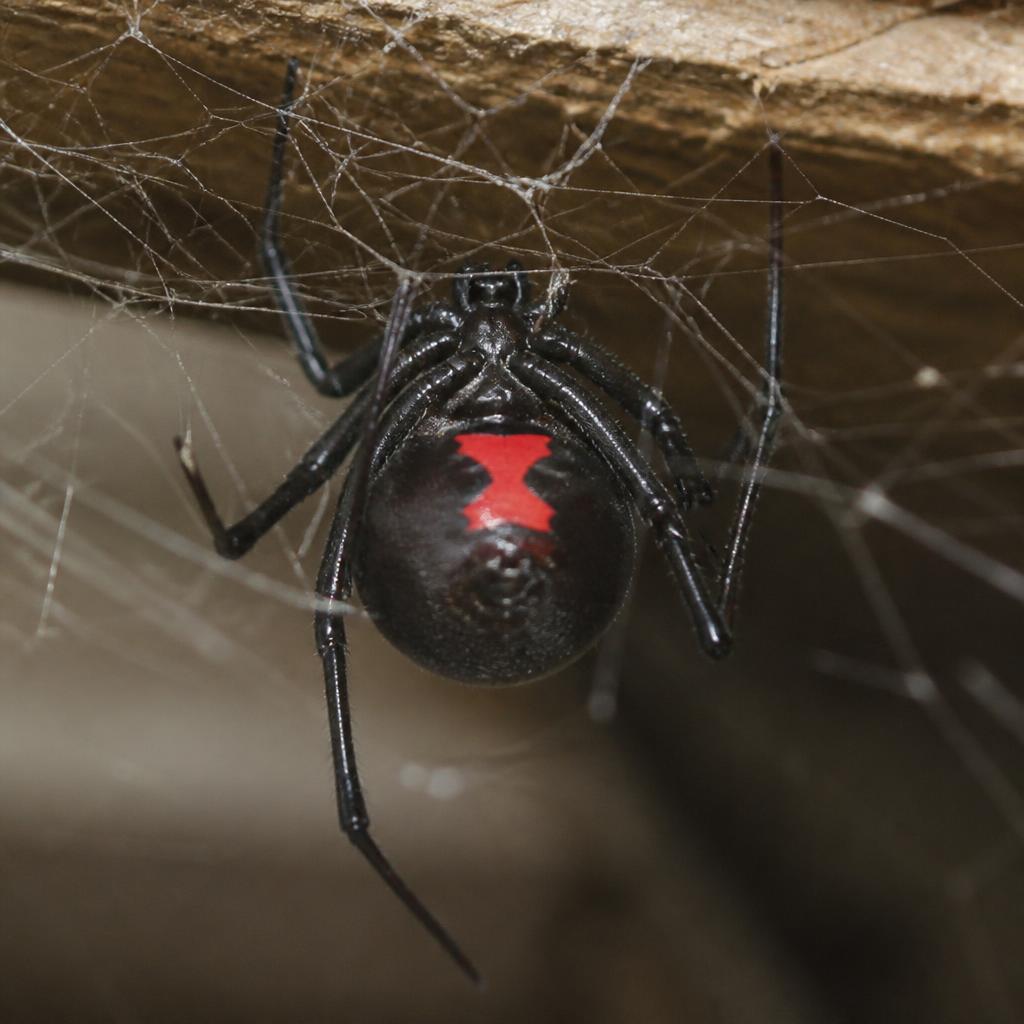
Spider
Southern Black Widow
Latrodectus mactans
Biology
Latrodectus mactans is the classic eastern widow: females are 8–13 mm, glossy jet-black with a complete, unbroken red hourglass on the underside of a globose abdomen, often with a small red spot above the spinnerets. Males (3–4 mm) are tan with white and red side stripes and are harmless. Females mature in 2–4 months, live 1–3 years and deposit 4–9 papery, pear-shaped egg sacs of 150–400 eggs each; eggs hatch in 14–30 days at 25–30°C. Spiderlings are cannibalistic and disperse by ballooning on silk. Fangs are small but deliver potent alpha-latrotoxin.
Behaviour
Nocturnal, solitary and strongly thigmotactic, the southern black widow hides in a silk retreat by day and hangs inverted in her tangle web at night. The web is a tough, irregular three-dimensional snare with gum-footed trap lines anchored to the ground that catch crawling beetles, crickets and roaches. She is timid rather than aggressive: bites almost always occur when a spider is pressed against skin inside clothing, gloves or stored items, or when a female defends her sacs. Envenomation causes latrodectism — cramping abdominal and back pain, sweating, hypertension and nausea — and warrants medical evaluation, especially in children and the elderly.
Habits
Look for southern black widows in meter boxes, irrigation valve boxes, water meters, crawlspace vents, hollow blocks, under deck rails and lawn furniture, in woodpiles and inside cluttered garages and sheds. They rarely wander far from the web, so populations build wherever prey and undisturbed voids coincide. Diagnostic signs are coarse, irregular silk that crackles when pulled, insect husks in the snare and one or more cream-coloured papery egg sacs. Warm, sheltered, low-traffic structures with abundant ground insects are the most conducive conditions, and populations peak from late spring through autumn in the southeastern United States.
Control methods
- 1Wear gloves inspecting meter boxes, woodpiles and stored items
- 2Knock down webs and remove/destroy egg sacs
- 3Declutter garages, sheds and crawlspaces; store items off the floor
- 4Seal vents, weep holes and gaps around utility penetrations
- 5Apply residual product into voids, eaves and box interiors
- 6Refer suspected bites for medical evaluation immediately
Tailored to Southern Black Widow
IPM Procedure Checklist
Inspection
- Inspect undisturbed corners, voids and stored items
- Identify webs, egg sacs and prey debris
- Note conducive insect prey populations
Identification
- Confirm Southern Black Widow (Latrodectus mactans) — not a look-alike
- Note life stage and risk level: High
- Capture clear photos and samples for the record
Action Thresholds
- Zero-tolerance: act on first confirmed sighting
- Notify client and document the trigger event
- Prioritize health and regulatory risk in the plan
Prevention
- Reduce clutter and seal cracks around the structure
- Switch exterior lights to yellow / sodium to reduce prey
- Install door sweeps and screen vents
Control Methods
- Wear gloves inspecting meter boxes, woodpiles and stored items
- Knock down webs and remove/destroy egg sacs
- Declutter garages, sheds and crawlspaces; store items off the floor
- Seal vents, weep holes and gaps around utility penetrations
Monitoring & Evaluation
- Service monitors on schedule and trend captures
- Re-inspect for Southern Black Widow activity at follow-up
- Adjust tactics based on data; report findings to client