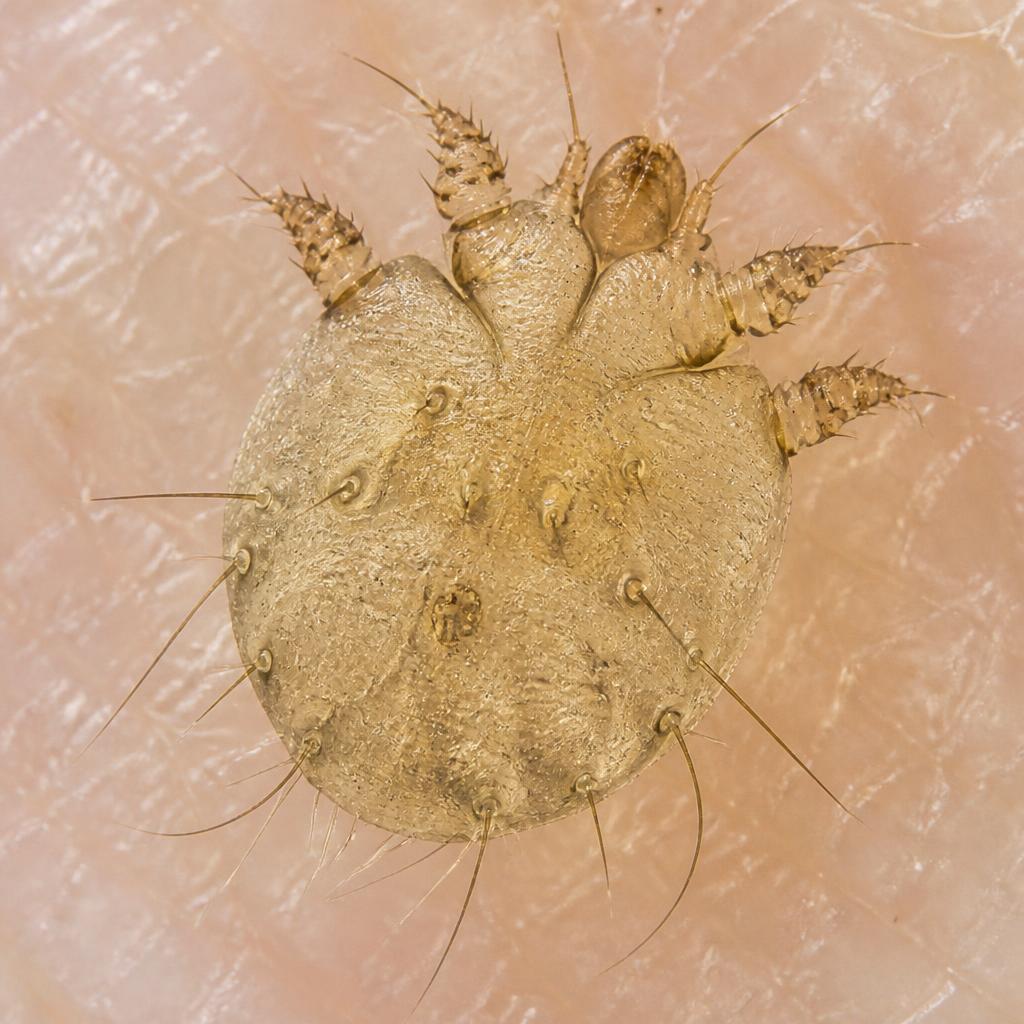
Blood Feeder
Scabies Mite
Sarcoptes scabiei
Biology
Sarcoptes scabiei, commonly known as the scabies mite, is an obligate parasitic acarid (Order Sarcoptiformes, Family Sarcoptidae) that causes the skin condition scabies in mammals, including humans. These microscopic mites, typically 0.2-0.4 mm long, possess an oval, flattened body with eight short, stubby legs. Females are slightly larger than males. The entire life cycle, taking approximately 10-14 days to complete, occurs entirely on the host's skin. After mating on the skin surface, the female burrows into the stratum corneum, laying 2-3 eggs per day for 4-6 weeks. Eggs hatch into six-legged larvae, which then molt into nymphs and finally into eight-legged adults. Mites can survive off a host for only 24-72 hours under typical indoor conditions.
Behaviour
Scabies mites are highly specialized parasites, spending their entire life cycle on or within the host's epidermis. The primary behavioral cue is the female's burrowing activity, driven by chemotaxis towards secretions and warmth from the host. Most burrowing and feeding occur at night, leading to intensified itching, the hallmark symptom of scabies. Mites are generally slow-moving, with direct and prolonged skin-to-skin contact being the most common mode of transmission between hosts. They avoid light and prefer the warmer, protected areas of the skin, such as between fingers, wrist creases, and belt lines. The immune response to mite feces and body parts within the burrows causes the characteristic pruritic rash.
Habits
Scabies mites create distinctive serpiginous burrows within the superficial layers of the host's epidermis, most commonly found in the interdigital spaces, flexor surfaces of the wrists, elbows, axillae, groin, and around the waistline. These burrows serve as both harborage and feeding sites for the mites. Conducive conditions for the proliferation and transmission of scabies mites are directly related to close human contact and overcrowded living arrangements, such as nursing homes, dormitories, and childcare facilities. Infestation risk increases with poor hygiene, although scabies can affect individuals of all socioeconomic backgrounds. Their microscopic size and intracellular existence make them challenging to detect without close dermatological examination.
Control methods
- 1Confirm diagnosis with medical professional.
- 2Apply prescribed topical scabicides thoroughly.
- 3Treat all close contacts simultaneously.
- 4Wash all clothing and bedding in hot water.
- 5Vacuum and clean infested environments.
- 6Seal potentially infested items for 72 hours.
Tailored to Scabies Mite
IPM Procedure Checklist
Inspection
- Survey interior and exterior for evidence and conducive conditions
- Document findings with photos and a site map
- Place monitors to confirm activity
Identification
- Confirm Scabies Mite (Sarcoptes scabiei) — not a look-alike
- Note life stage and risk level: High
- Capture clear photos and samples for the record
Action Thresholds
- Zero-tolerance: act on first confirmed sighting
- Notify client and document the trigger event
- Prioritize health and regulatory risk in the plan
Prevention
- Exclude entry points and harborage
- Improve sanitation and moisture control
- Modify habitat around the structure
Control Methods
- Confirm diagnosis with medical professional.
- Apply prescribed topical scabicides thoroughly.
- Treat all close contacts simultaneously.
- Wash all clothing and bedding in hot water.
Monitoring & Evaluation
- Service monitors on schedule and trend captures
- Re-inspect for Scabies Mite activity at follow-up
- Adjust tactics based on data; report findings to client