Rodent
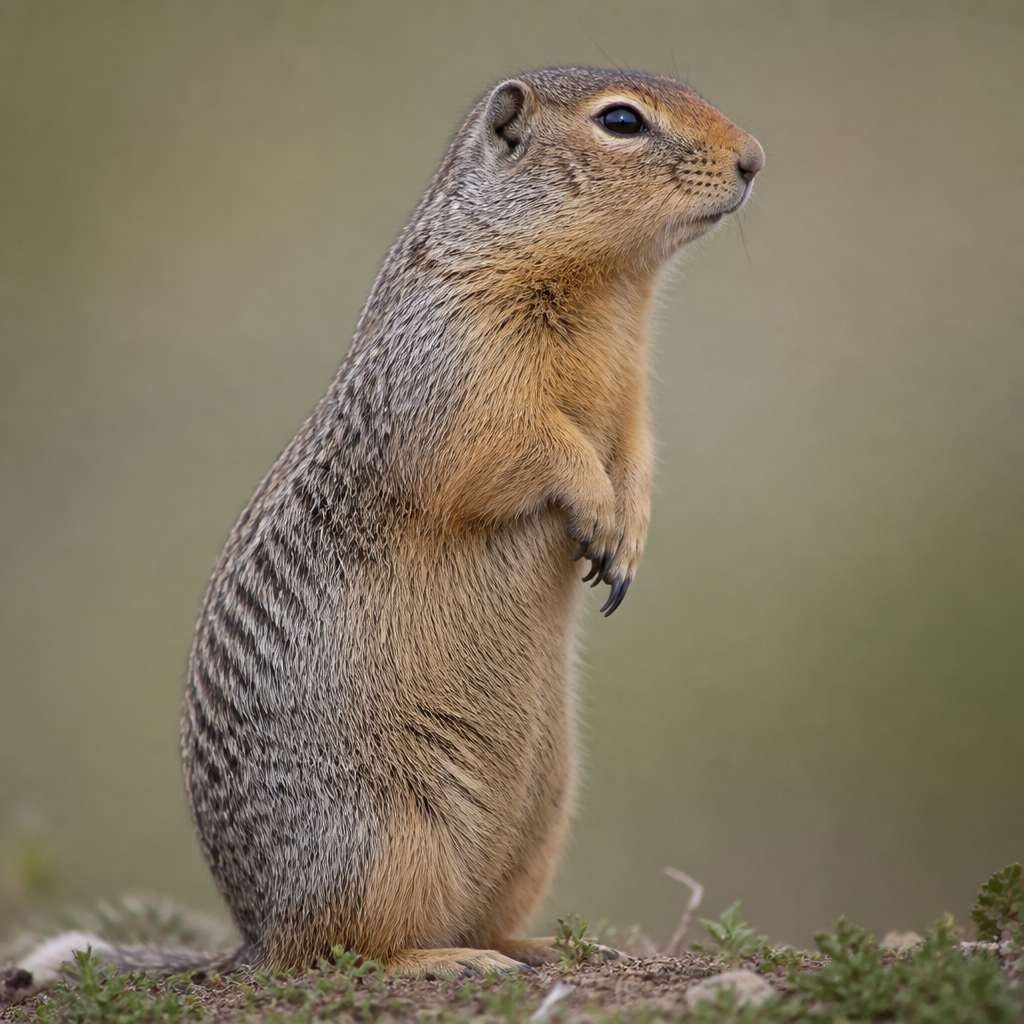
Richardson's Ground Squirrel
Urocitellus richardsonii
Biology
Richardson's ground squirrels, *Urocitellus richardsonii*, are sciurid rodents, typically measuring 19-33 cm in head-body length with an additional 6-8 cm tail, and weighing 280-410 grams, varying seasonally. Their pelage is a uniform sandy-brown to grey-brown dorsally, with a paler, buffy underside, lacking prominent spots or stripes, distinguishing them from other *Urocitellus* species in some parts of their range. They are univoltine, breeding shortly after emergence from hibernation in March-April, with a gestation period of approximately 28 days, producing a single litter of 6-8 altricial pups annually. Pups are weaned by 4-6 weeks and reach sexual maturity around one year of age; adult longevity typically ranges from 2-4 years, though some individuals may live up to 6 years in optimal conditions. They exhibit remarkable cold tolerance and fat deposition, essential for their extended 7-9 month hibernation period.
Behaviour
These highly social, diurnal sciurids communicate through a complex repertoire of vocalizations, including alarm whistles and trills, and tactile signals, indicating a colonial social structure often comprising a dominant male, several females, and their offspring. Dispersal of juveniles, primarily males, occurs in late summer, aiding in gene flow between colonies, with average dispersal distances of several kilometers reported. *Urocitellus richardsonii* are primarily herbivorous, acting as opportunistic foragers, consuming a wide variety of grasses, forbs, seeds, and occasionally insects, which can lead to significant crop depredation in agricultural areas. Their extensive burrow systems, which can span up to 10 meters horizontally and 1-2 meters deep, create tripping hazards for livestock and humans, contribute to soil erosion, and can compromise the structural integrity of irrigation systems and farm infrastructure. They exhibit aggressive defensive behaviors when threatened, including chattering, tail-flicking, and direct confrontation, particularly when defending young or burrow entrances, though their primary defense is retreat to burrows.
Habits
Richardson's ground squirrels prefer open, well-drained grasslands, pastures, and agricultural edges, typically avoiding dense cover, where they excavate elaborate, multi-entrance burrow systems in relatively dry, compact soils. Foraging ranges are localized, usually within 100 meters of their burrow entrance, often following established runways through vegetation, with peak activity observed during mid-morning and late afternoon. Infestation signs for pest management professionals include visible mounds of excavated soil around burrow entrances, trampled vegetation indicating feeding areas, and distinct 'whistle' vocalizations that signal alarm. Conducive conditions for population increases include readily available food sources like cereal crops or lush pasture, limited predation pressure, and well-drained, sandy-loam soils conducive to burrow construction. Their activity is highly seasonal, commencing in early spring (March-April) and concluding with entry into hibernation by late summer (July-August), dependent on geographic location and resource availability, with males typically emerging and entering hibernation earlier than females.
Control methods
- 1Zinc phosphide treated grain bait in burrows (per label)
- 2Strychnine bait where permitted by provincial rules
- 3Anticoagulant bait stations along burrow runs
- 4Pressurized exhaust / CO fumigation of active burrows
- 5Trapping with body-grip or live traps at burrow entrance
- 6Collapse and till burrows after treatment to deter recolonization
Tailored to Richardson's Ground Squirrel
IPM Procedure Checklist
Inspection
- Locate runways, droppings, rub marks and gnaw damage
- Identify entry points (gaps ≥6 mm) and harborage
- Place tracking patches or non-toxic monitors
Identification
- Confirm Richardson's Ground Squirrel (Urocitellus richardsonii) — not a look-alike
- Note life stage and risk level: High
- Capture clear photos and samples for the record
Action Thresholds
- Zero-tolerance: act on first confirmed sighting
- Notify client and document the trigger event
- Prioritize health and regulatory risk in the plan
Prevention
- Exclude with steel wool, hardware cloth and door sweeps
- Trim vegetation 0.5 m from structure; clear debris
- Secure trash, pet food and stored grain
Control Methods
- Zinc phosphide treated grain bait in burrows (per label)
- Strychnine bait where permitted by provincial rules
- Anticoagulant bait stations along burrow runs
- Pressurized exhaust / CO fumigation of active burrows
Monitoring & Evaluation
- Service monitors on schedule and trend captures
- Re-inspect for Richardson's Ground Squirrel activity at follow-up
- Adjust tactics based on data; report findings to client