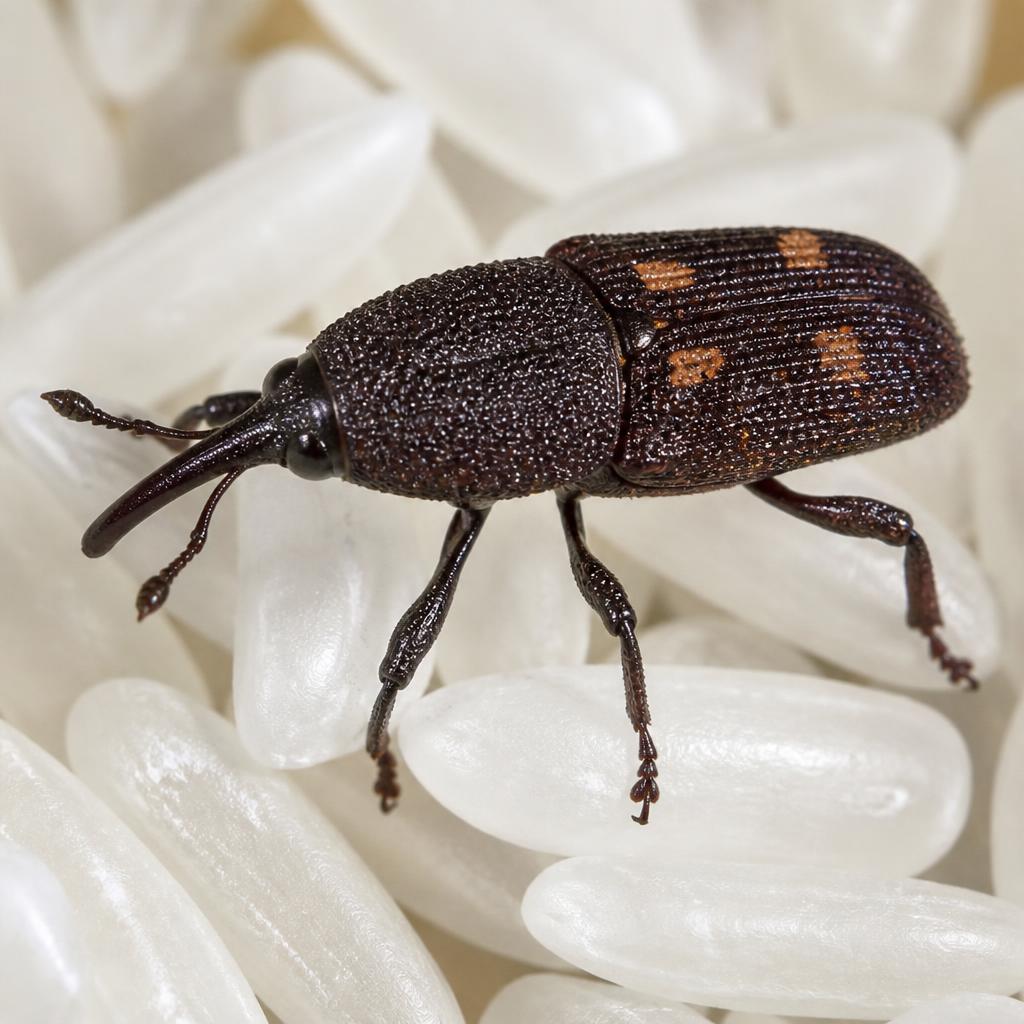
Stored Product Pest
Rice Weevil
Sitophilus oryzae
Biology
The rice weevil, scientifically classified as *Sitophilus oryzae*, is a coleopteran belonging to the family Curculionidae. Adults typically measure 2.5–3.5 mm in length, possessing an elongated rostrum (snout) and four distinct reddish-brown to black spots on their elytra, which distinguish them from similar species like the maize weevil (*S. zeamais*) primarily by size and pronotal punctures. The life cycle, from egg to adult, averages 32 days at optimal conditions of 27–30°C and 70% relative humidity, but can extend significantly at lower temperatures (up to 120 days at 18°C). Females lay 200–400 eggs over their 4- to 5-month lifespan, inserting a single egg into a cavity bored into a grain kernel and sealing it with a gelatinous plug. Larval and pupal stages are completed entirely within the grain, making early detection challenging.
Behaviour
Originating from tropical regions, *Sitophilus oryzae* adults are capable fliers, facilitating rapid dispersal within and between infested facilities, particularly common in warm climates. They are primarily nocturnal, showing peak activity in foraging and oviposition during darkness, though they can be active under dim light. Reproduction involves sexual dimorphism, with pheromones playing a role in mate location; males produce aggregation pheromones to attract both sexes. Their feeding ecology is strictly granivorous, with larvae consuming the endosperm of whole grains. Structural integrity of stored products is severely compromised by larval tunneling and adult feeding, leading to weight loss, nutrient degradation, and contamination by frass and exuviae, impacting marketability and public health due to potential mycotoxin development in damaged grains.
Habits
Rice weevils prefer harborage within whole grain kernels, making them internal feeders. Their foraging patterns are typically localized around the infested grain mass, with adults dispersing when conditions become unfavorable or food sources depleted. Infestations commonly initiate in bulk stored grains such as rice, corn, wheat, oats, and barley, but can extend to processed products like pasta and dried fruits, though full development often requires whole kernels. Conducive conditions include grain moisture content above 13% and temperatures between 25–32°C. Technicians should look for 'shot-hole' appearance in individual grains, live or dead adult weevils on grain surfaces, commodity spillage, and accumulation of frass or dust, all indicative of an active infestation within stored products and food processing facilities.
Control methods
- 1Discard infested grain and clean storage
- 2Freeze grain 4 days at -18°C before storage
- 3Use airtight containers with bay leaves as deterrent
- 4Pheromone-baited traps in bulk storage
- 5Rotate stock and inspect kernels for exit holes
- 6Residual aerosol in empty bins before refilling
Tailored to Rice Weevil
IPM Procedure Checklist
Inspection
- Inspect grain, spices, pet food and dry goods for larvae and webbing
- Deploy pheromone monitors near storage and shelving
- Check spillage in seams, cracks and shelf liners
Identification
- Confirm Rice Weevil (Sitophilus oryzae) — not a look-alike
- Note life stage and risk level: High
- Capture clear photos and samples for the record
Action Thresholds
- Zero-tolerance: act on first confirmed sighting
- Notify client and document the trigger event
- Prioritize health and regulatory risk in the plan
Prevention
- Rotate stock FIFO; reject damaged packaging at receiving
- Store products in airtight containers
- Maintain low humidity and clean storage surfaces
Control Methods
- Discard infested grain and clean storage
- Freeze grain 4 days at -18°C before storage
- Use airtight containers with bay leaves as deterrent
- Pheromone-baited traps in bulk storage
Monitoring & Evaluation
- Service monitors on schedule and trend captures
- Re-inspect for Rice Weevil activity at follow-up
- Adjust tactics based on data; report findings to client