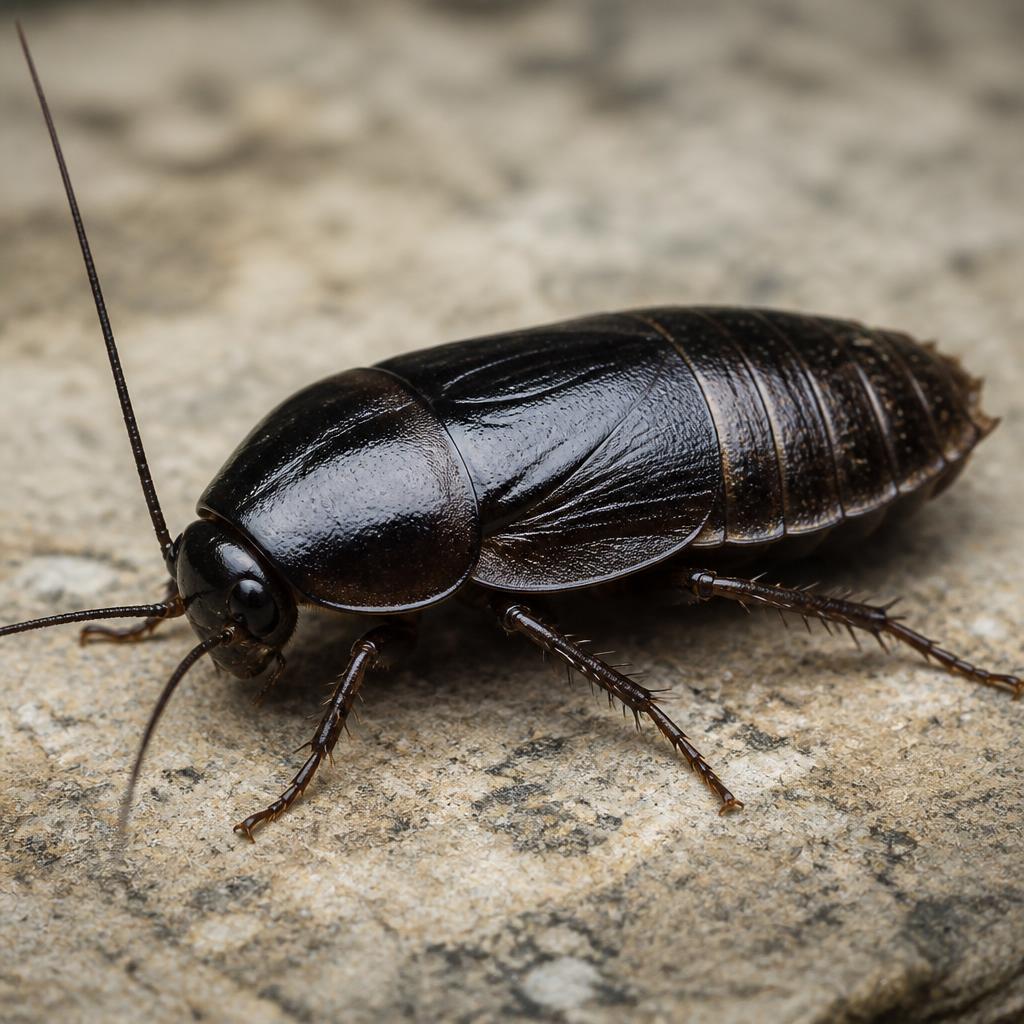
Cockroach
Oriental Cockroach
Blatta orientalis
Biology
The Oriental cockroach, *Blatta orientalis*, is a nocturnal hemimetabolous insect belonging to the family Blattidae. Adults measure 25–30 mm (male) or 20–27 mm (female) and are uniform glossy black to dark reddish-brown, distinguishable by the females having greatly reduced, non-functional wings while males possess wings covering about three-quarters of the abdomen. The lifecycle typically spans 200–800 days from egg to adult at 25°C, with nymphs undergoing 6–10 instars over 130–300 days. Females produce 5–10 oothecae in their lifetime, each containing 12–18 eggs, which hatch after approximately 60 days. This species exhibits a lower optimal temperature range (around 20-29°C) and higher humidity tolerance (up to 90% RH) compared to other common peri-domestic cockroach species, allowing it to thrive in cooler, damper environments.
Behaviour
Primarily nocturnal, *B. orientalis* exhibits limited flight capability, particularly the females, and is typically a ground-dwelling species, preferring to crawl. They communicate through aggregation pheromones deposited in fecal trails, leading to localized infestations and encouraging communal harborage. Their feeding ecology is scavenger-generalist, consuming decaying organic matter, starches, and other refuse; however, they require regular access to water and can survive for weeks without food but only days without water. When disturbed or perceiving a threat, they will exhibit a thigmotactic response, flattening their bodies and disappearing into cracks and crevices. Public health impact stems from mechanical transmission of pathogens, including bacteria (e.g., *Salmonella* spp., *E. coli*) and viruses, by contact with their feces, body surfaces, and regurgitated food, particularly in food preparation and storage areas.
Habits
Oriental cockroaches prefer harborage in cool, damp, and dark environments, often congregating in basements, crawl spaces, utility tunnels, sewers, drains, under concrete slabs, and within refuse piles or leaf litter outdoors. Their foraging patterns typically involve short-range movements from harborages to food and water sources, not usually venturing more than a few meters from their primary refuge unless populations are high. Seasonal movements involve migration indoors during colder weather or periods of drought, often entering structures via pipe penetrations, expansion joints, or gaps in foundations. Conducive active infestation conditions include high moisture levels, poor sanitation, and abundant decaying organic matter, with signs including the presence of live or dead nymphs and adults, discarded oothecae, characteristic large fecal smears or pellets, and a distinct, persistent musty odor permeating infested areas, which can be particularly strong in confined spaces.
Control methods
- 1Granular baits in mulch beds and crawlspaces
- 2Dehumidify and fix grade-level water intrusion
- 3Door sweeps and threshold seals on basement doors
- 4Perimeter residual barrier 1 m up/out
- 5Remove leaf litter and ground debris near foundation
- 6Inspect sump pits and floor drains monthly
Tailored to Oriental Cockroach
IPM Procedure Checklist
Inspection
- Survey interior and exterior for evidence and conducive conditions
- Document findings with photos and a site map
- Place monitors to confirm activity
Identification
- Confirm Oriental Cockroach (Blatta orientalis) — not a look-alike
- Note life stage and risk level: Moderate
- Capture clear photos and samples for the record
Action Thresholds
- Trigger action when monitor counts trend up
- Re-evaluate weekly during active season
- Document trigger criteria in the IPM plan
Prevention
- Exclude entry points and harborage
- Improve sanitation and moisture control
- Modify habitat around the structure
Control Methods
- Granular baits in mulch beds and crawlspaces
- Dehumidify and fix grade-level water intrusion
- Door sweeps and threshold seals on basement doors
- Perimeter residual barrier 1 m up/out
Monitoring & Evaluation
- Service monitors on schedule and trend captures
- Re-inspect for Oriental Cockroach activity at follow-up
- Adjust tactics based on data; report findings to client