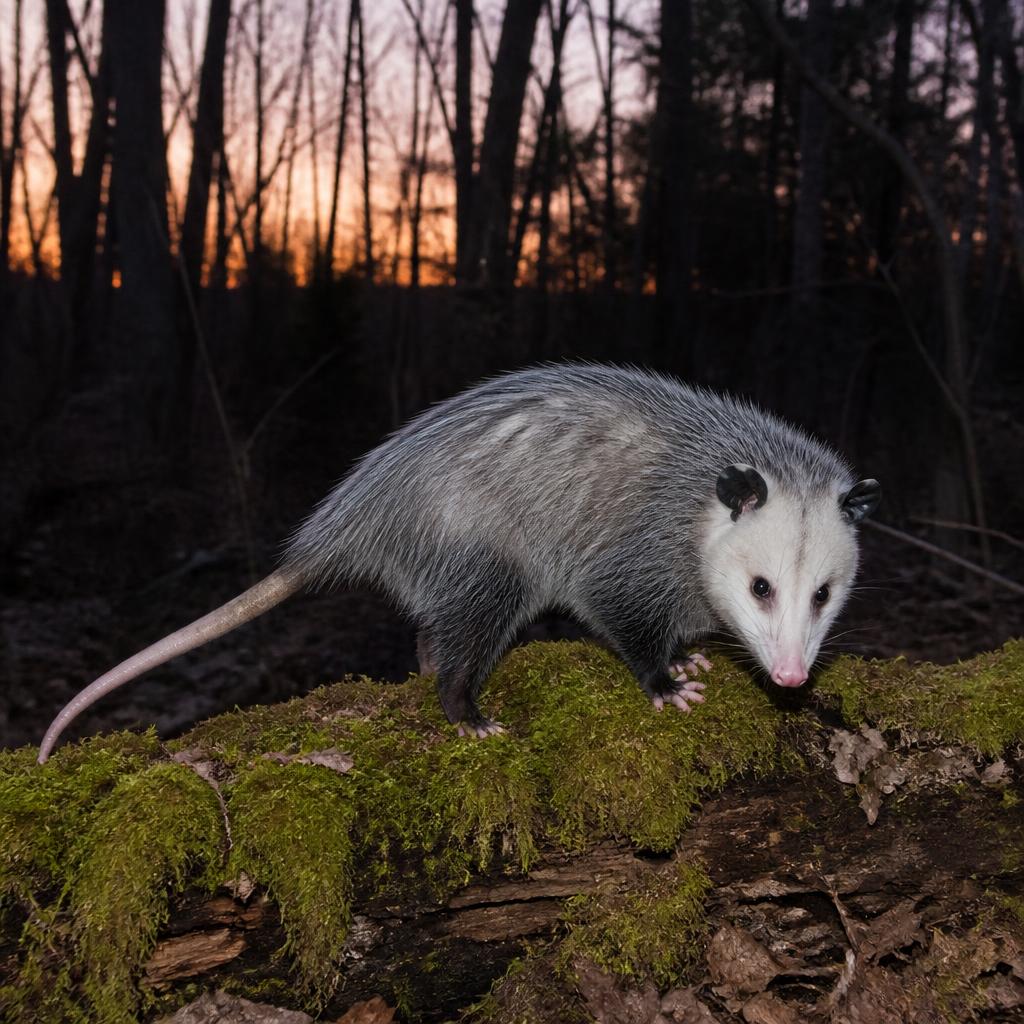
Mammal
Virginia Opossum
Didelphis virginiana
Biology
The Virginia Opossum, *Didelphis virginiana*, is North America's only marsupial, typically weighing 1.8-6.0 kg and measuring 35-55 cm body length with an additional 25-50 cm tail. Their dental formula (I 5/4, C 1/1, P 3/3, M 4/4) yields 50 teeth, the most of any North American land mammal, adapted for a varied diet. Gestation is remarkably short, just 12-14 days, with females giving birth to 4-25 undeveloped young that immediately crawl into the ventral pouch (marsupium) to nurse for 50-70 days. Young then ride on the mother's back for another 2-3 months before dispersal, contributing to a rapid reproductive cycle that can yield 1-3 litters annually. Their lifespan is relatively short, averaging 1-3 years in the wild, with a maximum recorded of 5 years.
Behaviour
Opossums are primarily nocturnal and solitary arboreal foragers, exhibiting complex social avoidance rather than true social structures. Their large home ranges, typically 4-40 hectares depending on resource availability, are not strictly defended territories but rather foraging areas they navigate in search of food. When threatened, beyond the well-known 'playing dead' (thanatosis) response-a catatonic state where breathing and heart rate slow, and an anal gland secretes a foul-smell-they may also hiss, growl, and even bite. Despite popular myths, opossums are not exceptional tick predators; their grooming removes some, but they are not a primary control agent. They are resistant to venomous snakebites due to a protective peptide in their blood serum, a unique adaptation.
Habits
These opportunistic omnivores exhibit highly adaptable foraging patterns, consuming a diverse array of items from fruits, grains, and insects to carrion, small vertebrates, and garden produce, often frequenting human-modified landscapes. They do not excavate burrows but rather utilize existing natural crevices, hollow logs, abandoned burrows of other animals, or man-made structures like attics, sheds, and espaços sob casas for temporary dens. Signs of infestation often include overturned trash cans, depredated pet food, gnaw marks on garden produce, and the presence of pale, cylindrical feces often containing undigested seeds or insect parts. Their presence is often indicative of readily available food and shelter sources within a 1-2 km foraging radius.
Control methods
- 1Remove fallen fruit and secure compost
- 2Close off crawlspaces and deck access
- 3Bring pet food in at dusk
- 4Live-trap and relocate where legal
- 5Tolerate where possible — eats many ticks
- 6Cap chimneys and seal attic gaps
Tailored to Virginia Opossum
IPM Procedure Checklist
Inspection
- Survey interior and exterior for evidence and conducive conditions
- Document findings with photos and a site map
- Place monitors to confirm activity
Identification
- Confirm Virginia Opossum (Didelphis virginiana) — not a look-alike
- Note life stage and risk level: Low
- Capture clear photos and samples for the record
Action Thresholds
- Tolerate low-level activity outside sensitive zones
- Act if activity moves indoors or near food
- Review threshold seasonally with the client
Prevention
- Exclude entry points and harborage
- Improve sanitation and moisture control
- Modify habitat around the structure
Control Methods
- Remove fallen fruit and secure compost
- Close off crawlspaces and deck access
- Bring pet food in at dusk
- Live-trap and relocate where legal
Monitoring & Evaluation
- Service monitors on schedule and trend captures
- Re-inspect for Virginia Opossum activity at follow-up
- Adjust tactics based on data; report findings to client