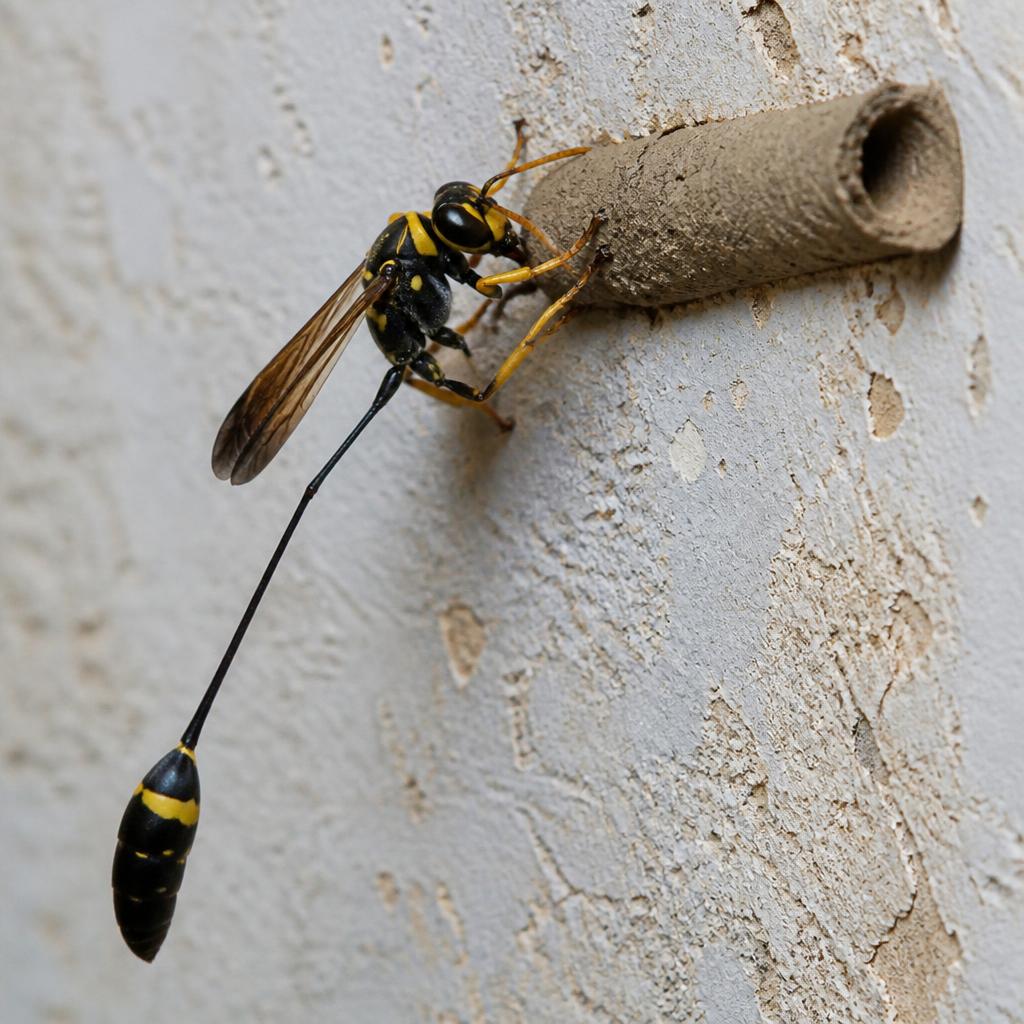
Stinging Insect
Mud Dauber
Sceliphron / Chalybion spp.
Biology
Mud daubers, primarily within the genera Sceliphron and Chalybion, are solitary wasps belonging to the family Sphecidae. These slender-waisted insects typically range from 20 to 30 mm in length, exhibiting either a black and yellow coloration (Sceliphron) or an iridescent metallic blue-black (Chalybion), with the diagnostic petiole or 'thread-waist' being extremely attenuated. The life cycle begins with an egg laid on a paralyzed spider within a mud cell; larvae then hatch, consume the provisions, and pupate within a silken cocoon over several weeks to months, depending on species and environmental conditions. Adults can live for several weeks, with a single female capable of constructing multiple nests containing numerous cells throughout her reproductive period. Optimal development occurs between 25-35°C and moderate humidity, though they are quite tolerant of arid conditions once nests are sealed.
Behaviour
Mud daubers are strictly solitary, exhibiting no social hierarchy or cooperative brood care, which is a key differentiator from social wasps. Their activity is primarily diurnal, spent foraging for mud and prey or constructing nests. Dispersal is typically limited to the immediate vicinity of suitable nesting and foraging sites, though juveniles will disperse upon emergence. Communication is minimal, lacking complex pheromonal trails or alarm signals characteristic of social insects. Feeding ecology involves adult wasps primarily consuming nectar and pollen, while their larvae are obligate carnivores, feeding on spiders paralyzed by the female's venom. They are generally non-aggressive and rarely sting unless directly handled or provoked, posing a minimal public health risk, though their mud nests can be aesthetically unpleasing and sometimes harbor other insects.
Habits
Female mud daubers exhibit distinct preferences for sheltered, dry locations for nest construction, commonly selecting vertical or horizontal surfaces such as building eaves, porch ceilings, shed walls, and even attic joists. Foraging patterns for mud usually involve nearby puddles, muddy banks, or moist soil, while prey (spiders) are hunted in vegetation, under rocks, or within structures. Their movements are largely dictated by the availability of these resources. While active during warmer months, they do not overwinter as adults within structures; instead, larvae or pupae diapause within sealed mud cells. Conducive conditions for infestation include the presence of abundant spider populations, readily available mud, and sheltered harborage points. Technicians should look for the characteristic cylindrical or organ-pipe shaped mud nests, often with exit holes indicating successful emergence, and observe wasp activity around structures during daylight hours.
Control methods
- 1Scrape mud nests off surfaces with a putty knife
- 2Treat secondary occupants before removal if present
- 3Repaint or seal porous masonry to discourage building
- 4Tolerate active nests where possible — low sting risk
- 5Inspect attics and sheds annually for old nests
- 6Address spider populations to reduce prey base
Tailored to Mud Dauber
IPM Procedure Checklist
Inspection
- Survey interior and exterior for evidence and conducive conditions
- Document findings with photos and a site map
- Place monitors to confirm activity
Identification
- Confirm Mud Dauber (Sceliphron / Chalybion spp.) — not a look-alike
- Note life stage and risk level: Low
- Capture clear photos and samples for the record
Action Thresholds
- Tolerate low-level activity outside sensitive zones
- Act if activity moves indoors or near food
- Review threshold seasonally with the client
Prevention
- Exclude entry points and harborage
- Improve sanitation and moisture control
- Modify habitat around the structure
Control Methods
- Scrape mud nests off surfaces with a putty knife
- Treat secondary occupants before removal if present
- Repaint or seal porous masonry to discourage building
- Tolerate active nests where possible — low sting risk
Monitoring & Evaluation
- Service monitors on schedule and trend captures
- Re-inspect for Mud Dauber activity at follow-up
- Adjust tactics based on data; report findings to client