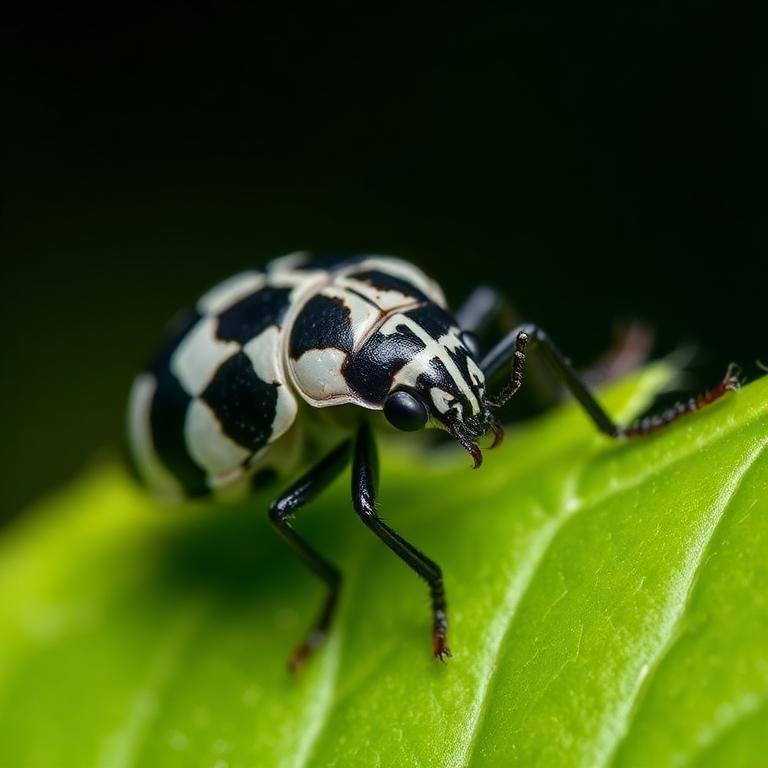
Occasional Invader
Minute Pirate Bug
Orius insidiosus
Biology
Minute pirate bugs (Anthocoridae) are among the smallest true bugs encountered by technicians, just 2–5 mm long, black with contrasting white or pale patches on the forewings that produce an X-shaped pattern at rest. Nymphs are teardrop-shaped and yellow-orange to reddish-brown. Females insert eggs into plant tissue; development from egg to adult takes about 20 days in warm weather, allowing three to four overlapping generations per season. Adults overwinter in leaf litter, under bark, and in sheltered crevices, emerging in spring as prey populations build.
Behaviour
They are day-active generalist predators and are commercially reared as biological control agents for thrips, spider mites, aphids, and small caterpillar eggs — genuinely beneficial insects. The pest complaint is behavioural: in late summer and autumn, as crops mature and prey becomes scarce, adults probe human skin with their piercing stylets. The bite is not a blood feed and transmits no disease, but it produces a sharp, disproportionate sting and an itchy welt that can persist for a day or two, and repellents containing DEET give only partial protection. Complaints spike around harvest in agricultural regions and near ornamental plantings.
Habits
Populations concentrate in flowering weeds, corn and soybean fields, alfalfa, and ornamental beds; drift to structures increases sharply after crops are cut or dry down. They are small enough to pass standard window screening and are drawn to light-coloured clothing and outdoor lighting, entering through screens, door gaps, and vents. Conducive conditions are proximity to crops or heavy flowering ground cover, coarse screening, and outdoor work or dining areas near those plantings. Because they neither breed nor persist indoors, interior counts track outdoor pressure — inspect perimeter vegetation and screening rather than searching for a harborage inside.
Control methods
- 1Explain the beneficial role — avoid broad treatment of source vegetation
- 2Fit 20-mesh or finer screening on windows, doors and vents
- 3Seal door gaps and weatherstripping during late-summer peak
- 4Advise dark clothing and long sleeves for outdoor areas at peak
- 5Reduce flowering weed cover immediately around occupied outdoor spaces
- 6Use fans on patios and entries to disrupt drifting flight
Tailored to Minute Pirate Bug
IPM Procedure Checklist
Inspection
- Inspect exterior perimeter for entry pathways
- Note moisture, mulch and ground-cover near foundation
- Identify aggregation sites on warm walls
Identification
- Confirm Minute Pirate Bug (Orius insidiosus) — not a look-alike
- Note life stage and risk level: Low
- Capture clear photos and samples for the record
Action Thresholds
- Tolerate low-level activity outside sensitive zones
- Act if activity moves indoors or near food
- Review threshold seasonally with the client
Prevention
- Seal foundation cracks, weep holes and utility penetrations
- Pull mulch and vegetation back from the structure
- Improve drainage and reduce exterior moisture
Control Methods
- Explain the beneficial role — avoid broad treatment of source vegetation
- Fit 20-mesh or finer screening on windows, doors and vents
- Seal door gaps and weatherstripping during late-summer peak
- Advise dark clothing and long sleeves for outdoor areas at peak
Monitoring & Evaluation
- Service monitors on schedule and trend captures
- Re-inspect for Minute Pirate Bug activity at follow-up
- Adjust tactics based on data; report findings to client