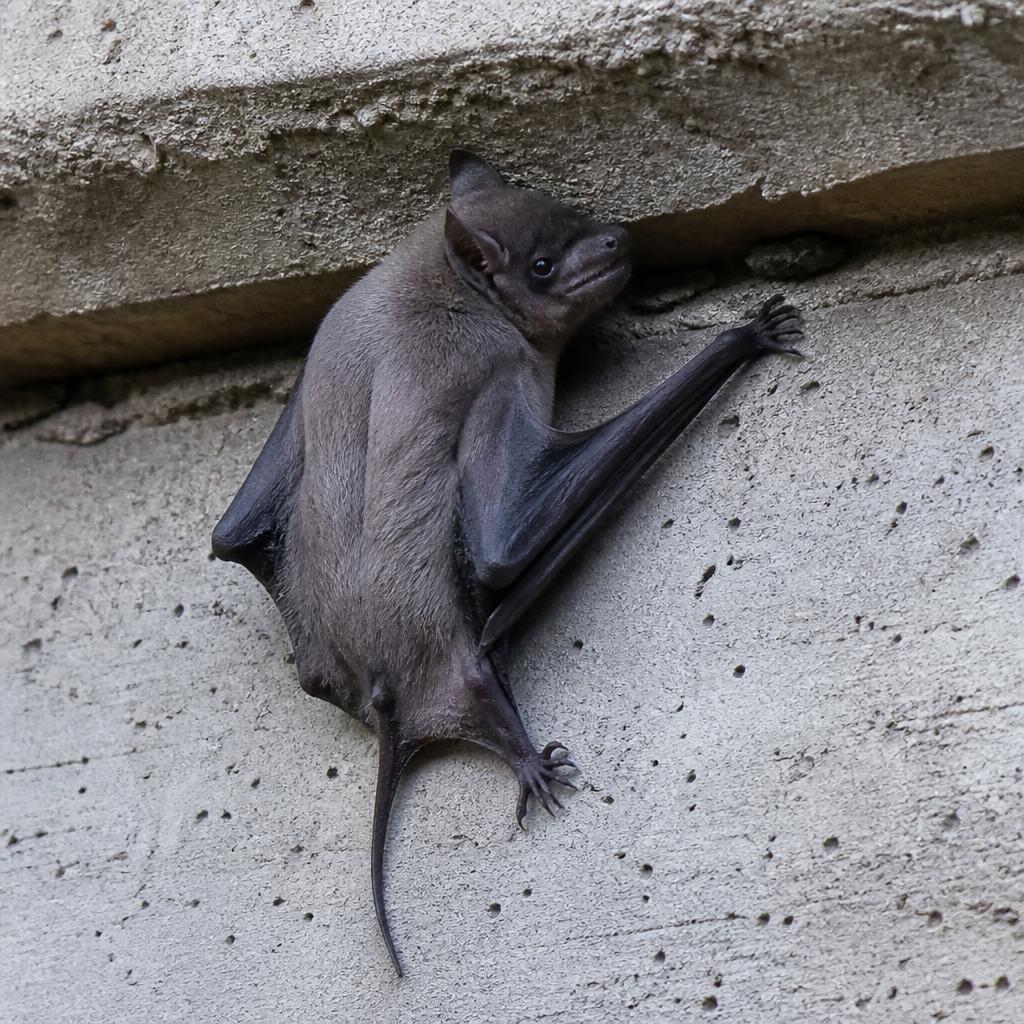
Bat
Mexican Free-tailed Bat
Tadarida brasiliensis
Biology
Tadarida brasiliensis (Molossidae) is a medium-sized bat, 9 cm long with a 30–32 cm wingspan and 11–14 g in weight, recognised by long narrow wings, wrinkled upper lips, forward-projecting ears and a tail that extends well beyond the tail membrane — the 'free tail'. Females bear a single pup in June and cluster it into crèches of up to 500 pups per square metre, locating their own young by scent and voice. Colonies are the largest warm-blooded aggregations known, reaching millions in Texas cave and bridge roosts, and most northern populations migrate to Mexico for the winter.
Behaviour
Flight is fast, high and direct, with individuals foraging up to 3,000 m in altitude and 50 km from the roost, feeding heavily on migrating moths of major agricultural importance. Emergence from large colonies forms dense columns visible on weather radar. Colony guano accumulates rapidly and in enclosed structures produces intense ammonia odour, ceiling staining and structural collapse in extreme cases, along with an established histoplasmosis exposure risk. Rabies prevalence in wild populations is low, but the sheer number of grounded bats around large urban roosts raises the chance of public contact.
Habits
In the southern and southwestern United States it roosts under bridges and highway expansion joints, in parking decks, stadium overhangs, tile roofs, attics and Spanish-tile soffits, squeezing through slots as narrow as 1 cm. Signs are heavy dark guano piles beneath the roost, strong ammonia smell, greasy staining at slot entries and loud chattering audible through ceilings during the day. Conducive conditions are open expansion joints, unsealed tile roof edges, gaps at parapet caps and untreated attic vents in warm climates. Colony size means partial exclusion fails quickly — every slot must be treated as an exit.
Control methods
- 1Survey at dusk over several nights; large colonies use many exits
- 2Exclude only after pups are volant, generally September to October
- 3Use netting or tube excluders sized for narrow slot openings
- 4Seal tile edges, expansion joints and parapet gaps completely
- 5Wear respiratory PPE — large guano deposits carry histoplasmosis risk
- 6Pressure-clean and deodorise staining after the colony is out
- 7Coordinate with bridge or facility owners on protected-roost requirements
Tailored to Mexican Free-tailed Bat
IPM Procedure Checklist
Inspection
- Inspect at dusk to locate active entry/exit points
- Check attics, soffits and chimneys for guano
- Identify maternity colonies before any action
Identification
- Confirm Mexican Free-tailed Bat (Tadarida brasiliensis) — not a look-alike
- Note life stage and risk level: High
- Capture clear photos and samples for the record
Action Thresholds
- Zero-tolerance: act on first confirmed sighting
- Notify client and document the trigger event
- Prioritize health and regulatory risk in the plan
Prevention
- Seal gaps ≥6 mm with caulk, mesh and flashing
- Cap chimneys and screen attic vents
- Provide alternative bat houses on the property
Control Methods
- Survey at dusk over several nights; large colonies use many exits
- Exclude only after pups are volant, generally September to October
- Use netting or tube excluders sized for narrow slot openings
- Seal tile edges, expansion joints and parapet gaps completely
Monitoring & Evaluation
- Service monitors on schedule and trend captures
- Re-inspect for Mexican Free-tailed Bat activity at follow-up
- Adjust tactics based on data; report findings to client