Stinging Insect
Mason Bee
Osmia lignaria
Biology
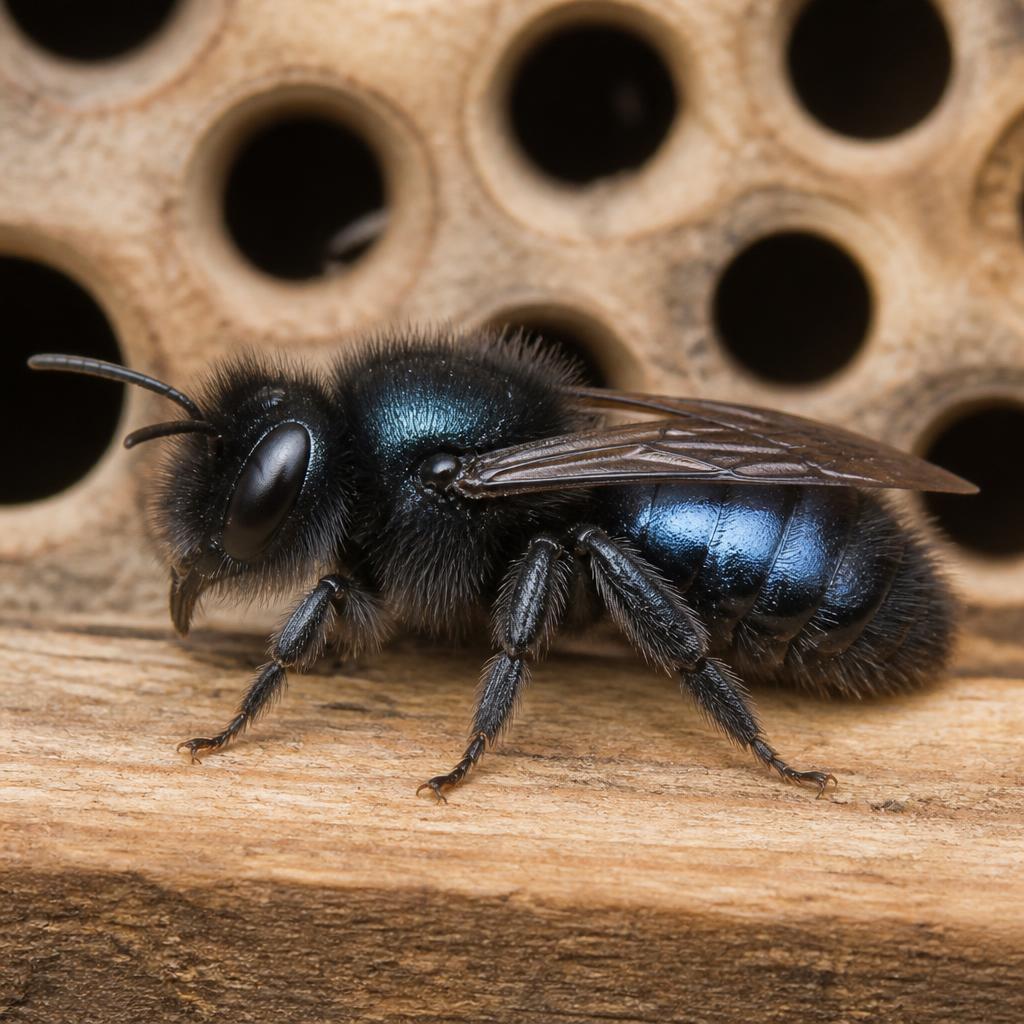
Osmia lignaria Say, known as the blue orchard mason bee (family Megachilidae), is a solitary, non-social bee characterized by its metallic blue or blue-green coloration and robust, almost cylindrical body, typically 10-14 mm in length. Females have scopal hairs on the underside of their abdomen for carrying pollen, a distinguishing feature of the Megachilidae. They do not sting aggressively. Females construct nests in pre-existing cavities, such as hollow stems, wood holes, or artificial bee shelters, dividing them into a series of cells with mud partitions. A single generation emerges each spring.
Behaviour
Mason bees are highly efficient pollinators, active in early spring when many fruit trees bloom. Females collect pollen and nectar, which they pack into individual cells within their nest tunnels, lay an egg on the pollen mass, and then seal the cell with mud. They are solitary and do not defend a hive, focusing solely on provisioning their nests. Their non-aggressive nature makes them ideal for backyard gardens and orchards. Adult bees emerge in spring, mate, and the females immediately begin nesting activities.
Habits
O. lignaria is native to North America and thrives in temperate climates. They require access to pre-existing tunnels for nesting, typically favoring holes 6-10 mm in diameter, found in wood, hollow plant stems, or artificial nesting blocks. Conducive conditions include the presence of flowering trees and shrubs in early spring, a nearby source of moist clayey mud for cell construction, and suitable nesting cavities. These bees are often encouraged in orchards to enhance pollination, making their presence generally desirable.
Control methods
- 1Provide suitable nesting tubes or drill boards.
- 2Ensure access to clayey mud for nesting.
- 3Plant early spring blooming flowers and trees.
- 4Avoid using pesticides during bloom period.
- 5Educate on their beneficial pollination role.
- 6Do not disturb active nesting sites.
Tailored to Mason Bee
IPM Procedure Checklist
Inspection
- Survey interior and exterior for evidence and conducive conditions
- Document findings with photos and a site map
- Place monitors to confirm activity
Identification
- Confirm Mason Bee (Osmia lignaria) — not a look-alike
- Note life stage and risk level: Low
- Capture clear photos and samples for the record
Action Thresholds
- Tolerate low-level activity outside sensitive zones
- Act if activity moves indoors or near food
- Review threshold seasonally with the client
Prevention
- Exclude entry points and harborage
- Improve sanitation and moisture control
- Modify habitat around the structure
Control Methods
- Provide suitable nesting tubes or drill boards.
- Ensure access to clayey mud for nesting.
- Plant early spring blooming flowers and trees.
- Avoid using pesticides during bloom period.
Monitoring & Evaluation
- Service monitors on schedule and trend captures
- Re-inspect for Mason Bee activity at follow-up
- Adjust tactics based on data; report findings to client