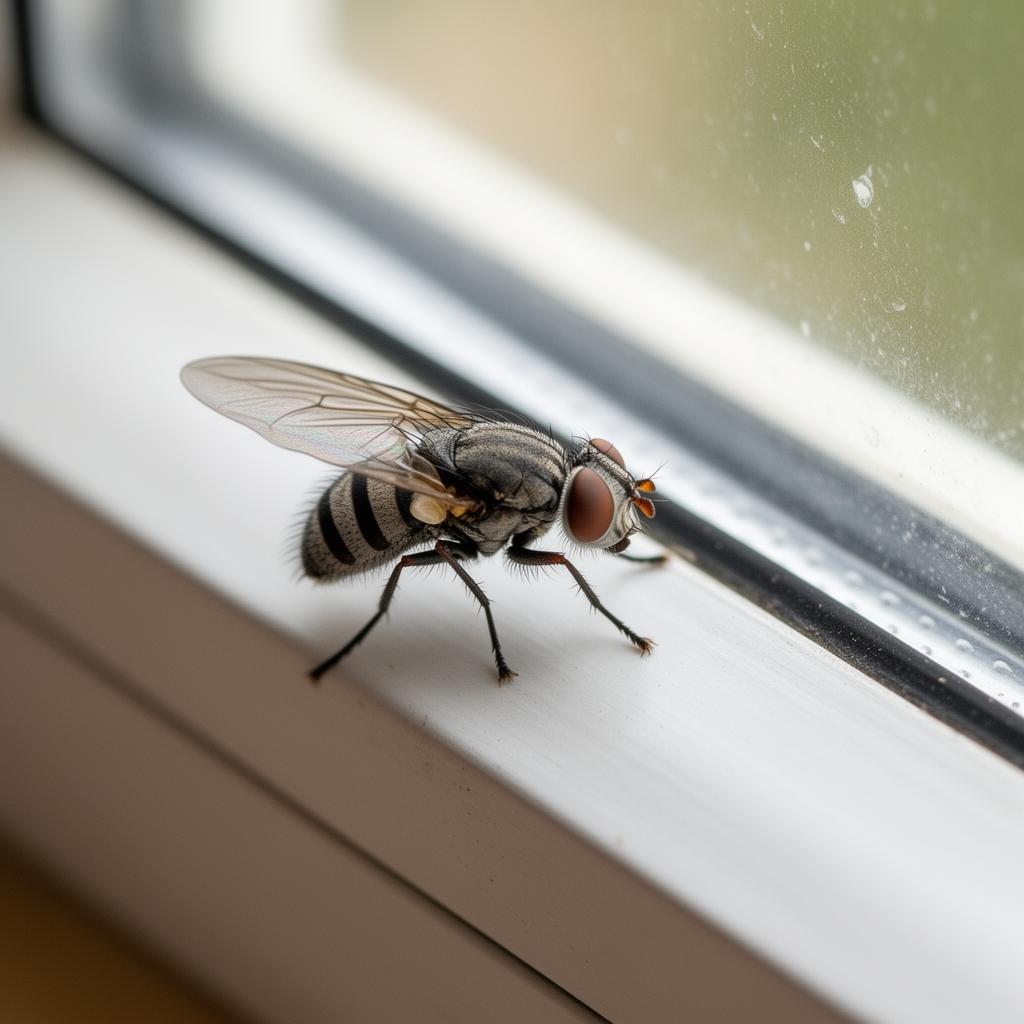
Fly
Little House Fly
Fannia canicularis
Biology
Fannia canicularis, commonly known as the little house fly, belongs to the family Fanniidae. Adults are small, slender flies, typically 3.5-6 mm in length, characterized by a greyish-black thorax with three indistinct longitudinal stripes and a largely dull grey abdomen. Males possess distinctive enlarged hind femurs. The lifecycle from egg to adult typically spans 15-30 days, heavily influenced by temperature, with optimal development occurring around 25°C. Eggs are elongated and hatch within 24-48 hours. Larvae are flattened and spiny, developing through three instars over 6-10 days in moist organic matter before pupating.
Behaviour
Little house flies exhibit a strong preference for cooler temperatures and lower light intensities compared to Musca domestica. Males are often observed engaging in characteristic hovering flight patterns within enclosed spaces, particularly near host animals, and will actively chase females for mating pursuits. Their flight is erratic and often follows complex, non-linear trajectories. Adults are attracted to a wide range of decaying organic materials, seeking both moisture and nutritional resources, including animal manure, refuse sites, and decomposing vegetation. Dispersal is often limited to areas in close proximity to suitable breeding sites.
Habits
These flies are primarily synanthropic, thriving in environments rich in decaying organic matter such as poultry houses, piggeries, and other agricultural settings, as well as poorly maintained refuse areas. Larval development occurs in semi-liquid to solid substrates, including moist excrement, spilled feed, and decaying plant material, requiring consistently high humidity for survival. Adults typically rest on ceilings, walls, and other elevated surfaces within structures, especially in shaded areas. Conducive conditions include poor sanitation, accumulation of animal waste, and inadequate waste management.
Control methods
- 1Eliminate breeding sites.
- 2Improve sanitation practices.
- 3Exclude flies from structures.
- 4Apply residual insecticides to resting surfaces.
- 5Utilize sticky traps.
- 6Implement biological control agents.
Tailored to Little House Fly
IPM Procedure Checklist
Inspection
- Locate breeding sites: drains, decaying matter, moist organics
- Use tape-over-drain tests and UV/light traps to confirm
- Map dumpster, grease and floor-drain hot-spots
Identification
- Confirm Little House Fly (Fannia canicularis) — not a look-alike
- Note life stage and risk level: Low
- Capture clear photos and samples for the record
Action Thresholds
- Tolerate low-level activity outside sensitive zones
- Act if activity moves indoors or near food
- Review threshold seasonally with the client
Prevention
- Clean drains with enzymatic foam to remove biofilm
- Manage trash, recycling and grease daily
- Screen windows, doors and air curtains at entries
Control Methods
- Eliminate breeding sites.
- Improve sanitation practices.
- Exclude flies from structures.
- Apply residual insecticides to resting surfaces.
Monitoring & Evaluation
- Service monitors on schedule and trend captures
- Re-inspect for Little House Fly activity at follow-up
- Adjust tactics based on data; report findings to client