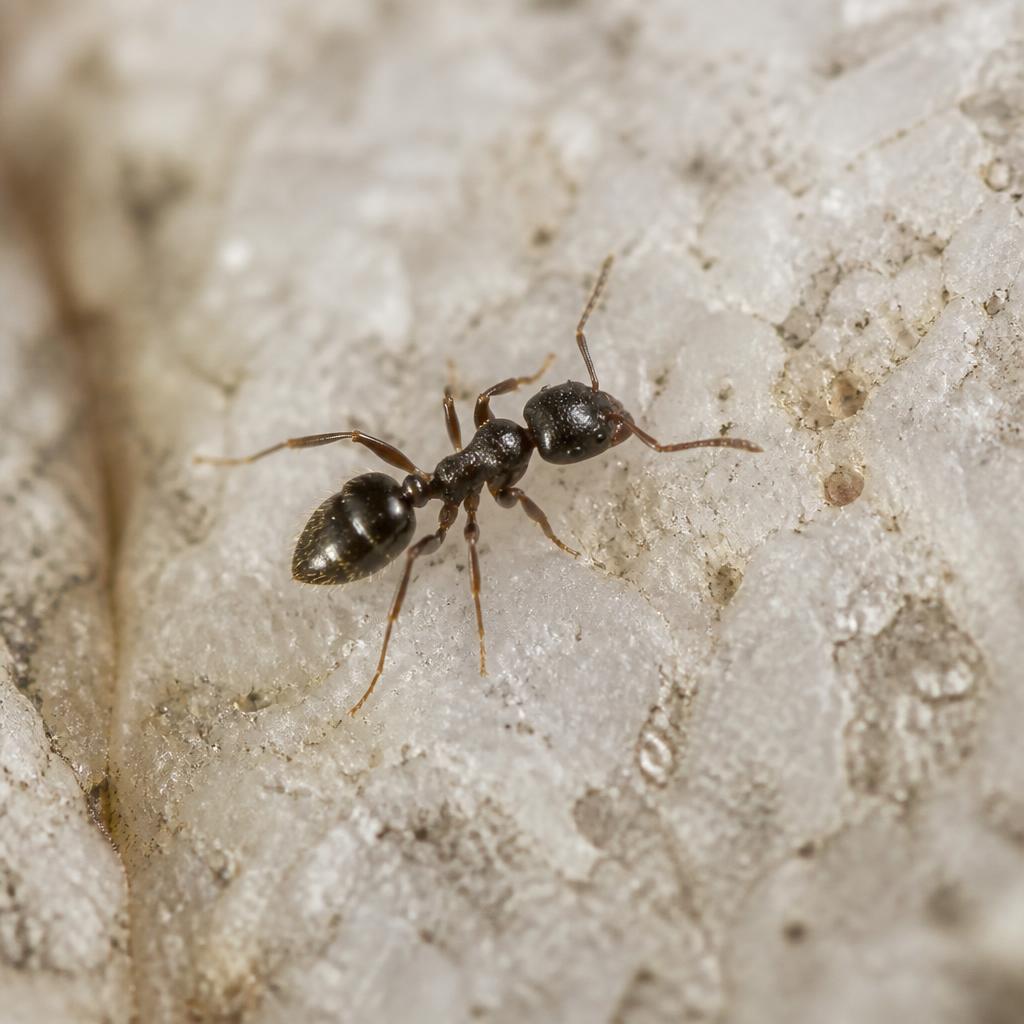
Ant
Little Black Ant
Monomorium minimum
Biology
The little black ant, *Monomorium minimum*, belongs to the subfamily Myrmicinae, characterized by a two-segmented petiole. Workers are minute, typically 1.5-2.0 mm, and uniformly glossy black, lacking any distinctive sculpturing or hairs, with 12-segmented antennae terminating in a three-segmented club. Colonies are polygnous, containing numerous queens (often 20 or more) and rapidly developing populations that can exceed 2,000 workers. The lifecycle from egg to adult takes approximately 30-40 days under optimal conditions of 25-30°C and 70-80% RH, contributing to swift colony growth and high reproductive rates. Queens can live for several years, continuously laying eggs, while workers live for several months.
Behaviour
*Monomorium minimum* exhibits primarily diurnal foraging activity, though some nocturnal activity can occur, particularly indoors in undisturbed areas. Colonies communicate through pheromones, laying distinct chemical trails to guide nestmates to newly discovered food sources, resulting in the characteristic long, thin foraging lines. Workers are omnivorous scavengers, displaying a preference for sweets, honeydew, greasy foods, and protein-rich items, making them significant pests in kitchens and pantries. The species is known for budding, where queens and workers split off to form new satellite colonies, a primary mode of dispersal that makes eradication challenging. This budding behavior, coupled with their small size, allows them to exploit numerous microhabitats and quickly re-establish populations.
Habits
Little black ants are opportunists, nesting in a wide array of cryptic locations both indoors and outdoors. Outdoors, they favor shallow nests under stones, logs, leaf litter, rotting wood, and within soil mounds, often near building foundations. Indoors, they prefer harborage in wall voids, insulation, decaying wood, under carpets, and beneath appliances, utilizing existing cracks and crevices for entry. Foraging activity often peaks during warmer months, with workers entering structures along utility lines, through weep holes, and via small structural gaps. Technicians should look for their distinct foraging trails on countertops, along baseboards, and inside cabinets, as well as small piles of frass or excavated soil near nest entrances, particularly in areas with moisture or food availability.
Control methods
- 1Sweet liquid + protein gel bait combo
- 2Trace trails to nest entry points
- 3Seal cracks around windows and pipes
- 4Store food in tight containers
- 5Avoid contact sprays that scatter the colony
- 6Outdoor granular bait around foundation
Tailored to Little Black Ant
IPM Procedure Checklist
Inspection
- Follow trails to nests, food and moisture sources
- Inspect wall voids, slab edges and exterior soil
- Place non-repellent monitors at trail crossings
Identification
- Confirm Little Black Ant (Monomorium minimum) — not a look-alike
- Note life stage and risk level: Low
- Capture clear photos and samples for the record
Action Thresholds
- Tolerate low-level activity outside sensitive zones
- Act if activity moves indoors or near food
- Review threshold seasonally with the client
Prevention
- Seal entry cracks, utility penetrations and weep holes
- Eliminate honeydew-producing pests on landscape plants
- Store food in sealed containers and clean spills promptly
Control Methods
- Sweet liquid + protein gel bait combo
- Trace trails to nest entry points
- Seal cracks around windows and pipes
- Store food in tight containers
Monitoring & Evaluation
- Service monitors on schedule and trend captures
- Re-inspect for Little Black Ant activity at follow-up
- Adjust tactics based on data; report findings to client