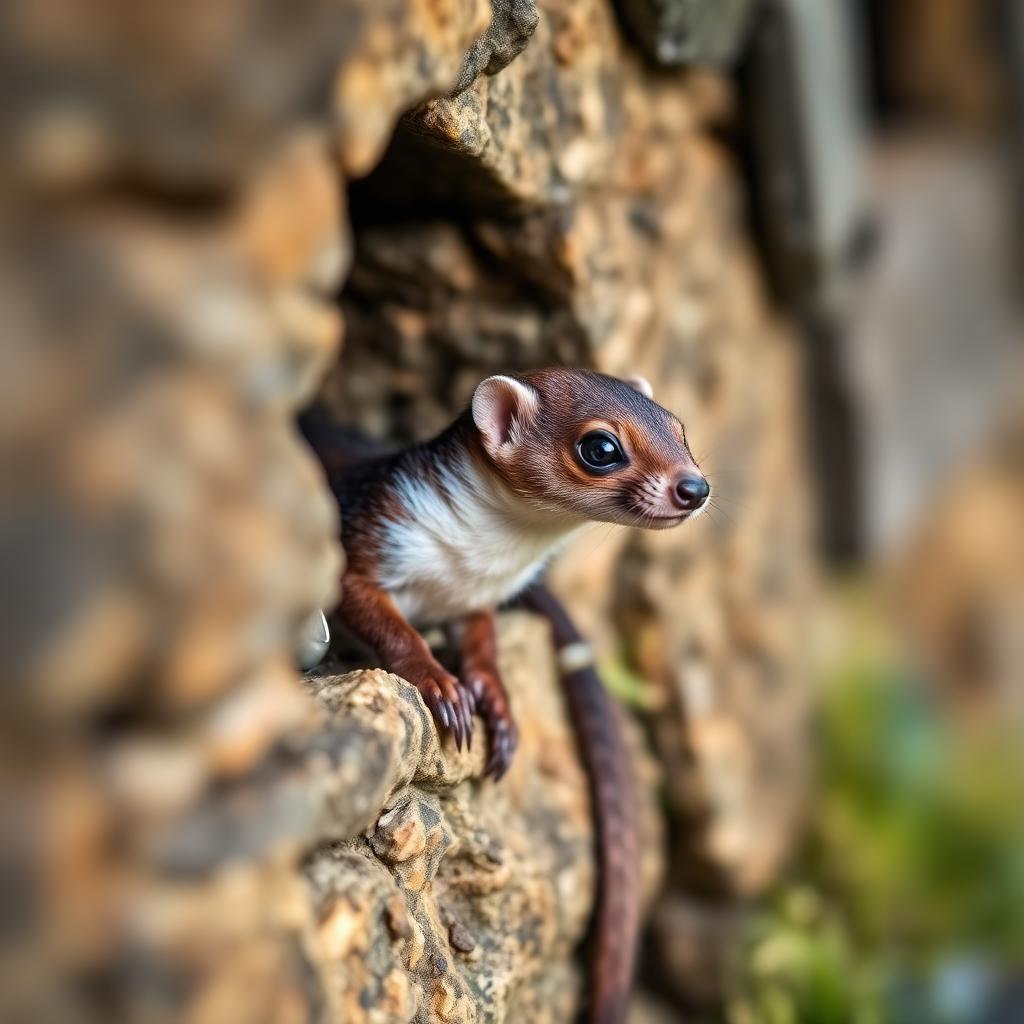
Mammal
Least Weasel
Mustela nivalis
Biology
The least weasel, *Mustela nivalis*, is the world's smallest carnivore, with adults typically 16–22 cm long and weighing only 25–70 g — small enough to pass through a 20 mm (3/4 in.) opening. It is distinguished from the long-tailed weasel and stoat by its very short tail (under 25% of body length) that lacks a black tip. Summer coat is dark brown above with an irregular white throat and belly line; northern animals turn entirely white in winter. Unlike most mustelids the least weasel has no delayed implantation, so females can raise 2–3 litters of 3–7 young per year with gestation of about 35 days, allowing populations to track vole cycles closely. Their metabolism is so high they must eat 40–60% of body weight daily and can starve within 24 hours without food.
Behaviour
Least weasels hunt almost exclusively small rodents — voles, deer mice, and shrews — following prey directly into their burrow systems, a niche no other predator of that size occupies. They are active in short bouts of 10–30 minutes around the clock, alternating hunting with rest in cached nests. Populations rise and crash with vole abundance, and in vole-poor years dispersing animals push into farmyards, barns, and outbuildings looking for mice. They are generally beneficial around agricultural properties, removing large numbers of rodents, and rarely take poultry larger than chicks or quail. When cornered they hiss, chatter, and release a strong musk; they seldom bite humans unless handled.
Habits
Least weasels take over vole and mouse burrows rather than digging their own, lining chambers with rodent fur, and will also nest in wall voids, hay bales, grain bins, and under floorboards where rodents are established. Home ranges are small, roughly 1–10 ha, and shift with prey density. Field signs are easy to overlook: droppings only 2–4 cm long and pencil-thin, sudden disappearance of a barn mouse population, small fur-lined caches of dead rodents, and narrow runways in snow or dust. Presence indoors almost always follows a rodent infestation and unsealed foundation gaps, weep holes, or utility penetrations.
Control methods
- 1Eliminate the rodent population that draws them in
- 2Seal openings down to 1/2 in. with steel wool and hardware cloth
- 3Store grain and feed in metal, lidded containers
- 4Keep hay and bedding stacked off the floor and away from walls
- 5Protect chick brooders and quail pens with fine 1/4-in. mesh
- 6Live-trap and relocate only where legal; check state furbearer rules
Tailored to Least Weasel
IPM Procedure Checklist
Inspection
- Survey interior and exterior for evidence and conducive conditions
- Document findings with photos and a site map
- Place monitors to confirm activity
Identification
- Confirm Least Weasel (Mustela nivalis) — not a look-alike
- Note life stage and risk level: Low
- Capture clear photos and samples for the record
Action Thresholds
- Tolerate low-level activity outside sensitive zones
- Act if activity moves indoors or near food
- Review threshold seasonally with the client
Prevention
- Exclude entry points and harborage
- Improve sanitation and moisture control
- Modify habitat around the structure
Control Methods
- Eliminate the rodent population that draws them in
- Seal openings down to 1/2 in. with steel wool and hardware cloth
- Store grain and feed in metal, lidded containers
- Keep hay and bedding stacked off the floor and away from walls
Monitoring & Evaluation
- Service monitors on schedule and trend captures
- Re-inspect for Least Weasel activity at follow-up
- Adjust tactics based on data; report findings to client