Occasional Invader
Kudzu Bug
Megacopta cribraria
Biology
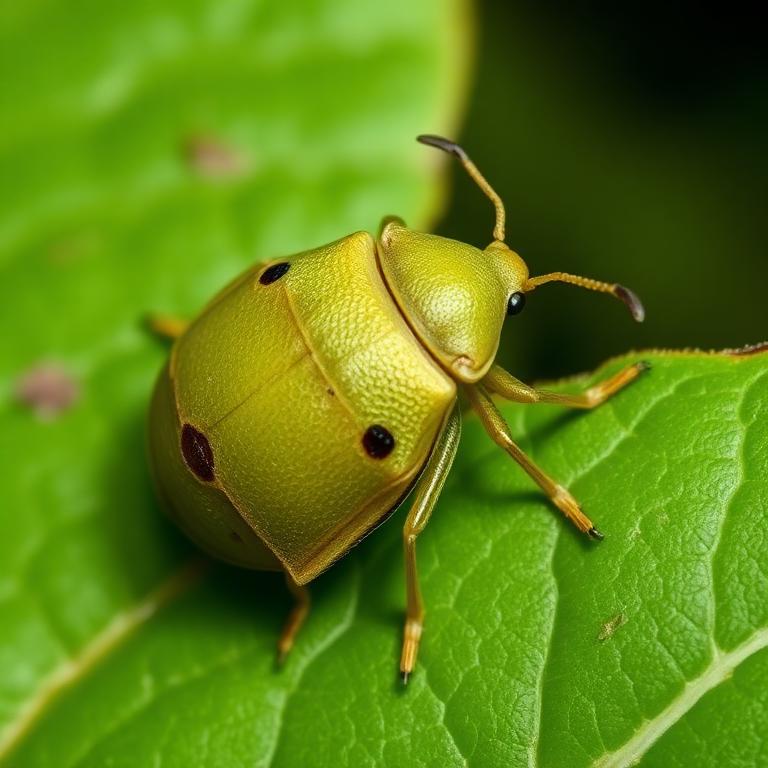
The kudzu bug, also called the bean plataspid, is a small globular true bug (Plataspidae) 3.5–6 mm long, olive-green to brown with a coarsely pitted surface and a broad scutellum covering the abdomen — it is frequently mistaken for a beetle. Females lay eggs in two-row clusters on host foliage and deposit alongside them a capsule of symbiotic gut bacteria that nymphs must consume to develop. Nymphs pass through five fuzzy, greenish instars in about 6–8 weeks. Two generations per year are typical in the southeastern United States, with adults overwintering under bark, in leaf litter, and in structures.
Behaviour
Adults are day-active, strong fliers, and highly gregarious, forming dense aggregations on host stems and, in autumn, on light-coloured building exteriors. They feed with piercing-sucking mouthparts on kudzu, soybean, wisteria, and other legumes, reducing soybean yield. They do not bite or sting and cannot breed indoors, but when handled or crushed they discharge a pungent defensive secretion that stains fabric and can cause mild dermal irritation and blistering in sensitive individuals. Mass flights on warm autumn afternoons produce sudden, heavy wall coverage that alarms occupants.
Habits
Overwintering site selection strongly favours white and light-coloured, sun-warmed walls; from there the bugs move into siding gaps, soffits, window frames, attic vents, and wall voids. Proximity to kudzu patches, wisteria, and soybean fields is the primary risk factor, along with unsealed cladding and unscreened vents. Peak invasion is late September through November, with a second interior appearance during warm spells and again at spring emergence. Inspection points are sunny exterior walls, window channels, attic gables, and light fixtures, plus staining on curtains and sills where bugs have been crushed.
Control methods
- 1Seal cladding gaps, soffits and window frames before late September
- 2Screen attic, gable and ridge vents with fine mesh
- 3Vacuum interior bugs into a sealed bag — never crush (stains and odour)
- 4Remove kudzu and wisteria within reach of the structure
- 5Exterior residual applied to sunny walls at the start of autumn flight
- 6Repair window screens and add door sweeps
Tailored to Kudzu Bug
IPM Procedure Checklist
Inspection
- Inspect exterior perimeter for entry pathways
- Note moisture, mulch and ground-cover near foundation
- Identify aggregation sites on warm walls
Identification
- Confirm Kudzu Bug (Megacopta cribraria) — not a look-alike
- Note life stage and risk level: Low
- Capture clear photos and samples for the record
Action Thresholds
- Tolerate low-level activity outside sensitive zones
- Act if activity moves indoors or near food
- Review threshold seasonally with the client
Prevention
- Seal foundation cracks, weep holes and utility penetrations
- Pull mulch and vegetation back from the structure
- Improve drainage and reduce exterior moisture
Control Methods
- Seal cladding gaps, soffits and window frames before late September
- Screen attic, gable and ridge vents with fine mesh
- Vacuum interior bugs into a sealed bag — never crush (stains and odour)
- Remove kudzu and wisteria within reach of the structure
Monitoring & Evaluation
- Service monitors on schedule and trend captures
- Re-inspect for Kudzu Bug activity at follow-up
- Adjust tactics based on data; report findings to client