Bird
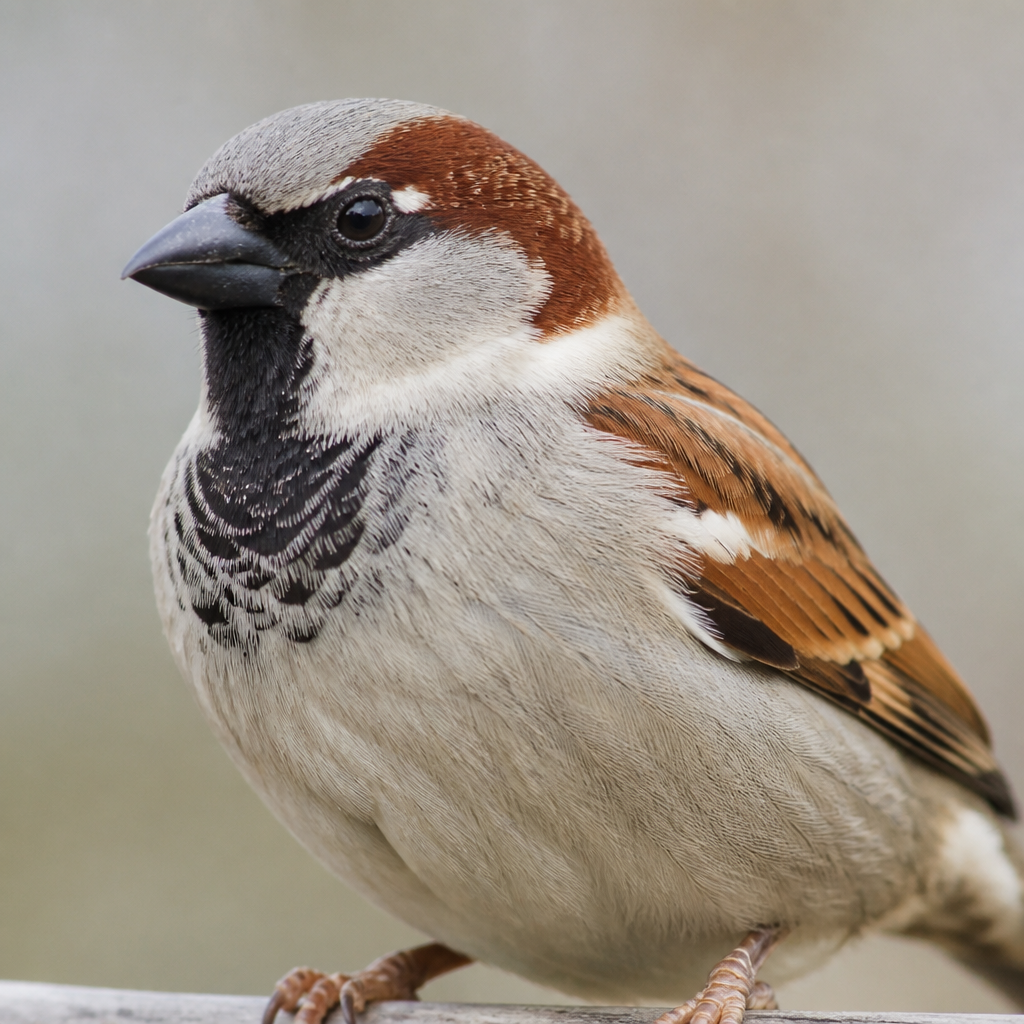
House Sparrow
Passer domesticus
Biology
The House Sparrow (Passer domesticus) is a small, robust passerine belonging to the family Passeridae, typically measuring 14–16 cm in length with a wingspan of 21–25 cm and weighing 24–40 grams. Males exhibit a distinctive grey cap, chestnut nape, and a prominent black bib extending to the breast, while females are duller, buff-brown overall with streaky backs. This species breeds prolifically year-round in temperate climates, producing 3–5 broods annually, each consisting of 3–7 eggs, which hatch after 10–14 days incubation. Nestlings fledge within 15–17 days and reach sexual maturity in 10–12 months, contributing to a typical lifespan of 2–3 years in the wild, though some individuals may live up to 7 years. They thrive in a wide range of temperatures but require access to water and nesting sites, with higher reproductive success observed in stable, human-dominated environments.
Behaviour
House Sparrows are highly social and gregarious, often foraging, nesting, and roosting in large, noisy flocks, especially outside the breeding season. They exhibit diurnal activity patterns, with peak foraging efforts in the early morning and late afternoon, often engaging in dust bathing or water bathing communally. Communication involves a variety of chirping and chattering calls, used for alarm, kontakt, and territorial defense, particularly by males displaying at nesting sites. These birds are opportunistic omnivores, feeding primarily on seeds and grains, but also consuming insects, berries, and human food scraps, demonstrating significant dietary adaptability. Their aggressive and territorial nature frequently leads to the displacement of native avian species from prime nesting sites, posing a conservation challenge and contributing to ecological imbalance in urban and agricultural settings.
Habits
House Sparrows are highly commensal, demonstrating a remarkable adaptation to anthropogenic environments, rarely found far from human habitation. They prefer to construct their messy, often dome-shaped nests in sheltered cavities, including building crevices, eaves, rafters, ventilation systems, signage, and machinery, utilizing a diverse array of fibrous materials. Foraging occurs within a relatively small radius of their nesting or roosting sites, typically within a few hundred meters, focusing on spilled grains, livestock feed, food waste, and weed seeds in cultivated areas. Conducive conditions for heavy infestation include readily available food sources, such as animal feedlots, food processing plants, and open-air eateries, coupled with abundant harborage in dilapidated or poorly maintained structures, leading to significant structural damage and contamination issues.
Control methods
- 1Screen vents and louvres with 1 cm mesh
- 2Bird spikes or sloped covers on signs and ledges
- 3Remove nests promptly under permits where required
- 4Sanitation: cover bins, clean spilled grain
- 5Live traps baited with seed near nesting sites
- 6Block roof and soffit gaps >2 cm
Tailored to House Sparrow
IPM Procedure Checklist
Inspection
- Identify roosting, loafing and nesting sites
- Document droppings, feathers and damage to structure
- Note food and water sources attracting birds
Identification
- Confirm House Sparrow (Passer domesticus) — not a look-alike
- Note life stage and risk level: Moderate
- Capture clear photos and samples for the record
Action Thresholds
- Trigger action when monitor counts trend up
- Re-evaluate weekly during active season
- Document trigger criteria in the IPM plan
Prevention
- Install spikes, netting or shock track on ledges
- Remove standing water and accessible food
- Close openings to attics, vents and signage voids
Control Methods
- Screen vents and louvres with 1 cm mesh
- Bird spikes or sloped covers on signs and ledges
- Remove nests promptly under permits where required
- Sanitation: cover bins, clean spilled grain
Monitoring & Evaluation
- Service monitors on schedule and trend captures
- Re-inspect for House Sparrow activity at follow-up
- Adjust tactics based on data; report findings to client