Rodent
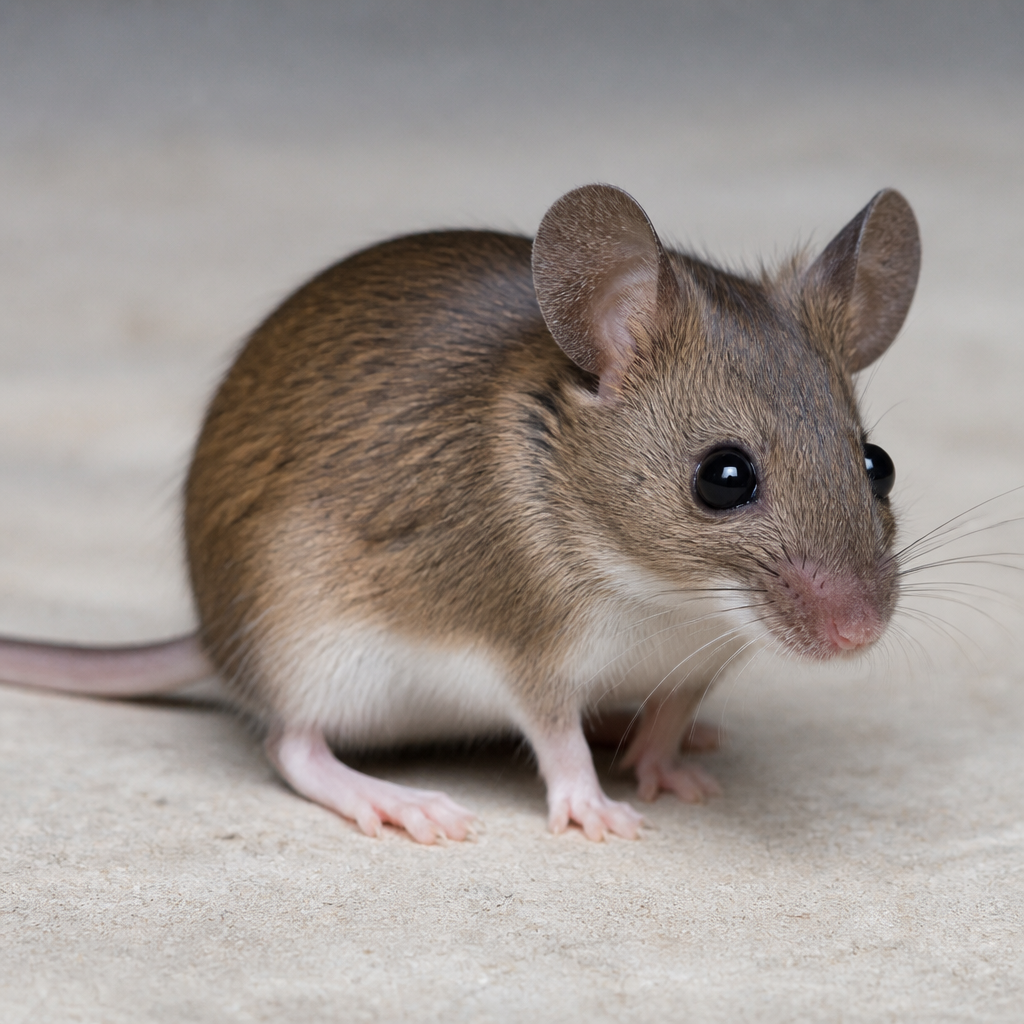
House Mouse
Mus musculus
Biology
The common house mouse, Mus musculus domesticus, is a small murid rodent, typically weighing 12-30 grams and measuring 6-10 cm in body length with a tail of comparable length. Its fur is generally grey-brown dorsally, often lighter ventrally, and its ears are relatively large and prominent with fine hair. Reproductive maturity is reached astonishingly quickly, often by 5-7 weeks of age, enabling rapid population growth under favorable conditions. Gestation lasts 19-21 days, yielding litters of 5-12 pups, and females can produce 5-10 litters annually, sometimes even more under ideal conditions. Average lifespan is 9-12 months in the wild but can extend to 2-3 years in protected environments, with optimal breeding conditions occurring between 21-32°C and moderate humidity.
Behaviour
House mice are primarily nocturnal or crepuscular, exhibiting peak activity shortly after dusk and before dawn, though they can forage during the day in undisturbed environments or when population pressure is high. They are neophobic towards new objects but exploratory towards novel food sources, often sampling many different items in small quantities, leading to widespread food contamination. Communication occurs through a complex repertoire of ultrasonic vocalizations for courtship and territoriality, as well as scent marking with urine, which conveys information about social status and reproductive state. Their agility allows them to climb rough vertical surfaces, jump up to 30 cm vertically, and squeeze through openings as small as 6 mm in diameter. Public health impacts stem from their role as vectors for pathogens like Salmonella, Hantavirus, and lymphocytic choriomeningitis virus (LCMV), transmitted through droppings, urine, and saliva.
Habits
House mice establish harborages very close to readily available food and water sources, typically within a 3-10 meter radius of their foraging grounds, though foraging ranges can extend further in resource-scarce environments. Preferred nesting sites include secluded, dark, and undisturbed locations such as wall voids, ceiling voids, storage boxes, cabinets, within insulation, beneath appliances, and cluttered areas. They are omnivorous but primarily granivorous, consuming seeds, grains, and cereals, but will also readily consume insects, pet food, and discarded human food. Signs of infestation include gnaw marks on wood, plastics, and food packaging; small, rod-shaped droppings (3-6 mm long); urine pillars in long-standing infestations; smudge marks along runways; and distinct musky odors. Conducive conditions include poor sanitation, structural deficiencies allowing entry, and abundant food and water availability.
Control methods
- 1Multi-catch and snap traps every 6–10 ft along walls
- 2Exclusion: copper mesh + sealant on all gaps
- 3Tamper-resistant bait stations outdoors
- 4Sanitation and food storage in sealed containers
- 5Remove indoor clutter for harborage reduction
- 6Monitor with tracking powder or fluorescent dust
Tailored to House Mouse
IPM Procedure Checklist
Inspection
- Locate runways, droppings, rub marks and gnaw damage
- Identify entry points (gaps ≥6 mm) and harborage
- Place tracking patches or non-toxic monitors
Identification
- Confirm House Mouse (Mus musculus) — not a look-alike
- Note life stage and risk level: High
- Capture clear photos and samples for the record
Action Thresholds
- Zero-tolerance: act on first confirmed sighting
- Notify client and document the trigger event
- Prioritize health and regulatory risk in the plan
Prevention
- Exclude with steel wool, hardware cloth and door sweeps
- Trim vegetation 0.5 m from structure; clear debris
- Secure trash, pet food and stored grain
Control Methods
- Multi-catch and snap traps every 6–10 ft along walls
- Exclusion: copper mesh + sealant on all gaps
- Tamper-resistant bait stations outdoors
- Sanitation and food storage in sealed containers
Monitoring & Evaluation
- Service monitors on schedule and trend captures
- Re-inspect for House Mouse activity at follow-up
- Adjust tactics based on data; report findings to client