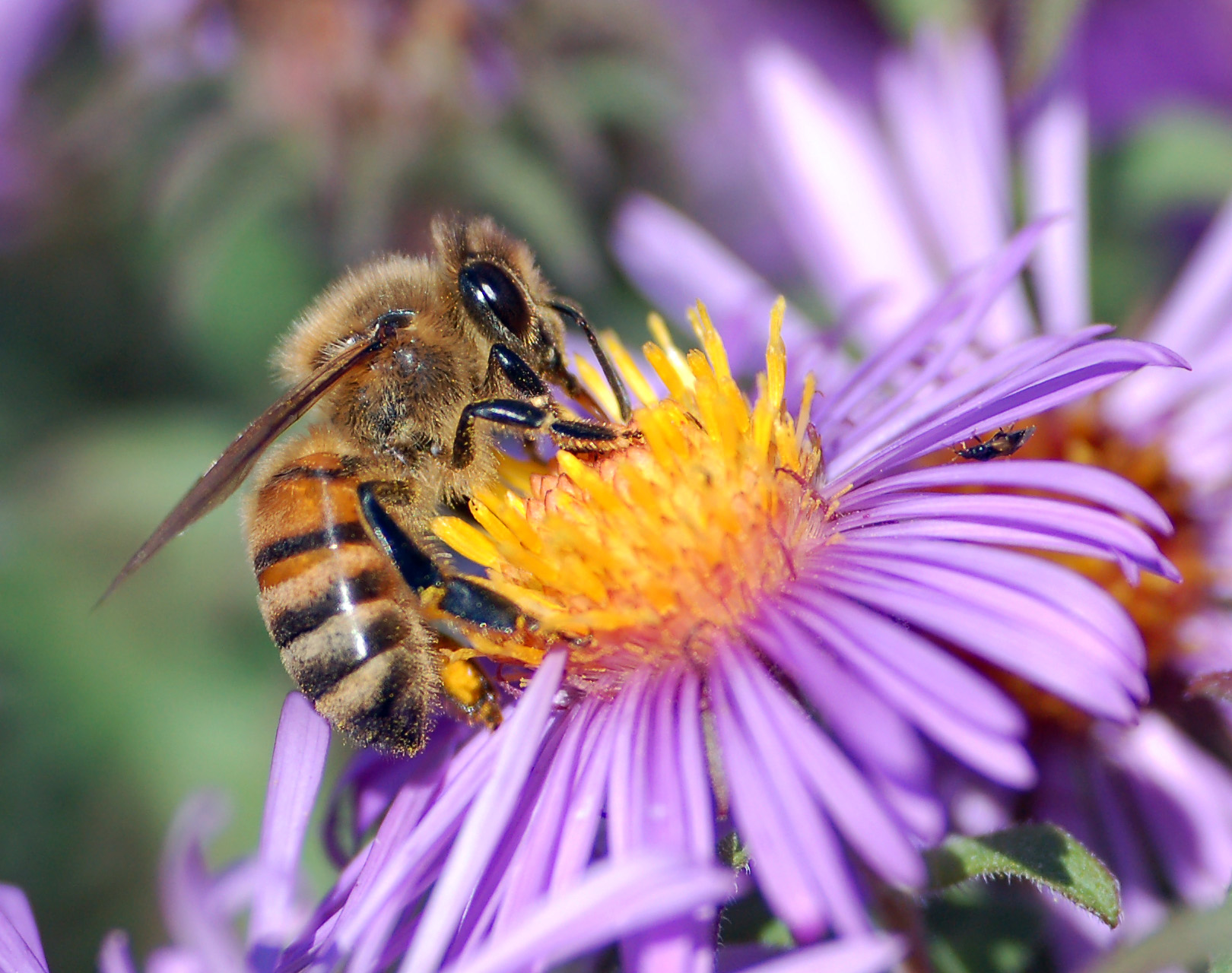
Stinging Insect
Honey Bee
Apis mellifera
Biology
Apis mellifera, the Western honey bee, is a Hymenopteran insect belonging to the family Apidae, characterized by its robust, hairy body, typically 12-15 mm for workers and 18-20 mm for queens, with distinctive black and amber banding. Its lifecycle involves complete metamorphosis: egg (3 days), larva (5-9 days, fed by nurse bees), pupa (7-12 days), and adult emergence. Queens are polyandrous, mating with multiple drones and laying up to 2,000 eggs per day, sustaining colonies of 20,000 to 80,000 individuals, which can survive for several years in temperate climates, thanks to their ability to regulate nest temperature between 32-35°C year-round. Worker bees live 4-6 weeks in summer but several months over winter, while queens can live 3-5 years.
Behaviour
Honey bee workers exhibit complex social behaviors within their eusocial colonies, communicating through trophallaxis (food exchange) and intricate 'waggle dances' to indicate food sources up to several miles away. While foraging, they are generally non-aggressive, but the colony's defensive response is potent, triggered by alarm pheromones released by 1-2 workers when a perceived threat invades a 10-20 m radius around the nest entrance. Although individual workers can only sting once due to their barbed stinger, which disembowels them, mass stinging events can be medically significant, delivering sufficient venom to cause anaphylaxis in susceptible individuals or even death in cases of extreme envenomation. Colonies in structural voids can compromise building integrity due to heavy comb construction and pose significant public health risks from active defensive swarms.
Habits
Honey bees construct elaborate, vertically oriented wax combs for brood rearing and honey storage, preferably in dark, enclosed cavities offering thermal stability, such as hollow trees, rock crevices, or increasingly, anthropogenic structures like wall voids, chimneys, and attic spaces. Swarming, their primary method of colony reproduction, typically occurs in spring-early summer when a portion of the colony, led by the old queen, vacates the original nest to establish a new one, often clustering temporarily on nearby objects before finding a suitable permanent harborage. Foraging patterns are extensive, covering several square kilometers; workers collect nectar and pollen from a wide array of flowering plants. A pest management technician should look for sustained bee activity around structural entry points, listen for buzzing within walls, and investigate unexplained stains that might indicate honey/water leakage from an internal nest.
Control methods
- 1Contact a beekeeper for live swarm capture first
- 2Never spray a wall-void colony without a removal plan
- 3After removal, cut out comb and wax to prevent rot
- 4Seal entry points with hardware cloth and mortar
- 5Avoid scented products and dark clothing near hives
- 6Carry an epinephrine auto-injector if known allergic
Tailored to Honey Bee
IPM Procedure Checklist
Inspection
- Survey interior and exterior for evidence and conducive conditions
- Document findings with photos and a site map
- Place monitors to confirm activity
Identification
- Confirm Honey Bee (Apis mellifera) — not a look-alike
- Note life stage and risk level: Moderate
- Capture clear photos and samples for the record
Action Thresholds
- Trigger action when monitor counts trend up
- Re-evaluate weekly during active season
- Document trigger criteria in the IPM plan
Prevention
- Exclude entry points and harborage
- Improve sanitation and moisture control
- Modify habitat around the structure
Control Methods
- Contact a beekeeper for live swarm capture first
- Never spray a wall-void colony without a removal plan
- After removal, cut out comb and wax to prevent rot
- Seal entry points with hardware cloth and mortar
Monitoring & Evaluation
- Service monitors on schedule and trend captures
- Re-inspect for Honey Bee activity at follow-up
- Adjust tactics based on data; report findings to client