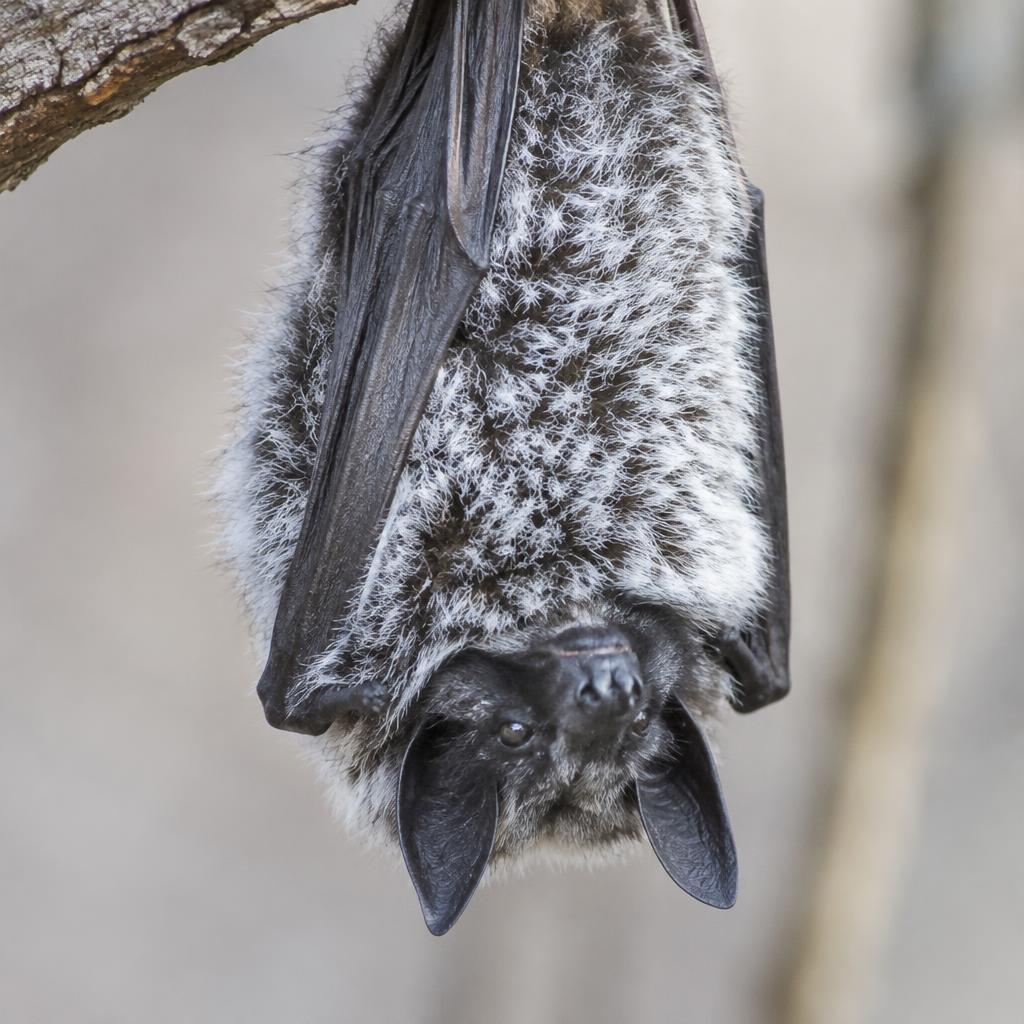
Bat
Hoary Bat
Lasiurus cinereus
Biology
Lasiurus cinereus is North America's largest tree bat, with a wingspan of 34–41 cm. Adults have thick, frosted white-tipped fur over dark brown bodies, a heavily furred tail membrane, and a broad, short muzzle. Females give birth to twins in early summer, roosting in foliage rather than caves.
Behaviour
Hoary bats are solitary, nocturnal aerial hawkers that feed mainly on moths, beetles, and other flying insects. They are strong, fast fliers and typically roost alone in the canopy of deciduous trees, concealed among leaves. They rarely form colonies and are not adapted to sustained indoor roosting.
Habits
Encounters usually involve a single bat found in a yard, on a porch, or briefly entering an open building at night. They are attracted to lights that concentrate insect prey. They do not establish attic colonies, so repeated indoor sightings usually indicate an open window, chimney, or gap rather than a roost.
Control methods
- 1Confirm it is not a colonial maternity species before exclusion
- 2Open windows/doors at dusk and turn off interior lights to let it exit
- 3Install chimney caps and seal attic vents >3/8 inch
- 4Switch outdoor lighting to motion-activated or yellow bulbs to reduce insect prey
- 5Contact a wildlife professional if the bat is injured or found in a sleeping area
- 6Avoid direct handling; seek medical advice if a bite or scratch occurs
Tailored to Hoary Bat
IPM Procedure Checklist
Inspection
- Inspect at dusk to locate active entry/exit points
- Check attics, soffits and chimneys for guano
- Identify maternity colonies before any action
Identification
- Confirm Hoary Bat (Lasiurus cinereus) — not a look-alike
- Note life stage and risk level: Low
- Capture clear photos and samples for the record
Action Thresholds
- Tolerate low-level activity outside sensitive zones
- Act if activity moves indoors or near food
- Review threshold seasonally with the client
Prevention
- Seal gaps ≥6 mm with caulk, mesh and flashing
- Cap chimneys and screen attic vents
- Provide alternative bat houses on the property
Control Methods
- Confirm it is not a colonial maternity species before exclusion
- Open windows/doors at dusk and turn off interior lights to let it exit
- Install chimney caps and seal attic vents >3/8 inch
- Switch outdoor lighting to motion-activated or yellow bulbs to reduce insect prey
Monitoring & Evaluation
- Service monitors on schedule and trend captures
- Re-inspect for Hoary Bat activity at follow-up
- Adjust tactics based on data; report findings to client