Insect
Spongy (Gypsy) Moth
Lymantria dispar
Biology
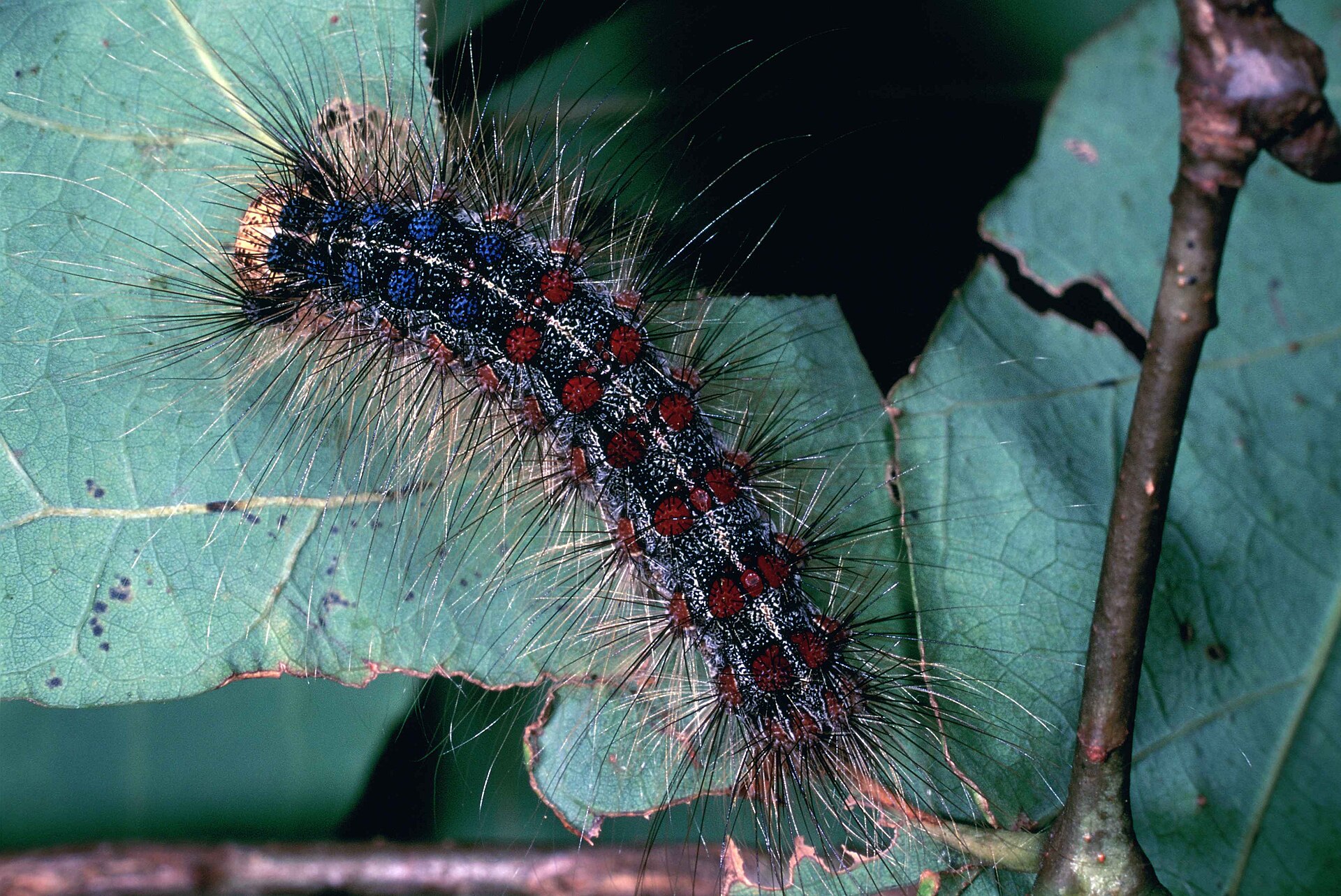
The spongy moth, Lymantria dispar (Linnaeus), is a polyphagous defoliator belonging to the family Erebidae. Mature larvae are distinctively hairy, 50-65 mm long, with five pairs of blue spots followed by six pairs of red spots along their dorsal surface. Adult males have a wingspan of 30-40 mm, are brownish and good fliers, while females are larger (50-60 mm wingspan), whitish, and flightless. A single generation occurs annually. Eggs are laid in masses, typically covered with buff-colored hairs from the female's abdomen, overwintering on tree trunks and other surfaces. Hatching occurs in spring, with larval development lasting 6-8 weeks.
Behaviour
Upon hatching, young larvae may exhibit ballooning, dispersing to new host trees by spinning silk threads and being carried by wind. Larvae are primarily nocturnal feeders, resting in sheltered locations during the day. As they mature, they consume significant amounts of foliage. Pupation occurs in crevices or on bark, characterized by a dark brown pupa. Adult males are active fliers, searching for flightless females that release pheromones to attract mates. Females lay a single egg mass, containing several hundred to over a thousand eggs, before dying.
Habits
Spongy moths prefer deciduous trees, with oaks being a favored host, but can infest over 500 species of trees and shrubs. Outbreaks lead to severe defoliation, stressing trees and making them susceptible to secondary pests and diseases. Conducive conditions for outbreaks include large contiguous areas of host trees and mild winters that favor egg mass survival. Egg masses are a critical indicator of potential future infestations and are often found on tree trunks, branches, rocks, and outdoor structures. Overwintering egg masses are highly resilient to cold temperatures.
Control methods
- 1Scrape and destroy overwintering egg masses.
- 2Apply Bacillus thuringiensis (Bt) insecticide to young larvae.
- 3Use pheromone traps to monitor male moth populations.
- 4Introduce parasitic wasps and flies for biological control.
- 5Utilize horticultural oil applications on dormant egg masses.
- 6Implement tree banding to ensnare climbing larvae.
Tailored to Spongy (Gypsy) Moth
IPM Procedure Checklist
Inspection
- Inspect harborage near food, water and warmth
- Check cracks, voids and appliance interiors
- Place sticky monitors at suspected hot-spots
Identification
- Confirm Spongy (Gypsy) Moth (Lymantria dispar) — not a look-alike
- Note life stage and risk level: High
- Capture clear photos and samples for the record
Action Thresholds
- Zero-tolerance: act on first confirmed sighting
- Notify client and document the trigger event
- Prioritize health and regulatory risk in the plan
Prevention
- Seal cracks, plumbing penetrations and wall voids
- Eliminate moisture sources and standing water
- Improve sanitation: sealed food storage, grease removal
Control Methods
- Scrape and destroy overwintering egg masses.
- Apply Bacillus thuringiensis (Bt) insecticide to young larvae.
- Use pheromone traps to monitor male moth populations.
- Introduce parasitic wasps and flies for biological control.
Monitoring & Evaluation
- Service monitors on schedule and trend captures
- Re-inspect for Spongy (Gypsy) Moth activity at follow-up
- Adjust tactics based on data; report findings to client