Bird
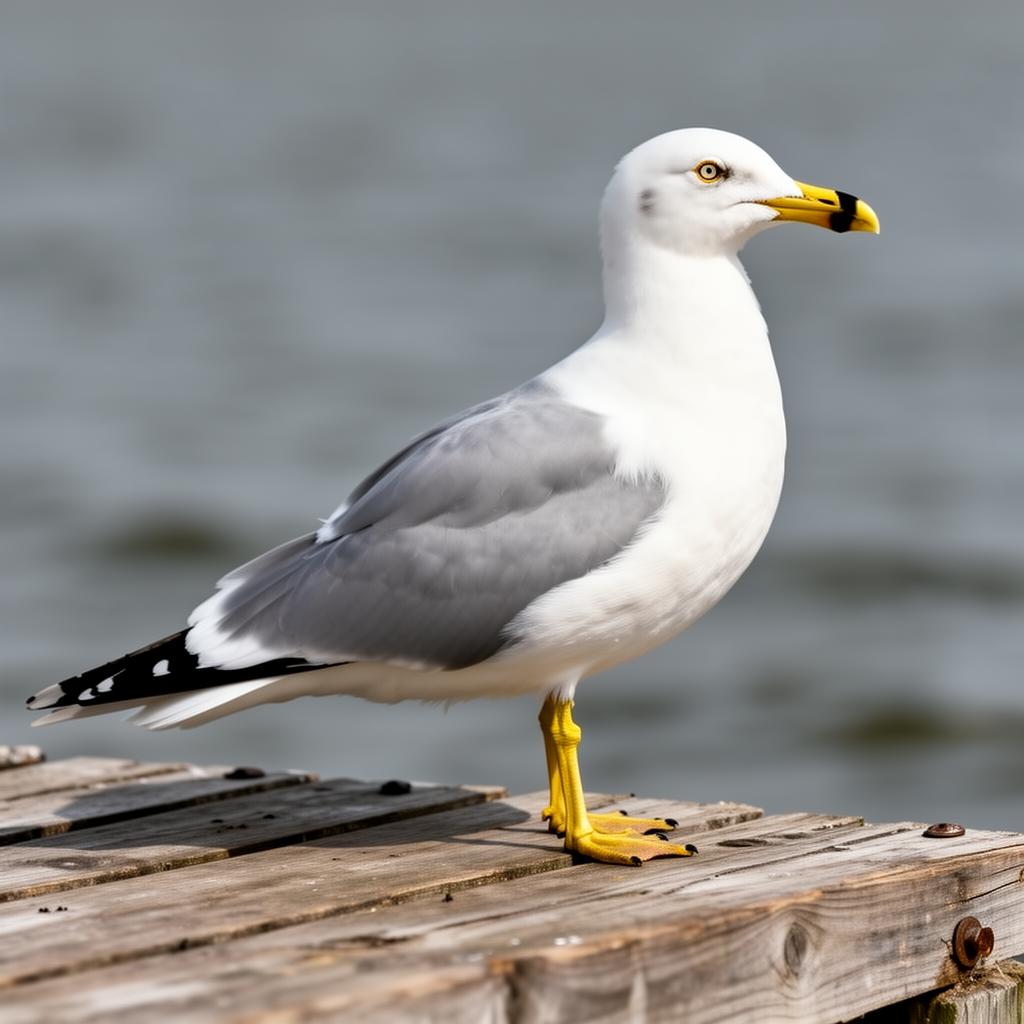
Ring-billed Gull
Larus delawarensis
Biology
The Ring-billed Gull, Larus delawarensis, is a medium-sized gull within the family Laridae, typically measuring 40-54 cm in length with a wingspan of 105-120 cm and weighing between 300-700 grams. Distinguishable by its adult plumage of white body, pale grey back and upperwings, black wingtips with white spots (mirrors), and bright yellow legs and orbital ring, its most definitive feature is the black band encircling its yellow bill. Reproduction involves monogamous pairs nesting colonially, laying 2-4 olive-brown, spotted eggs in a shallow nest; incubation lasts 23-28 days, and chicks fledge in 35-42 days. Lifespan averages 10-15 years, with some individuals reaching over 20 years, contributing to sustained local populations.
Behaviour
Ring-billed Gulls exhibit highly adaptable feeding ecology, functioning as opportunistic scavengers and predators. Their daily activity patterns are largely diurnal, closely aligned with human activity for food sources, but they will forage at night under artificial illumination. They demonstrate complex social behaviors within their colonial nesting and roosting aggregations, including vocalizations for alarm and recognition, and body language during territorial disputes. Dispersal patterns involve seasonal migrations from breeding grounds but increasingly feature year-round residency in urbanized areas, utilizing thermals and prevailing winds for efficient flight. Structurally, their nesting materials (twigs, debris) can block drainage systems, and widespread droppings accelerate corrosion of building materials, while accumulations present substantial public health risks due to pathogenic bacteria such as Salmonella and E. coli.
Habits
Ring-billed Gulls prefer human-modified landscapes for foraging and harborage, frequently congregating on flat, gravel-covered rooftops that mimic natural nesting islands, offering protection from ground predators and access to elevation. Their foraging patterns are extensive, covering several square kilometers from roosting sites, focusing on open-air restaurants, landfills, agricultural fields, and bodies of water. Seasonal movements include south-ward migration from northern breeding grounds, but many populations in temperate urban environments are becoming increasingly sedentary due to consistent food availability. Conducive conditions for heavy infestation include inadequate waste management, easily accessible outdoor food waste, and large, unmanaged flat roof spaces. Signs of infestation include significant guano accumulation on ledges, roofs, vehicles, and walkways, evidence of nesting material on rooftops, and distinct vocalizations present throughout daylight hours at preferred sites.
Control methods
- 1Install bird wire or spikes on ledges and roof edges
- 2Secure dumpster lids and clean spills daily
- 3Use trained falconry or raptor effigies
- 4Audio deterrents (predator calls, alarms)
- 5Eliminate standing water on roofs
- 6Discourage public feeding through signage
Tailored to Ring-billed Gull
IPM Procedure Checklist
Inspection
- Identify roosting, loafing and nesting sites
- Document droppings, feathers and damage to structure
- Note food and water sources attracting birds
Identification
- Confirm Ring-billed Gull (Larus delawarensis) — not a look-alike
- Note life stage and risk level: Moderate
- Capture clear photos and samples for the record
Action Thresholds
- Trigger action when monitor counts trend up
- Re-evaluate weekly during active season
- Document trigger criteria in the IPM plan
Prevention
- Install spikes, netting or shock track on ledges
- Remove standing water and accessible food
- Close openings to attics, vents and signage voids
Control Methods
- Install bird wire or spikes on ledges and roof edges
- Secure dumpster lids and clean spills daily
- Use trained falconry or raptor effigies
- Audio deterrents (predator calls, alarms)
Monitoring & Evaluation
- Service monitors on schedule and trend captures
- Re-inspect for Ring-billed Gull activity at follow-up
- Adjust tactics based on data; report findings to client