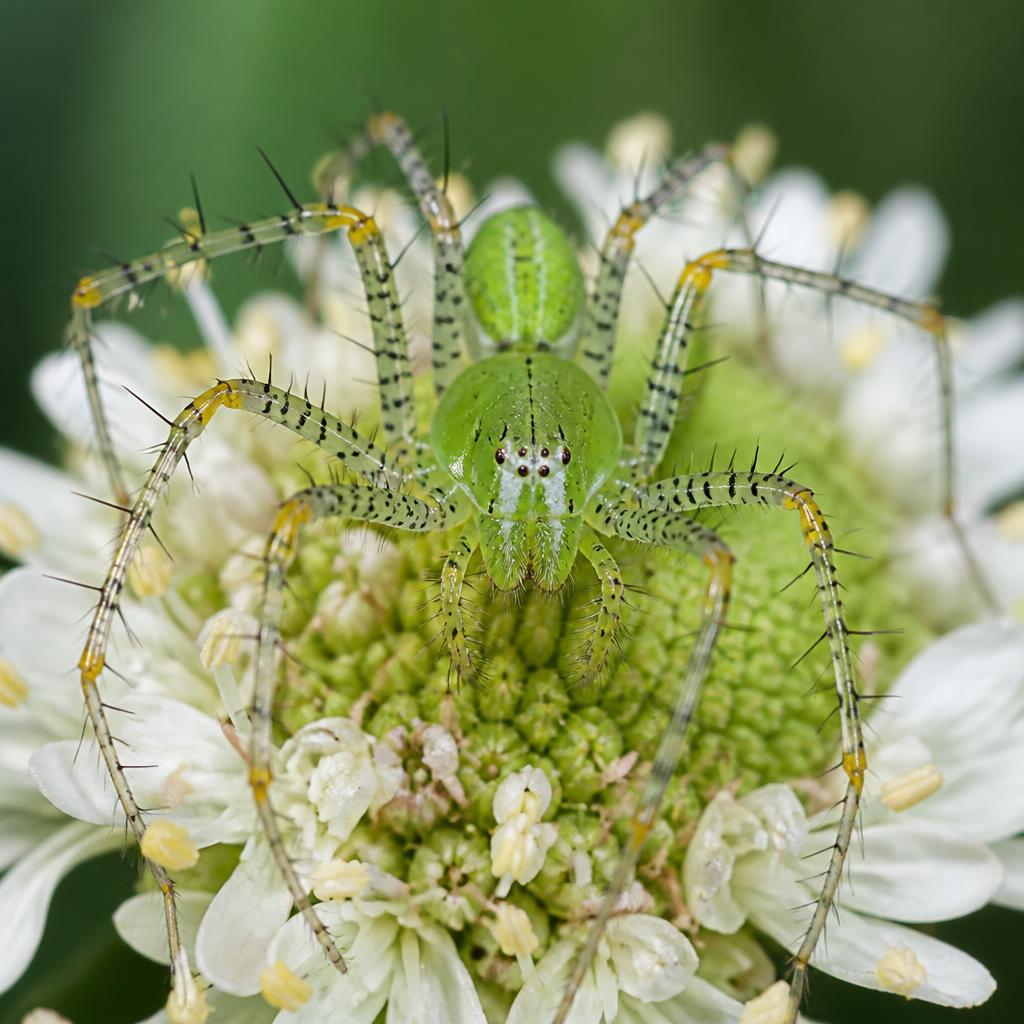
Spider
Green Lynx Spider
Peucetia viridans
Biology
Peucetia viridans is a large oxyopid, 12–22 mm, bright translucent green with long spiny, black-spotted legs and a hexagonal eye arrangement. Colour can shift toward yellow or pale pink to match host flowers. In autumn the female lashes a bright green, spiky egg sac holding 200–600 eggs to a plant stem and guards it aggressively until spiderlings disperse; she dies after the brood emerges, giving a single yearly generation concentrated in the southern United States.
Behaviour
Green lynx spiders are diurnal ambush hunters that build no capture web, instead stalking and springing on pollinators and caterpillars among flower heads. They are famous for squirting venom up to 20 cm as a defence when a guarding female is disturbed — an eye irritant, not a systemic hazard. Bites are uncommon and produce transient local pain and swelling. Because they take large numbers of moths and caterpillars, they are considered beneficial in cotton and vegetable systems, though they also take honey bees.
Habits
They live on flowering shrubs and tall herbaceous plants — lantana, goldenrod, cotton, oleander and ornamental beds — usually within a metre of a bloom. Structures are affected only where such plantings touch the building, so encounters occur while pruning or harvesting rather than indoors. Signs are the vivid green spiky egg sac tethered to a stem with a female standing over it. Conducive conditions are dense flowering landscaping close to entries and walkways in warm climates.
Control methods
- 1Leave in place where possible — an effective garden predator
- 2Wear gloves and eye protection when pruning occupied shrubs
- 3Trim flowering shrubs back from doors and walkways
- 4Relocate guarded egg sacs to outlying landscaping
- 5Rinse eyes with water if venom is squirted
- 6Avoid broad landscape sprays that remove beneficials
Tailored to Green Lynx Spider
IPM Procedure Checklist
Inspection
- Inspect undisturbed corners, voids and stored items
- Identify webs, egg sacs and prey debris
- Note conducive insect prey populations
Identification
- Confirm Green Lynx Spider (Peucetia viridans) — not a look-alike
- Note life stage and risk level: Low
- Capture clear photos and samples for the record
Action Thresholds
- Tolerate low-level activity outside sensitive zones
- Act if activity moves indoors or near food
- Review threshold seasonally with the client
Prevention
- Reduce clutter and seal cracks around the structure
- Switch exterior lights to yellow / sodium to reduce prey
- Install door sweeps and screen vents
Control Methods
- Leave in place where possible — an effective garden predator
- Wear gloves and eye protection when pruning occupied shrubs
- Trim flowering shrubs back from doors and walkways
- Relocate guarded egg sacs to outlying landscaping
Monitoring & Evaluation
- Service monitors on schedule and trend captures
- Re-inspect for Green Lynx Spider activity at follow-up
- Adjust tactics based on data; report findings to client