All pests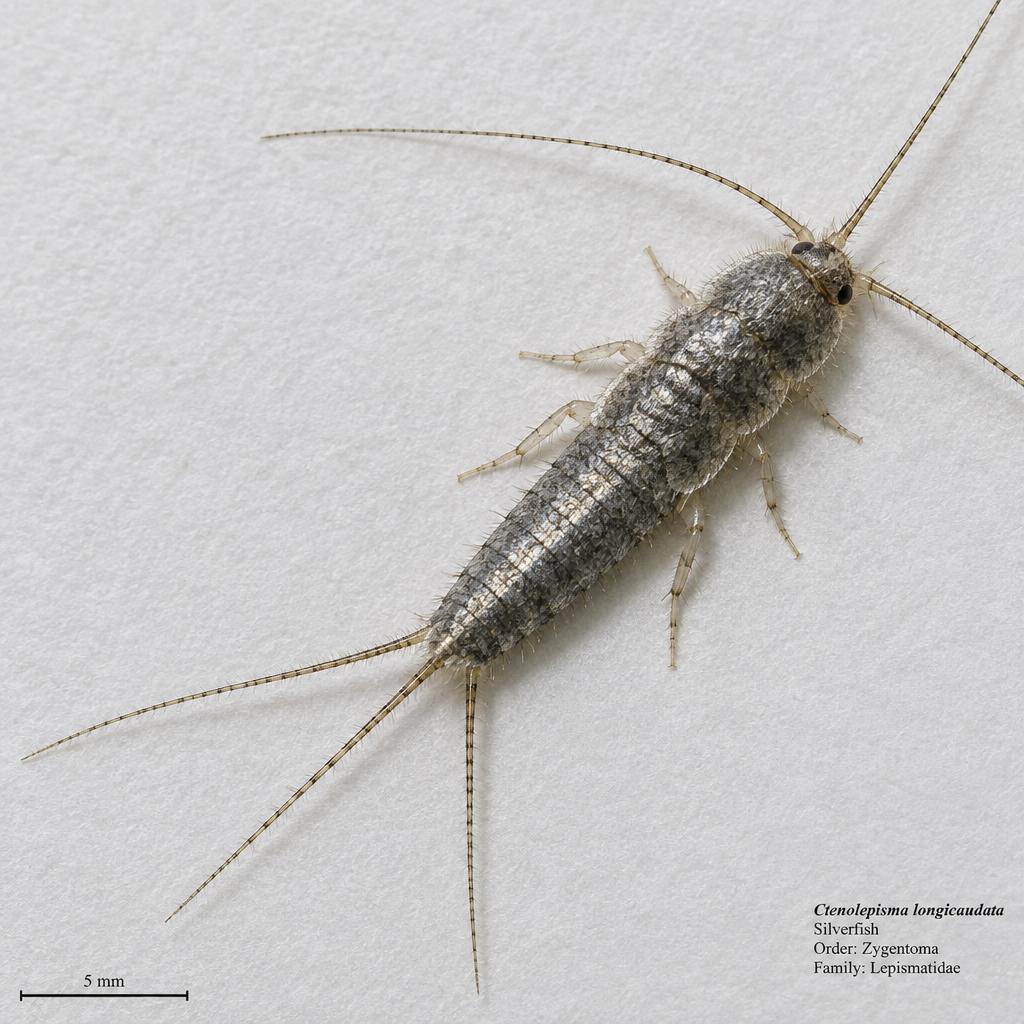 View full procedure
Insect
Gray Silverfish
Ctenolepisma longicaudata
Low Risk
Biology
Ctenolepisma longicaudata is a large silverfish 13–19 mm long, uniformly grey with very long antennae and tail filaments. Unlike the common silverfish it tolerates normal indoor humidity and can live up to eight years.
Behaviour
Nocturnal and secretive, it grazes on cellulose, paper, book bindings, wallpaper paste, textiles, and dust containing skin flakes. It disperses through wall voids and is often spread in cardboard and second-hand books.
Habits
Damage appears as surface etching and irregular holes in paper, photographs, and stored textiles, with yellow staining and shed scales. It frequents bookcases, storage rooms, archives, and skirting-board voids.
Control methods
- 1Reduce paper and cardboard clutter in storage areas
- 2Seal skirting boards, wall voids, and service penetrations
- 3Keep relative humidity below 50 percent with ventilation
- 4Store documents and textiles in sealed plastic boxes
- 5Use monitoring traps to map harborage before treatment
- 6Apply labelled residual dusts to voids and behind baseboards
Tailored to Gray Silverfish
IPM Procedure Checklist
Step 1
Inspection
- Inspect harborage near food, water and warmth
- Check cracks, voids and appliance interiors
- Place sticky monitors at suspected hot-spots
Step 2
Identification
- Confirm Gray Silverfish (Ctenolepisma longicaudata) — not a look-alike
- Note life stage and risk level: Low
- Capture clear photos and samples for the record
Step 3
Action Thresholds
- Tolerate low-level activity outside sensitive zones
- Act if activity moves indoors or near food
- Review threshold seasonally with the client
Step 4
Prevention
- Seal cracks, plumbing penetrations and wall voids
- Eliminate moisture sources and standing water
- Improve sanitation: sealed food storage, grease removal
Step 5
Control Methods
- Reduce paper and cardboard clutter in storage areas
- Seal skirting boards, wall voids, and service penetrations
- Keep relative humidity below 50 percent with ventilation
- Store documents and textiles in sealed plastic boxes
Step 6
Monitoring & Evaluation
- Service monitors on schedule and trend captures
- Re-inspect for Gray Silverfish activity at follow-up
- Adjust tactics based on data; report findings to client