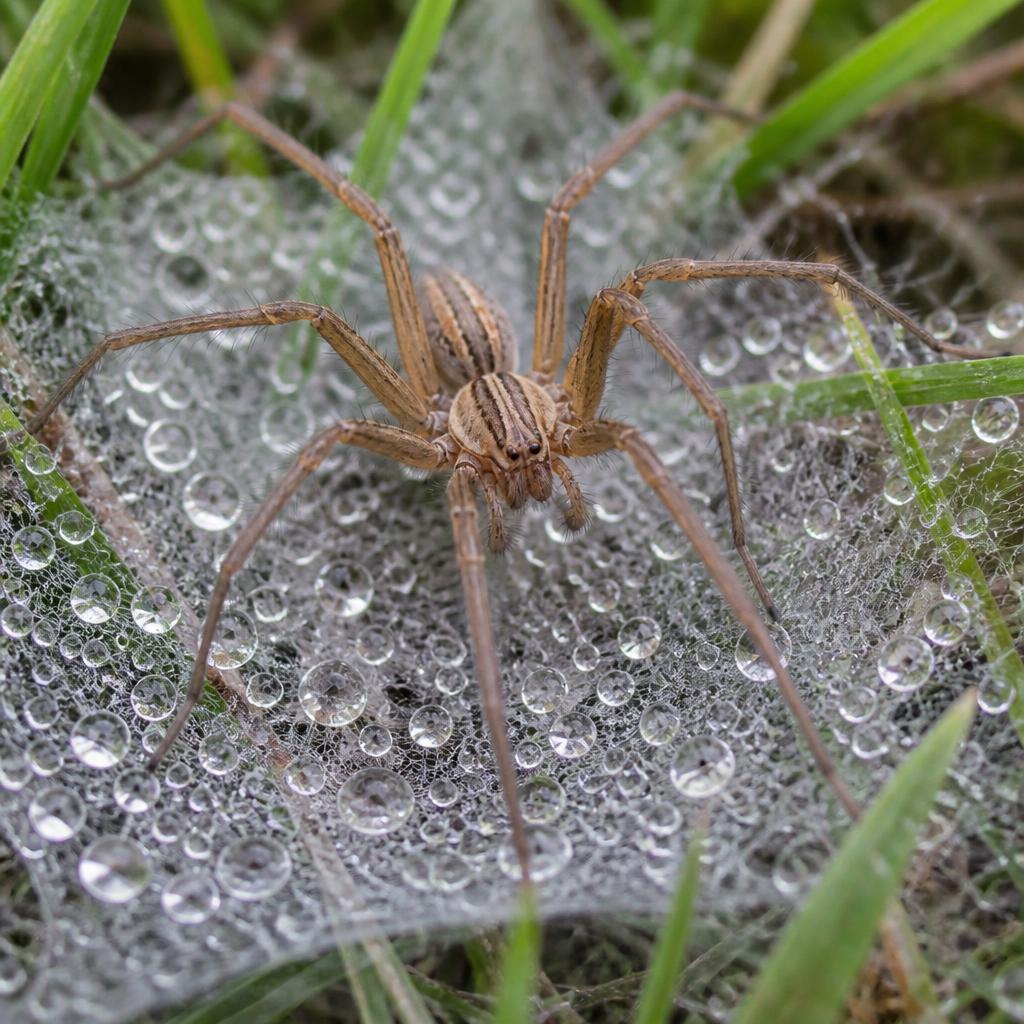
Spider
Grass Spider
Agelenopsis spp.
Biology
Agelenopsis species are agelenid funnel weavers, 10–20 mm, with a tan-brown carapace carrying two dark longitudinal stripes, a striped abdomen and conspicuously long, prominent posterior spinnerets that project like tails. Legs are long and hairy and the body is built for speed. Eggs are laid in flat, disc-shaped sacs in late summer and autumn under bark, siding and debris, overwintering to hatch in spring; most adults die at first hard frost, giving one generation per year with a strong autumn adult peak.
Behaviour
Grass spiders spin a dense horizontal sheet web with a funnel retreat at one edge, sitting head-out in the funnel and sprinting across the sheet to seize prey that stumbles onto it. The silk is not sticky — capture depends entirely on speed. They are shy, fleeing into the funnel or dropping away at the slightest disturbance, and bites on people are exceptionally rare and medically trivial. Males wander widely in late summer searching for mates, which is when they most often blunder indoors and generate service calls.
Habits
Sheet webs blanket lawns, ground cover, shrub tops, retaining walls, window wells and the mortar joints and corners of foundations, becoming spectacularly visible on dewy autumn mornings. Grass spiders are essentially exterior spiders and cannot sustain indoor populations; specimens found inside are dispersing males or accidental entries through gaps at doors and slabs. Conducive conditions are dense ground vegetation right up against the structure, mulch beds, rock walls and bright exterior lighting that concentrates prey insects along the wall line.
Control methods
- 1Trim vegetation and mulch back from the foundation
- 2Sweep webs from siding, corners and window wells
- 3Install tight door sweeps and repair damaged screens
- 4Switch to yellow or sodium exterior bulbs to cut prey
- 5Exterior residual band along foundation and window frames
- 6Glue boards along interior perimeters to catch wanderers
Tailored to Grass Spider
IPM Procedure Checklist
Inspection
- Inspect undisturbed corners, voids and stored items
- Identify webs, egg sacs and prey debris
- Note conducive insect prey populations
Identification
- Confirm Grass Spider (Agelenopsis spp.) — not a look-alike
- Note life stage and risk level: Low
- Capture clear photos and samples for the record
Action Thresholds
- Tolerate low-level activity outside sensitive zones
- Act if activity moves indoors or near food
- Review threshold seasonally with the client
Prevention
- Reduce clutter and seal cracks around the structure
- Switch exterior lights to yellow / sodium to reduce prey
- Install door sweeps and screen vents
Control Methods
- Trim vegetation and mulch back from the foundation
- Sweep webs from siding, corners and window wells
- Install tight door sweeps and repair damaged screens
- Switch to yellow or sodium exterior bulbs to cut prey
Monitoring & Evaluation
- Service monitors on schedule and trend captures
- Re-inspect for Grass Spider activity at follow-up
- Adjust tactics based on data; report findings to client