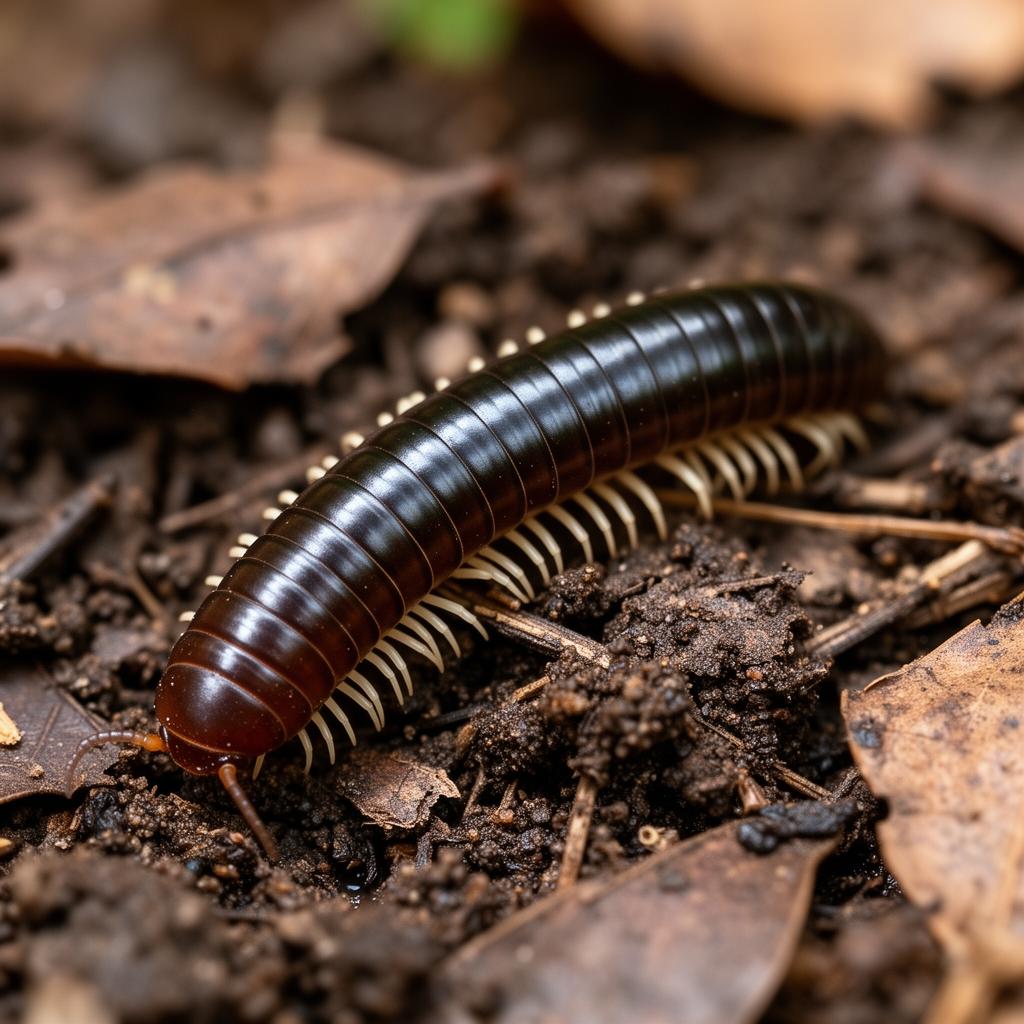
Occasional Invader
Garden Millipede
Oxidus gracilis
Biology
Oxidus gracilis, commonly known as the greenhouse millipede or garden millipede, belongs to the family Paradoxosomatidae within the order Polydesmida. Adults typically measure 19-25 mm in length and are characterized by their flattened, shiny dark-brown to black bodies, possessing a series of paranota (lateral keels) giving them a somewhat keeled appearance, distinguishing them from truly cylindrical millipedes. They exhibit a life cycle lasting 1-2 years, with females depositing clutches of 20-30 eggs in soil, which hatch into larvae with fewer segments and legs, gradually adding more segments with each molt. Optimal environmental conditions for development include temperatures between 20-25°C and high relative humidity (>75%), with lower temperatures prolonging development. An identifying characteristic is the presence of repugnatorial glands that secrete hydrogen cyanide and benzaldehydes, causing a distinct almond-like odor when disturbed.
Behaviour
This species exhibits primarily nocturnal activity, emerging from protected harborages to forage under conditions of high humidity. While lacking complex social structures, large aggregations can occur during dispersal or when favorable conditions are found, though this is not indicative of true sociality. Their feeding behavior is strictly detritivorous, consuming decaying plant matter, leaf litter, and occasionally soft-bodied living plant tissues if other food sources are scarce, acting as important decomposers in their natural habitat. When threatened, O. gracilis employs a defensive coiling mechanism, protecting its vulnerable ventral side, and concurrently exudes its noxious chemical secretions, deterring predators. Although not directly harmful, mass indoor migrations can trigger allergic reactions in sensitive individuals due to these secretions, and their sheer numbers can be a significant nuisance.
Habits
Oxidus gracilis primarily harbors in perpetually damp, dark environments rich in organic matter, such as under decaying logs, leaf litter, mulch, potted plants, and loose soil, particularly in horticultural settings like greenhouses and nurseries. Foraging activity is concentrated within these damp microhabitats, with dispersal occurring over relatively short distances, often facilitated by natural moisture gradients. Seasonal movements are pronounced, with significant migrations into structures common during periods of environmental stress like prolonged drought or excessive rainfall, or in autumn as outdoor conditions become less favorable. Conducive indoor conditions include high humidity, water leaks, damp basements, and the presence of potted plants. Signs of infestation primarily include the visual presence of millipedes, often aggregated, and occasionally a faint almond-like odor if large numbers are disturbed or crushed.
Control methods
- 1Remove leaf litter, mulch and debris from foundations
- 2Improve drainage and grade soil away from structure
- 3Seal door sweeps, weep holes and foundation cracks
- 4Reduce indoor humidity in basements and crawl spaces
- 5Vacuum or sweep up indoor specimens — they desiccate fast
- 6Apply perimeter granular barrier during migration peaks
Tailored to Garden Millipede
IPM Procedure Checklist
Inspection
- Inspect exterior perimeter for entry pathways
- Note moisture, mulch and ground-cover near foundation
- Identify aggregation sites on warm walls
Identification
- Confirm Garden Millipede (Oxidus gracilis) — not a look-alike
- Note life stage and risk level: Low
- Capture clear photos and samples for the record
Action Thresholds
- Tolerate low-level activity outside sensitive zones
- Act if activity moves indoors or near food
- Review threshold seasonally with the client
Prevention
- Seal foundation cracks, weep holes and utility penetrations
- Pull mulch and vegetation back from the structure
- Improve drainage and reduce exterior moisture
Control Methods
- Remove leaf litter, mulch and debris from foundations
- Improve drainage and grade soil away from structure
- Seal door sweeps, weep holes and foundation cracks
- Reduce indoor humidity in basements and crawl spaces
Monitoring & Evaluation
- Service monitors on schedule and trend captures
- Re-inspect for Garden Millipede activity at follow-up
- Adjust tactics based on data; report findings to client