Fly
Fly Maggots
Musca domestica (larvae)
Biology
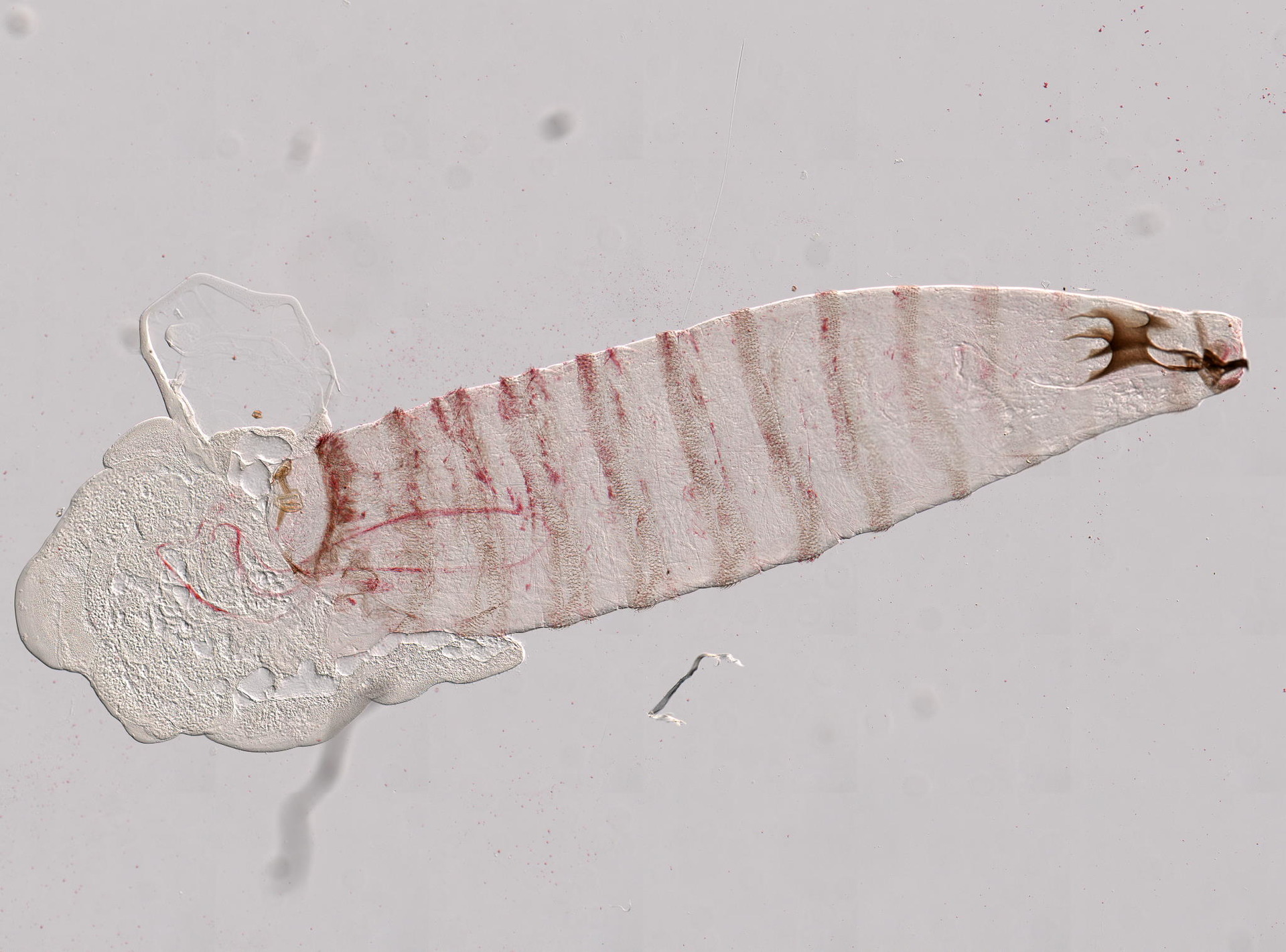
Musca domestica (house fly) larvae, commonly known as maggots, are acephalous (lacking a distinct head) and apodous (legless), presenting as creamy-white, cylindrical forms with 12 segments. They possess a characteristic anterior end that tapers to a pair of dark mouth hooks used for feeding and locomotion, while the posterior end is blunter, featuring two large spiracular plates essential for respiration. Development from egg to pupa typically spans 3–7 days under optimal conditions (25–30°C and 70–80% RH), but this can extend to several weeks at lower temperatures. A female house fly can lay up to 500–600 eggs in batches over her 2–4 week lifespan, leading to rapid population growth given sufficient substrate. The larval stage undergoes three instars, increasing significantly in size from hatching to a mature length of 8–12 mm.
Behaviour
House fly maggots exhibit photonegative and thigmotactic behaviors during their feeding stages, actively burrowing into decaying organic matter to avoid light and seek protection and sustenance. Their primary behavior revolves around continuous feeding, utilizing their mouth hooks to scrape and ingest liquefied organic material. As saprophagous organisms, they play a crucial role in decomposition, but their activity directly contributes to the mechanical transmission of over 100 different pathogens, including bacteria like Salmonella typhimurium, Escherichia coli O157:H7, and various Shigella species, often through regurgitation or fecal deposition. This vectoring capability poses significant public health risks, particularly in food handling environments. Prior to pupation, they actively disperse from the moist feeding substrate to locate drier, cooler sites, a behavior known as 'post-feeding larval dispersal,' to ensure successful metamorphosis.
Habits
Maggots primarily inhabit moist, putrefying organic substrates such as decaying animal carcasses, fermenting garbage, animal manure, spilled food products, and clogged drains—anywhere microbial activity is high and moisture is abundant. Their feeding activity is continuous within these substrates until they reach the third instar, at which point they cease feeding and actively migrate away from the primary food source. This migration, often up to 15 meters, is driven by an instinct to find a drier, darker, and cooler location for pupation, frequently under objects, in soil cracks, or beneath debris. Signs of infestation often include the visible presence of actively feeding larvae within a substrate, trails of slime, characteristic frass (excrement), and a strong putrid odor emanating from the infested material, indicating a significant sanitation breakdown.
Control methods
- 1Locate and remove the breeding source (garbage, carcass, drain)
- 2Clean bins, drains and grease traps with enzymatic cleaner
- 3Bag and remove refuse on a strict short cycle
- 4Apply IGR (insect growth regulator) to breeding sites
- 5Use residual surface spray in dumpster and bin areas
- 6Install fly traps and air curtains at entry points
Tailored to Fly Maggots
IPM Procedure Checklist
Inspection
- Locate breeding sites: drains, decaying matter, moist organics
- Use tape-over-drain tests and UV/light traps to confirm
- Map dumpster, grease and floor-drain hot-spots
Identification
- Confirm Fly Maggots (Musca domestica (larvae)) — not a look-alike
- Note life stage and risk level: High
- Capture clear photos and samples for the record
Action Thresholds
- Zero-tolerance: act on first confirmed sighting
- Notify client and document the trigger event
- Prioritize health and regulatory risk in the plan
Prevention
- Clean drains with enzymatic foam to remove biofilm
- Manage trash, recycling and grease daily
- Screen windows, doors and air curtains at entries
Control Methods
- Locate and remove the breeding source (garbage, carcass, drain)
- Clean bins, drains and grease traps with enzymatic cleaner
- Bag and remove refuse on a strict short cycle
- Apply IGR (insect growth regulator) to breeding sites
Monitoring & Evaluation
- Service monitors on schedule and trend captures
- Re-inspect for Fly Maggots activity at follow-up
- Adjust tactics based on data; report findings to client