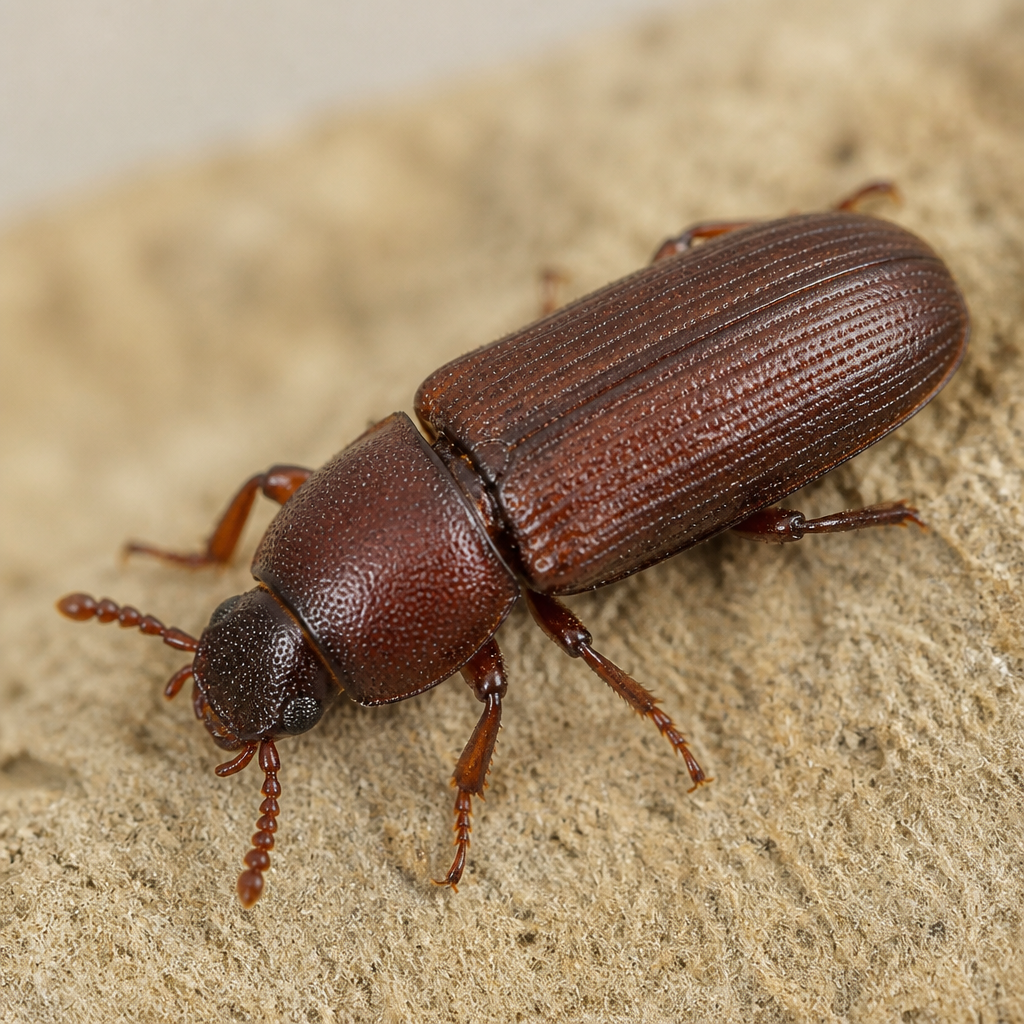
Stored Product Pest
Red Flour Beetle
Tribolium castaneum
Biology
The red flour beetle, *Tribolium castaneum*, belongs to the family Tenebrionidae and is a small, reddish-brown coleopteran, typically measuring 2.3–4.4 mm in length. Its antennae are distinctly clubbed, ending in a three-segmented club, a key differentiator from the confused flour beetle (*T. confusum*) which has a four-segmented club that gradually thickens. Optimal development occurs at 30–35°C and 70–90% relative humidity, with the egg-to-adult lifecycle completing in a brisk 20–30 days under these conditions, though extending significantly at lower temperatures. A single female can oviposit 200–400 eggs over her lifetime, laying 2–10 small, oval, sticky white eggs daily; adults can live for over a year, with a maximum recorded longevity of around two years, ensuring continuous population growth. Eggs hatch into slender, whitish larvae with a bifurcated posterior end, molting 5–12 times before pupating.
Behaviour
Red flour beetles are primarily nocturnal, though activity is observed during daylight, and they exhibit strong positive phototaxis to dim light, but avoidance of bright light. Dispersal occurs readily through flight, facilitating rapid colonization of new food sources, and passive transport within infested commodities. Communication heavily relies on aggregation pheromones, specifically (Z)-3-methyl-2-hexenoic acid, which attracts both sexes to food sources and potential mates, leading to dense infestations in localized areas. They are secondary feeders, incapable of damaging whole, intact grains, hence they target cracked kernels, flour, meal, and processed cereal products. When threatened or disturbed, adults release pungent quinone compounds from abdominal glands, acting as a defensive mechanism and causing a distinct, acrid odor and pinkish discoloration in heavily contaminated products, rendering them unpalatable and often allergenic to humans.
Habits
These ubiquitous stored product pests prefer dark, undisturbed harborage within the commodity itself, commonly found deep within flour bags, cereal boxes, grain bins, and machinery where flour dust accumulates. Foraging patterns are generally confined to the immediate vicinity of their food source, with continuous feeding by both larval and adult stages, leading to extensive contamination, not just consumption. Seasonal movements are indistinct in indoor, climate-controlled environments; however, in unheated structures, populations might decline in winter and resurge in warmer months. Conducive conditions for infestation include poor sanitation, spills of food products, inaccessible cracks and crevices in food processing equipment, and prolonged storage of susceptible commodities. Technicians should look for 'floury' dust accumulations, active larval and adult stages, and the characteristic pinkish hue and sour, pungent odor indicative of heavy quinone contamination in infested materials.
Control methods
- 1Discard infested product; vacuum shelves and seams
- 2Pheromone-baited monitor traps in pantries
- 3Store grains in glass/metal sealed containers
- 4Rotate stock; freeze new flour 4 days as prevention
- 5Crack-and-crevice residual in storage areas
- 6Maintain humidity <50% and temperatures <21°C
Tailored to Red Flour Beetle
IPM Procedure Checklist
Inspection
- Inspect grain, spices, pet food and dry goods for larvae and webbing
- Deploy pheromone monitors near storage and shelving
- Check spillage in seams, cracks and shelf liners
Identification
- Confirm Red Flour Beetle (Tribolium castaneum) — not a look-alike
- Note life stage and risk level: Moderate
- Capture clear photos and samples for the record
Action Thresholds
- Trigger action when monitor counts trend up
- Re-evaluate weekly during active season
- Document trigger criteria in the IPM plan
Prevention
- Rotate stock FIFO; reject damaged packaging at receiving
- Store products in airtight containers
- Maintain low humidity and clean storage surfaces
Control Methods
- Discard infested product; vacuum shelves and seams
- Pheromone-baited monitor traps in pantries
- Store grains in glass/metal sealed containers
- Rotate stock; freeze new flour 4 days as prevention
Monitoring & Evaluation
- Service monitors on schedule and trend captures
- Re-inspect for Red Flour Beetle activity at follow-up
- Adjust tactics based on data; report findings to client