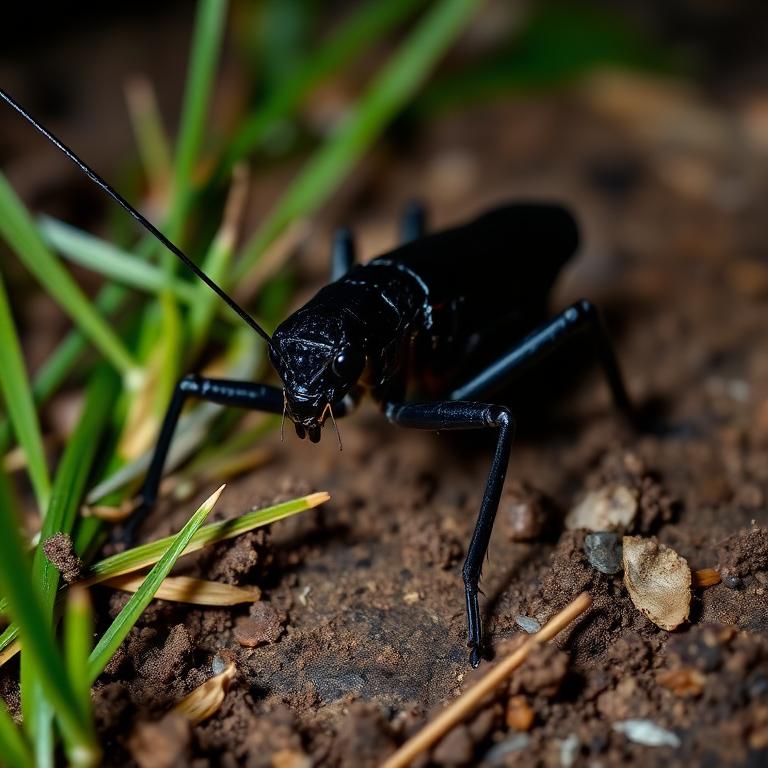
Occasional Invader
Field Cricket
Gryllus pennsylvanicus
Biology
Field crickets (Gryllidae) are robust, glossy black to dark brown insects 15–25 mm long with long filiform antennae, two prominent abdominal cerci, and — in females — a needle-like ovipositor up to 20 mm. Males possess a stridulatory file on the forewing used to produce the familiar chirp; call rate rises with temperature. Development is hemimetabolous through 8–10 nymphal instars. In most temperate regions the fall field cricket overwinters as eggs deposited singly in moist soil, hatching in spring, with adults appearing from midsummer through the first hard frost — typically one generation per year. Females may lay 150–400 eggs.
Behaviour
Crickets are nocturnal and strongly positively phototactic, which is why they mass around porch lights, illuminated signage, and loading-dock lamps before slipping indoors. Males call to attract females and defend small territories, sometimes fighting. Feeding is omnivorous and opportunistic: seeds, seedlings, decaying plant matter, dead and live insects, and, indoors, cotton, linen, wool, silk, rubber, leather, and paper — chewing damage often appears as irregular surface grazing rather than clean holes. They do not reproduce successfully indoors in most structures, so interior populations reflect ongoing exterior entry rather than an established colony.
Habits
Outdoors they harbor under stones, boards, mulch, thick turf, and debris, and in cracks in soil and pavement. Structural invasion peaks in late summer and early autumn, especially the first cool nights after a dry spell, when large numbers move toward warm, lit buildings. Entry points are gaps under overhead and pedestrian doors, weep holes, unscreened vents, garage thresholds, and utility penetrations. Conducive conditions include bright mercury-vapour or white exterior lighting, dense ground cover and mulch beds against the wall, and stored materials on the ground beside the building. Signs include audible chirping in wall voids and basements, chewed fabric or paper in storage, dark fecal pellets, and specimens on glueboards near doors.
Control methods
- 1Switch exterior lighting to sodium or warm LED and move fixtures off the wall
- 2Install tight door sweeps and seal thresholds, weep holes and vents
- 3Remove debris, boards and heavy mulch within 600 mm of the foundation
- 4Mow and thin dense turf and ground cover along the building line
- 5Glueboard monitors inside doorways, basements and storage rooms
- 6Perimeter residual or granular band during late-summer migration
Tailored to Field Cricket
IPM Procedure Checklist
Inspection
- Inspect exterior perimeter for entry pathways
- Note moisture, mulch and ground-cover near foundation
- Identify aggregation sites on warm walls
Identification
- Confirm Field Cricket (Gryllus pennsylvanicus) — not a look-alike
- Note life stage and risk level: Low
- Capture clear photos and samples for the record
Action Thresholds
- Tolerate low-level activity outside sensitive zones
- Act if activity moves indoors or near food
- Review threshold seasonally with the client
Prevention
- Seal foundation cracks, weep holes and utility penetrations
- Pull mulch and vegetation back from the structure
- Improve drainage and reduce exterior moisture
Control Methods
- Switch exterior lighting to sodium or warm LED and move fixtures off the wall
- Install tight door sweeps and seal thresholds, weep holes and vents
- Remove debris, boards and heavy mulch within 600 mm of the foundation
- Mow and thin dense turf and ground cover along the building line
Monitoring & Evaluation
- Service monitors on schedule and trend captures
- Re-inspect for Field Cricket activity at follow-up
- Adjust tactics based on data; report findings to client