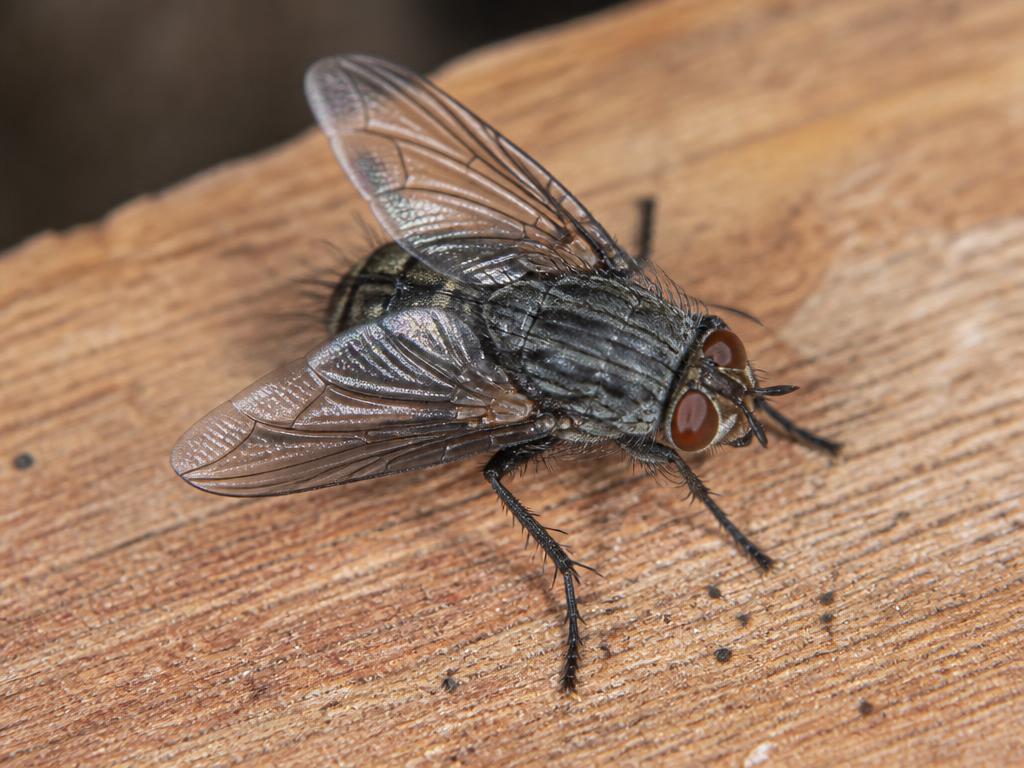
Fly
False Stable Fly
Muscina stabulans
Biology
Muscina stabulans (family Muscidae) is a stout grey-black fly, 7-9 mm long, resembling a large house fly but distinguished by four dark thoracic stripes and an orange-yellow tip to the scutellum and palps. Females lay 140-200 eggs on decaying vegetable matter, manure, carrion, or garbage. Larvae are cream-colored maggots that begin as saprophages and become facultative predators in later instars, attacking other fly larvae in the same substrate. Development takes 15-25 days, longer than house fly, and the species overwinters as pupae or as adults in sheltered structures.
Behaviour
Adults are non-biting sponging feeders attracted to sweets, decaying produce, feces, and carrion, and readily alight on human food, making them mechanical vectors of enteric bacteria and helminth eggs. They are less strongly synanthropic than the house fly but frequently enter homes in cool weather and are often the large 'house fly' seen indoors in autumn and early spring. Larvae are agents of accidental intestinal and urogenital myiasis when eggs or larvae are ingested with contaminated food. The predatory later instars can suppress co-occurring house fly larvae in the same medium.
Habits
Breeding sites include poultry and swine manure, compost heaps, spoiled fruit and vegetable waste, garbage bins, and carrion. Adults rest on walls, ceilings, fences, and vegetation near breeding sources and shelter indoors during temperature extremes. Conducive conditions include poor refuse management, uncovered compost, spilled feed, damp organic accumulations, and inadequate exclusion around doors and windows in autumn.
Control methods
- 1Remove and manage decaying produce, manure, and refuse.
- 2Keep garbage containers lined, sealed, and regularly cleaned.
- 3Turn and properly maintain compost to eliminate larval habitat.
- 4Screen doors and windows and repair worn door sweeps.
- 5Use light traps and sticky traps for interior adult capture.
- 6Apply residual treatments to exterior resting surfaces where warranted.
Tailored to False Stable Fly
IPM Procedure Checklist
Inspection
- Locate breeding sites: drains, decaying matter, moist organics
- Use tape-over-drain tests and UV/light traps to confirm
- Map dumpster, grease and floor-drain hot-spots
Identification
- Confirm False Stable Fly (Muscina stabulans) — not a look-alike
- Note life stage and risk level: Moderate
- Capture clear photos and samples for the record
Action Thresholds
- Trigger action when monitor counts trend up
- Re-evaluate weekly during active season
- Document trigger criteria in the IPM plan
Prevention
- Clean drains with enzymatic foam to remove biofilm
- Manage trash, recycling and grease daily
- Screen windows, doors and air curtains at entries
Control Methods
- Remove and manage decaying produce, manure, and refuse.
- Keep garbage containers lined, sealed, and regularly cleaned.
- Turn and properly maintain compost to eliminate larval habitat.
- Screen doors and windows and repair worn door sweeps.
Monitoring & Evaluation
- Service monitors on schedule and trend captures
- Re-inspect for False Stable Fly activity at follow-up
- Adjust tactics based on data; report findings to client