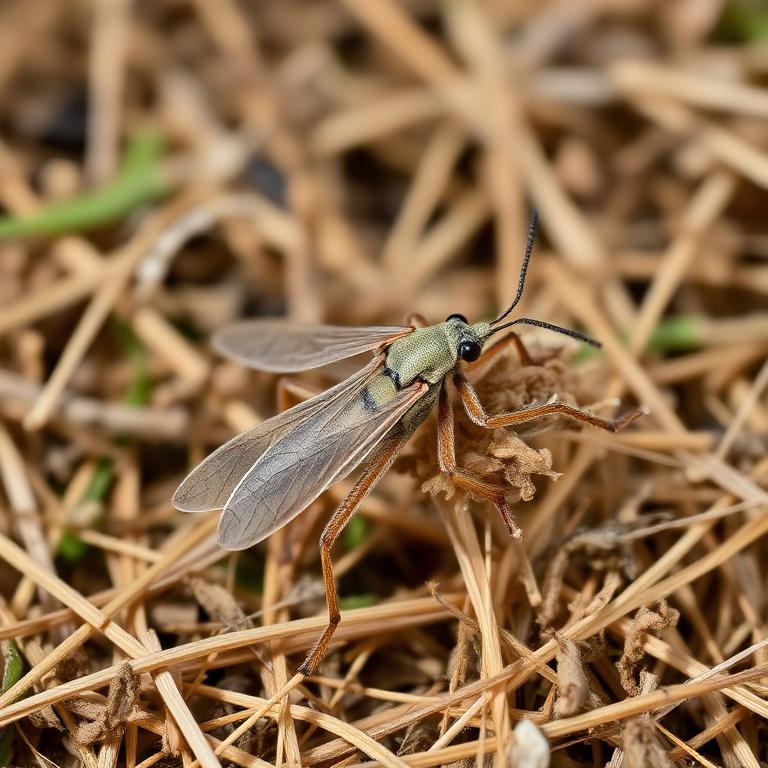
Occasional Invader
False Chinch Bug
Nysius raphanus
Biology
False chinch bugs (Lygaeidae) are slender greyish-brown seed bugs 3–4 mm long with pale, partly translucent forewings; nymphs are smaller with a reddish-brown abdomen. Females lay eggs in soil cracks and on host plants, and development through five instars takes roughly three to four weeks in warm weather, giving three to seven generations per year in hot, arid regions. Populations build explosively on mustards, London rocket, shepherd's purse, Russian thistle, and other weedy hosts, then collapse and migrate en masse when those hosts dry down.
Behaviour
They are day-active and intensely gregarious, moving as dense crawling and short-flying swarms — thousands of individuals can cover a wall, driveway, or patio within hours. Feeding is with piercing-sucking mouthparts on seeds and plant sap; they do not bite people, sting, or transmit disease, and they cannot breed or feed indoors. Damage significance is agricultural and horticultural: mass feeding can wilt seedlings, turf edges, and young ornamentals almost overnight. Indoors the problem is volume, dead-insect accumulation, and the mild odour of crushed bugs.
Habits
Migration is triggered by weed hosts drying — typically late spring and again after summer rain flushes in arid and semi-arid regions. Swarms move downwind and uphill into whatever they meet, entering through door thresholds, weep holes, window tracks, vents, and utility penetrations, and concentrating on sun-warmed light-coloured walls. Conducive conditions are weedy fallow ground, ditch banks or vacant lots adjacent to the property, and unsealed thresholds. Technicians should inspect adjacent weed stands in spring, watch for sudden dense bands on exterior walls and paving, and check window tracks and door sweeps for accumulations of live and dead bugs.
Control methods
- 1Mow or remove mustard-family weeds and volunteer hosts before they dry
- 2Seal door thresholds, weep holes, window tracks and utility gaps
- 3Apply a perimeter residual barrier at the first sign of migration
- 4Hose or sweep swarms off walls and paving rather than crushing
- 5Vacuum interior bugs and dispose of the bag outdoors
- 6Irrigate and maintain turf edges to reduce feeding stress damage
Tailored to False Chinch Bug
IPM Procedure Checklist
Inspection
- Inspect exterior perimeter for entry pathways
- Note moisture, mulch and ground-cover near foundation
- Identify aggregation sites on warm walls
Identification
- Confirm False Chinch Bug (Nysius raphanus) — not a look-alike
- Note life stage and risk level: Low
- Capture clear photos and samples for the record
Action Thresholds
- Tolerate low-level activity outside sensitive zones
- Act if activity moves indoors or near food
- Review threshold seasonally with the client
Prevention
- Seal foundation cracks, weep holes and utility penetrations
- Pull mulch and vegetation back from the structure
- Improve drainage and reduce exterior moisture
Control Methods
- Mow or remove mustard-family weeds and volunteer hosts before they dry
- Seal door thresholds, weep holes, window tracks and utility gaps
- Apply a perimeter residual barrier at the first sign of migration
- Hose or sweep swarms off walls and paving rather than crushing
Monitoring & Evaluation
- Service monitors on schedule and trend captures
- Re-inspect for False Chinch Bug activity at follow-up
- Adjust tactics based on data; report findings to client