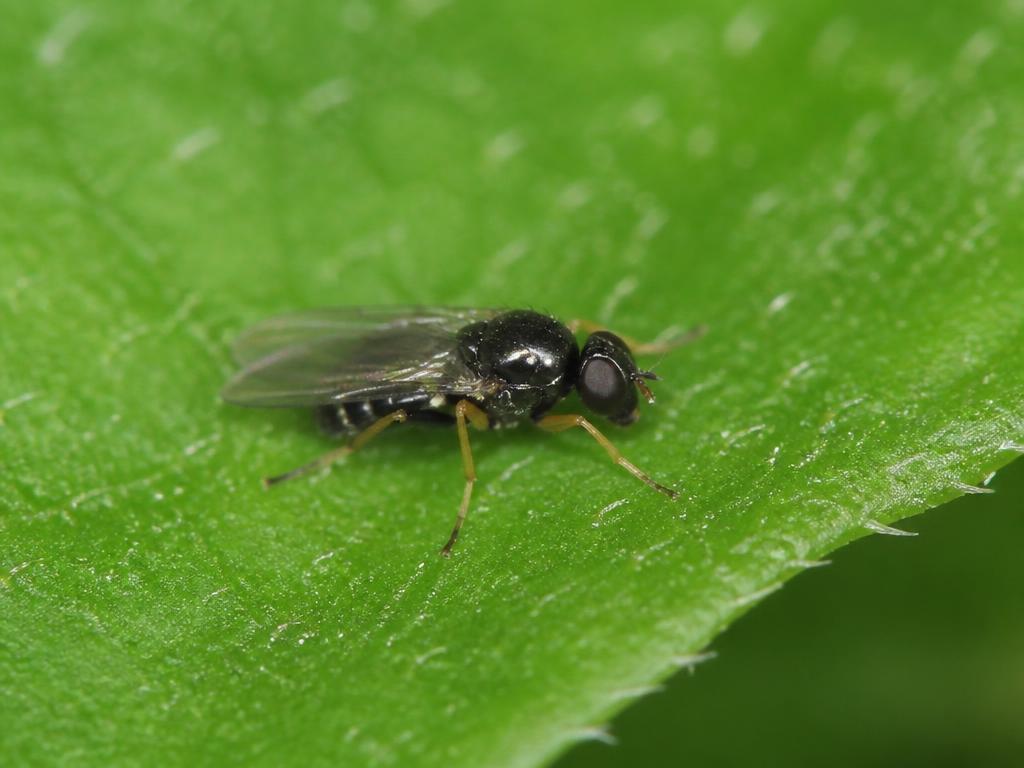
Fly
Eye Gnat
Liohippelates pusio
Biology
Liohippelates pusio (family Chloropidae) is a minute, shiny black fly measuring only 1.5-2.5 mm, with yellowish to tan legs and clear wings held flat over the abdomen. Females deposit eggs singly or in small clusters in loose, sandy, organically enriched soil, particularly freshly cultivated ground. Larvae are small, cream-colored maggots that feed on decaying organic matter and soil microorganisms, completing three instars in 7-11 days. Pupation occurs in the top few centimeters of soil, and the total egg-to-adult cycle can be completed in as little as 12-21 days at 27-30°C, producing overlapping generations throughout the warm season.
Behaviour
Eye gnats are non-biting but persistently attracted to mucous secretions of the eyes, nose, and mouth, as well as to sebum, sweat, blood, and pus from open wounds. They hover and repeatedly land on the face and exposed skin, using sponging mouthparts equipped with rasping spines that can abrade tissue. This behavior makes them efficient mechanical vectors of bacterial conjunctivitis (pinkeye), acute hemorrhagic conjunctivitis, bovine mastitis pathogens, and yaws. They are day-active, most abundant in the hours after sunrise and before sunset, and generally disperse within a few hundred meters of larval habitat, though wind can carry them farther.
Habits
Populations explode where sandy, loamy, or freshly tilled soils are combined with organic amendments — agricultural fields, turf farms, golf courses, orchards, and newly landscaped residential developments. Adults rest on low vegetation, grasses, and shaded ground during the hottest part of the day. Conducive conditions include soil disturbance, irrigation, manure or compost incorporation, and warm humid weather. Areas with heavy clay or permanently compacted soils rarely support significant populations.
Control methods
- 1Reduce soil disturbance and stabilize bare ground with dense turf.
- 2Manage irrigation to avoid persistently damp organic-rich soils.
- 3Deploy attractant-baited eye gnat traps around use areas.
- 4Apply approved soil larvicides or entomopathogenic nematodes to breeding ground.
- 5Use repellents and protective eyewear for outdoor workers.
- 6Time high-exposure outdoor activity outside peak morning/evening flights.
Tailored to Eye Gnat
IPM Procedure Checklist
Inspection
- Locate breeding sites: drains, decaying matter, moist organics
- Use tape-over-drain tests and UV/light traps to confirm
- Map dumpster, grease and floor-drain hot-spots
Identification
- Confirm Eye Gnat (Liohippelates pusio) — not a look-alike
- Note life stage and risk level: Moderate
- Capture clear photos and samples for the record
Action Thresholds
- Trigger action when monitor counts trend up
- Re-evaluate weekly during active season
- Document trigger criteria in the IPM plan
Prevention
- Clean drains with enzymatic foam to remove biofilm
- Manage trash, recycling and grease daily
- Screen windows, doors and air curtains at entries
Control Methods
- Reduce soil disturbance and stabilize bare ground with dense turf.
- Manage irrigation to avoid persistently damp organic-rich soils.
- Deploy attractant-baited eye gnat traps around use areas.
- Apply approved soil larvicides or entomopathogenic nematodes to breeding ground.
Monitoring & Evaluation
- Service monitors on schedule and trend captures
- Re-inspect for Eye Gnat activity at follow-up
- Adjust tactics based on data; report findings to client