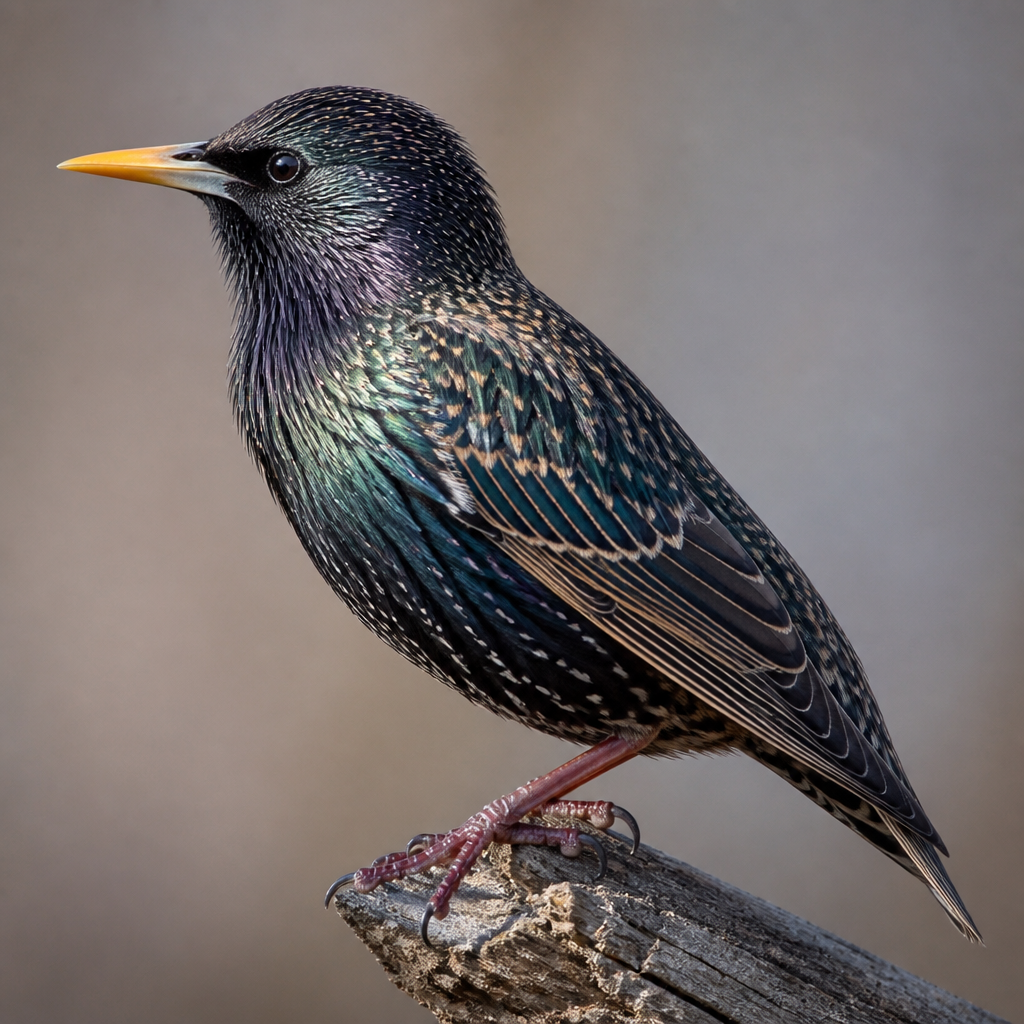
Bird
European Starling
Sturnus vulgaris
Biology
The European starling, *Sturnus vulgaris*, is a medium-sized passerine, typically weighing 75–90g with a length of 19–23 cm and a wingspan of 31–44 cm. Its plumage transitions from an iridescent oily black with prominent white speckles in winter to a less-spotted, glossy black during breeding season, complemented by a distinctive yellow bill in spring and summer that darkens to black in autumn and winter. Sexual dimorphism is subtle, with males often having slightly longer, less pointed throat feathers and a bluish bill base, while females exhibit reddish bill bases. These birds typically live 2–3 years but can reach 15 years in captivity, completing two broods of 4–6 sky-blue eggs per season after an 11–13 day incubation period, with young fledging in 20–22 days. They are highly adaptable to temperate climates.
Behaviour
Starlings exhibit complex social structures, forming massive, highly coordinated flocks known as murmurations during non-breeding seasons, sometimes numbering in the hundreds of thousands to over a million individuals, primarily for predator evasion and information exchange. They are aggressive and territorial, especially concerning nesting sites, and actively evict or destroy the eggs and young of native cavity-nesting species such as bluebirds, flickers, and woodpeckers, significantly impacting local avian biodiversity. Their omnivorous diet includes a wide range of invertebrates like grasshoppers, beetles, and caterpillars, as well as fruits, seeds, and grains, making them significant agricultural pests. During foraging, they employ a distinctive “open-billed probing” technique to locate subsurface insects. Their vocalizations are varied, including whistles, clicks, and mimicry of other bird calls and even human speech.
Habits
European starlings preferentially harbor in natural tree cavities, abandoned woodpecker holes, and increasingly, in anthropogenic structures such as soffits, attics, vents, and wall voids, which provide protection from predators and adverse weather. Their foraging range is typically within a few miles of roosting or nesting sites, though they can travel farther for preferred food sources, often concentrating in agricultural fields, orchards, and urban parks. Conducive conditions for infestation around structures include unsealed openings, particularly those leading to enclosed overhead spaces, and an abundance of accessible food waste or cultivated soft fruits. Technicians should look for accumulations of whitewash (droppings) on structures below roosting or nesting sites, dislodged insulation from nest-building attempts within vents, and the presence of coarse, messy nests constructed from grass, twigs, and feathers. Roosts are often established in dense canopy trees, communication towers, and building ledges.
Control methods
- 1Exclude cavities with 2 cm hardware cloth before nesting
- 2Reduce roost trees with selective pruning and netting
- 3Sonic and visual scare devices rotated weekly
- 4Bird netting over fruit trees and vineyards
- 5Remove standing water and accessible feed
- 6Trap with Australian crow traps for large infestations
Tailored to European Starling
IPM Procedure Checklist
Inspection
- Identify roosting, loafing and nesting sites
- Document droppings, feathers and damage to structure
- Note food and water sources attracting birds
Identification
- Confirm European Starling (Sturnus vulgaris) — not a look-alike
- Note life stage and risk level: Moderate
- Capture clear photos and samples for the record
Action Thresholds
- Trigger action when monitor counts trend up
- Re-evaluate weekly during active season
- Document trigger criteria in the IPM plan
Prevention
- Install spikes, netting or shock track on ledges
- Remove standing water and accessible food
- Close openings to attics, vents and signage voids
Control Methods
- Exclude cavities with 2 cm hardware cloth before nesting
- Reduce roost trees with selective pruning and netting
- Sonic and visual scare devices rotated weekly
- Bird netting over fruit trees and vineyards
Monitoring & Evaluation
- Service monitors on schedule and trend captures
- Re-inspect for European Starling activity at follow-up
- Adjust tactics based on data; report findings to client