Occasional Invader
Elm Leaf Beetle
Xanthogaleruca luteola
Biology
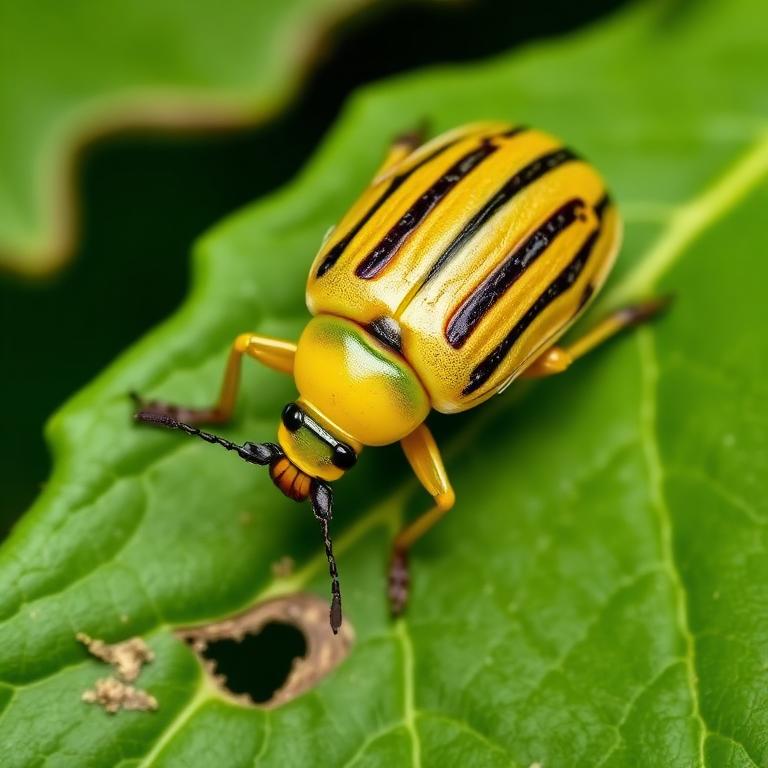
The elm leaf beetle (Chrysomelidae) is a 6–8 mm oblong beetle, yellowish-green to olive with a black longitudinal stripe along each elytral margin and three dark spots on the pronotum; overwintering adults fade to a dull olive-brown. Females lay yellow-orange eggs in double rows of 5–25 on the underside of elm leaves, laying several hundred over a season. Larvae are black-striped, yellowish, grub-like, and feed for 2–3 weeks through three instars before pupating in bark crevices or at the tree base. One to three generations occur per year depending on climate, with adults overwintering in sheltered, dry sites — very often inside buildings.
Behaviour
Adults are diurnal and fly readily on warm days, dispersing between elm hosts. Larvae skeletonise leaves, feeding on the lower surface and leaving the veins and upper epidermis intact, giving the characteristic lacy bronzed canopy; adults chew clean shot-holes straight through the blade. Repeated defoliation stresses elms and predisposes them to bark beetle attack and Dutch elm disease. Indoors the beetles neither bite, feed, nor breed — they are a pure nuisance and staining problem, aggregating in wall voids, attics, and window channels, then reappearing at windows on warm winter afternoons and again during spring emergence.
Habits
Overwintering aggregations concentrate on the sunny south and west aspects of structures near American, Siberian, and Chinese elms, entering through gaps in siding, soffit and fascia joints, attic and gable vents, window frames, and behind shutters. Conducive conditions are mature elms within 30 m, unsealed cladding details, and unscreened attic vents. Technicians should inspect the canopy in early summer for skeletonised foliage and larvae, the base and lower trunk for pupae, and window sills, light fixtures, and attic corners for live and dead adults. Vacuumed carcasses in voids also become a food source for carpet beetles.
Control methods
- 1Seal siding gaps, soffit joints and window frames before late summer
- 2Screen attic, gable and soffit vents with fine mesh
- 3Vacuum interior beetles and remove carcasses from voids
- 4Time canopy treatment to early larval stage where the elm warrants it
- 5Trunk banding or basal treatment to intercept larvae moving to pupate
- 6Spot exterior residual on aggregation walls during autumn flight
Tailored to Elm Leaf Beetle
IPM Procedure Checklist
Inspection
- Inspect exterior perimeter for entry pathways
- Note moisture, mulch and ground-cover near foundation
- Identify aggregation sites on warm walls
Identification
- Confirm Elm Leaf Beetle (Xanthogaleruca luteola) — not a look-alike
- Note life stage and risk level: Low
- Capture clear photos and samples for the record
Action Thresholds
- Tolerate low-level activity outside sensitive zones
- Act if activity moves indoors or near food
- Review threshold seasonally with the client
Prevention
- Seal foundation cracks, weep holes and utility penetrations
- Pull mulch and vegetation back from the structure
- Improve drainage and reduce exterior moisture
Control Methods
- Seal siding gaps, soffit joints and window frames before late summer
- Screen attic, gable and soffit vents with fine mesh
- Vacuum interior beetles and remove carcasses from voids
- Time canopy treatment to early larval stage where the elm warrants it
Monitoring & Evaluation
- Service monitors on schedule and trend captures
- Re-inspect for Elm Leaf Beetle activity at follow-up
- Adjust tactics based on data; report findings to client