Fly
Drone Fly (Rat-tailed Maggot)
Eristalis tenax
Biology
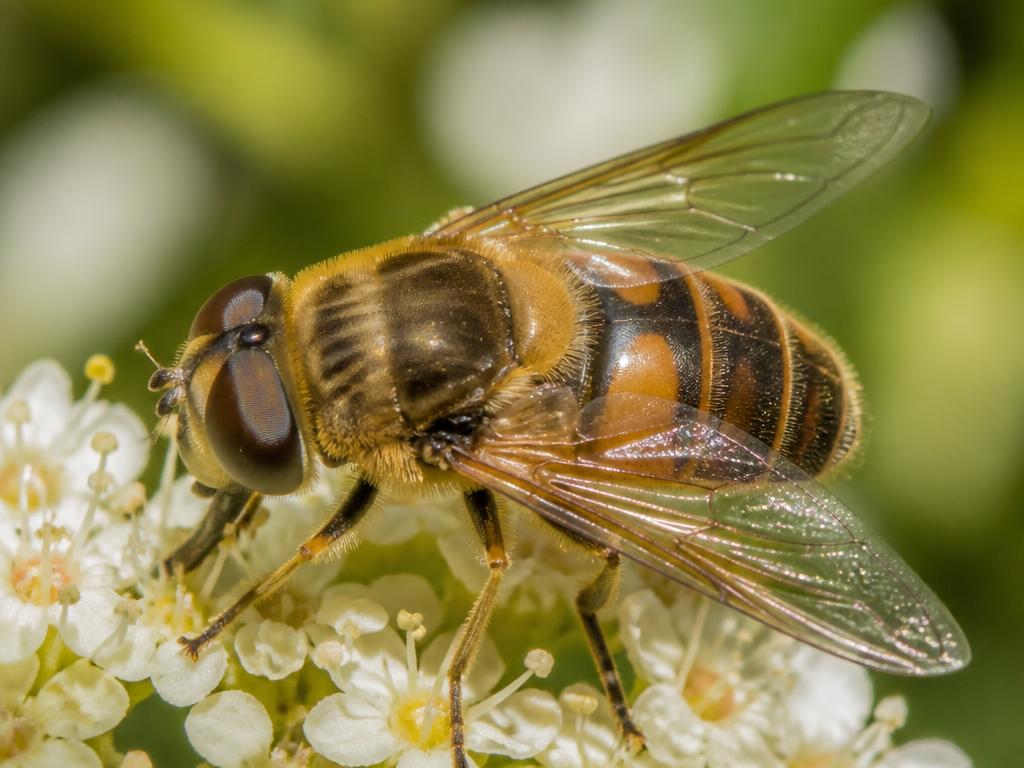
Eristalis tenax (family Syrphidae) is a 10-15 mm hover fly that closely mimics a honey bee drone, with a brown-and-orange banded abdomen, dense pile on the thorax, and large reddish compound eyes. Unlike bees it has one pair of wings, short antennae, and the characteristic syrphid false vein. Females lay eggs at the margin of foul, oxygen-poor water. Larvae are the well-known 'rat-tailed maggots': grey, sac-like larvae with a telescoping posterior breathing siphon up to three times body length, allowing them to feed in liquid organic sludge while breathing atmospheric air. Development takes roughly 3-5 weeks; adults overwinter in sheltered structures.
Behaviour
Adults are strong, hovering fliers and important pollinators, feeding on nectar and pollen at flowers; they are harmless and cannot sting, but their bee mimicry frequently triggers unnecessary control calls. In autumn adults enter buildings through eave gaps, attic vents, and window frames to overwinter, then become active on warm days and cluster at sunlit windows. Larvae thrive in septic-strength liquid: manure lagoons, clogged drains, sewage seepage, and stagnant tanks. Larval presence indoors is an important diagnostic clue pointing to a sanitary drain break or unsealed sewage source.
Habits
Harborage centers on any standing, highly organic water — livestock lagoons, silage runoff, blocked roof drains, neglected water features, and broken sewer lines beneath slabs. Adults harbor in attics, wall voids, and outbuildings during cool months. Conducive conditions include anaerobic sludge accumulation, poor drainage, leaking sanitary lines, and unscreened roof or eave openings. Populations are strongly seasonal, peaking in late summer and early autumn.
Control methods
- 1Locate and repair sanitary drain leaks or sewage seepage sources.
- 2Eliminate stagnant, sludge-laden standing water and clean catch basins.
- 3Screen attic, eave, and soffit vents to block overwintering entry.
- 4Seal exterior gaps around windows, fascia, and utility penetrations.
- 5Vacuum overwintering adults rather than spraying interiors.
- 6Correct grading and drainage to prevent anaerobic pooling.
Tailored to Drone Fly (Rat-tailed Maggot)
IPM Procedure Checklist
Inspection
- Locate breeding sites: drains, decaying matter, moist organics
- Use tape-over-drain tests and UV/light traps to confirm
- Map dumpster, grease and floor-drain hot-spots
Identification
- Confirm Drone Fly (Rat-tailed Maggot) (Eristalis tenax) — not a look-alike
- Note life stage and risk level: Low
- Capture clear photos and samples for the record
Action Thresholds
- Tolerate low-level activity outside sensitive zones
- Act if activity moves indoors or near food
- Review threshold seasonally with the client
Prevention
- Clean drains with enzymatic foam to remove biofilm
- Manage trash, recycling and grease daily
- Screen windows, doors and air curtains at entries
Control Methods
- Locate and repair sanitary drain leaks or sewage seepage sources.
- Eliminate stagnant, sludge-laden standing water and clean catch basins.
- Screen attic, eave, and soffit vents to block overwintering entry.
- Seal exterior gaps around windows, fascia, and utility penetrations.
Monitoring & Evaluation
- Service monitors on schedule and trend captures
- Re-inspect for Drone Fly (Rat-tailed Maggot) activity at follow-up
- Adjust tactics based on data; report findings to client