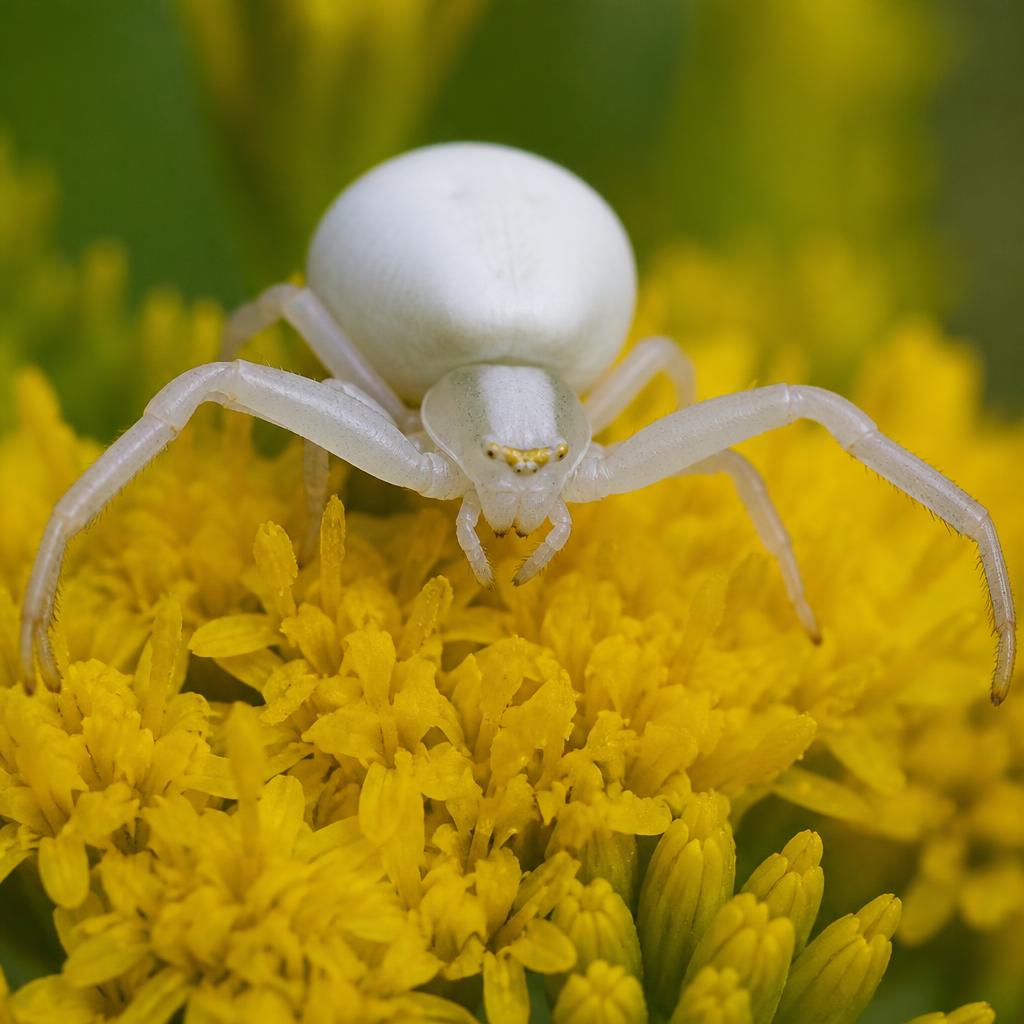
Spider
Goldenrod Crab Spider
Misumena vatia
Biology
Misumena vatia is a thomisid crab spider: females 6–11 mm with a squat, crab-like body and greatly elongated, laterally held front two leg pairs; males are 3–4 mm and dark-legged. Females can reversibly change between white and yellow over several days to match the flower they occupy, adding crimson lateral streaks in some individuals. Eggs are laid in a folded-leaf silk nest of 40–200, guarded until the female dies in autumn, with one generation per year and juveniles overwintering in leaf litter.
Behaviour
Crab spiders spin no capture web and instead sit motionless on a bloom with front legs held open, grabbing visiting bees, hoverflies and butterflies far larger than themselves and immobilising them with a fast-acting venom delivered through small fangs. They walk sideways and backwards like crabs and rely wholly on crypsis, freezing or dropping when approached. They are harmless to people — the fangs rarely penetrate skin and there is no medical significance — and are best regarded as an incidental garden species rather than a structural pest.
Habits
Look for them on open, pale or yellow flower heads in gardens, meadows and cut-flower plantings, and occasionally on white siding, window frames and painted trim next to blooms. They enter buildings only accidentally on cut flowers or produce and cannot establish indoors. Signs are a still, pale spider tucked into a bloom, often with a dead bee held beneath it. Conducive conditions are heavy flowering landscaping and cut-flower handling near entries.
Control methods
- 1Shake cut flowers outdoors before bringing them inside
- 2Live-capture and release accidental indoor specimens
- 3No structural treatment required — incidental species
- 4Keep flowering beds trimmed back from doorways
- 5Inspect nursery plants and produce at delivery
- 6Leave garden populations intact as pollinator-zone predators
Tailored to Goldenrod Crab Spider
IPM Procedure Checklist
Inspection
- Inspect undisturbed corners, voids and stored items
- Identify webs, egg sacs and prey debris
- Note conducive insect prey populations
Identification
- Confirm Goldenrod Crab Spider (Misumena vatia) — not a look-alike
- Note life stage and risk level: Low
- Capture clear photos and samples for the record
Action Thresholds
- Tolerate low-level activity outside sensitive zones
- Act if activity moves indoors or near food
- Review threshold seasonally with the client
Prevention
- Reduce clutter and seal cracks around the structure
- Switch exterior lights to yellow / sodium to reduce prey
- Install door sweeps and screen vents
Control Methods
- Shake cut flowers outdoors before bringing them inside
- Live-capture and release accidental indoor specimens
- No structural treatment required — incidental species
- Keep flowering beds trimmed back from doorways
Monitoring & Evaluation
- Service monitors on schedule and trend captures
- Re-inspect for Goldenrod Crab Spider activity at follow-up
- Adjust tactics based on data; report findings to client