Stored Product Pest
Confused Flour Beetle
Tribolium confusum
Biology
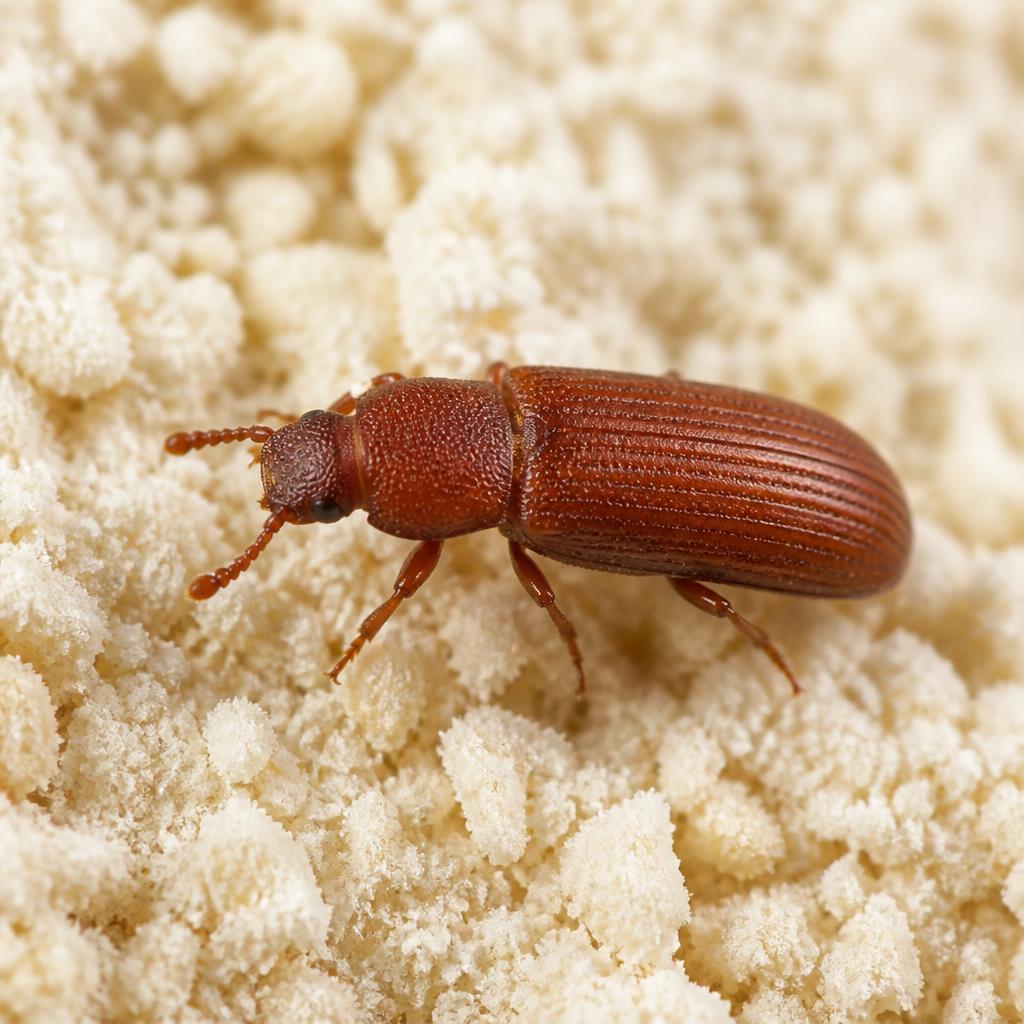
The confused flour beetle, *Tribolium confusum* (order Coleoptera, family Tenebrionidae), is a small, ovate, and flattened beetle, typically measuring 3.5-4.5 mm in length, with a uniform reddish-brown coloration. Its antennae gradually broaden toward the tip, and unlike its close relative *T. castaneum*, it lacks a distinct antennal club. The life cycle comprises egg, 4-7 larval instars, pupa, and adult stages, completed in 20-90 days depending on environmental conditions; ideal temperatures are 30-35°C with 70-90% relative humidity. Females lay 2-3 eggs per day, up to 500 eggs over their lifespan, cementing them to food particles. Adults can live for 1-3 years, a remarkable longevity for an insect of its size, and are highly tolerant of dry conditions.
Behaviour
This species exhibits a nocturnal activity pattern, primarily foraging and reproducing in darkness. While it possesses fully developed wings, *T. confusum* is flightless, relying on crawling and passive transport for dispersal, which limits its natural spread but facilitates human-aided distribution. Communication within the species involves aggregated pheromones that attract both sexes to suitable food sources and oviposition sites. Its feeding ecology centers on processed grain products — flours, meals, cereals, and pet foods — as it lacks the mandibles to penetrate intact whole grains. The beetles secrete benzoquinone compounds from specialized glands, which serve as a defense mechanism against predators and microbes but impart a pungent, acrid odor and pinkish discoloration to infested products, rendering them unpalatable and commercially worthless.
Habits
Confused flour beetles prefer harborage within the bulk of finely ground grain products or within tight crevices and cracks in food processing and storage equipment, silos, and pantry shelves, seeking protection from disturbance and desiccation. They establish localized infestations, burrowing indiscriminately throughout the available substrate. Foraging patterns are typically localized to the immediate vicinity of their harborage and food source, with limited long-distance movement. Infestations are often exacerbated by poor sanitation, allowing accumulation of spilled product and food debris. Key signs for technicians include the presence of live or dead beetles, shed larval skins, pupae, and a characteristic reddish-brown 'flour' that is actually fecal matter and metabolic waste. A tell-tale sign of a severe infestation is the pinkish tinge and pungent odor of heavily contaminated flour.
Control methods
- 1Pheromone traps in storage areas
- 2Discard contaminated flour; clean bins thoroughly
- 3Rotate stock — first in, first out
- 4Vacuum shelf seams and cracks
- 5Store flour in sealed glass or metal
- 6Heat treat (50°C/24h) infested mill rooms
Tailored to Confused Flour Beetle
IPM Procedure Checklist
Inspection
- Inspect grain, spices, pet food and dry goods for larvae and webbing
- Deploy pheromone monitors near storage and shelving
- Check spillage in seams, cracks and shelf liners
Identification
- Confirm Confused Flour Beetle (Tribolium confusum) — not a look-alike
- Note life stage and risk level: Moderate
- Capture clear photos and samples for the record
Action Thresholds
- Trigger action when monitor counts trend up
- Re-evaluate weekly during active season
- Document trigger criteria in the IPM plan
Prevention
- Rotate stock FIFO; reject damaged packaging at receiving
- Store products in airtight containers
- Maintain low humidity and clean storage surfaces
Control Methods
- Pheromone traps in storage areas
- Discard contaminated flour; clean bins thoroughly
- Rotate stock — first in, first out
- Vacuum shelf seams and cracks
Monitoring & Evaluation
- Service monitors on schedule and trend captures
- Re-inspect for Confused Flour Beetle activity at follow-up
- Adjust tactics based on data; report findings to client