Spider
Common House Spider
Parasteatoda tepidariorum
Biology
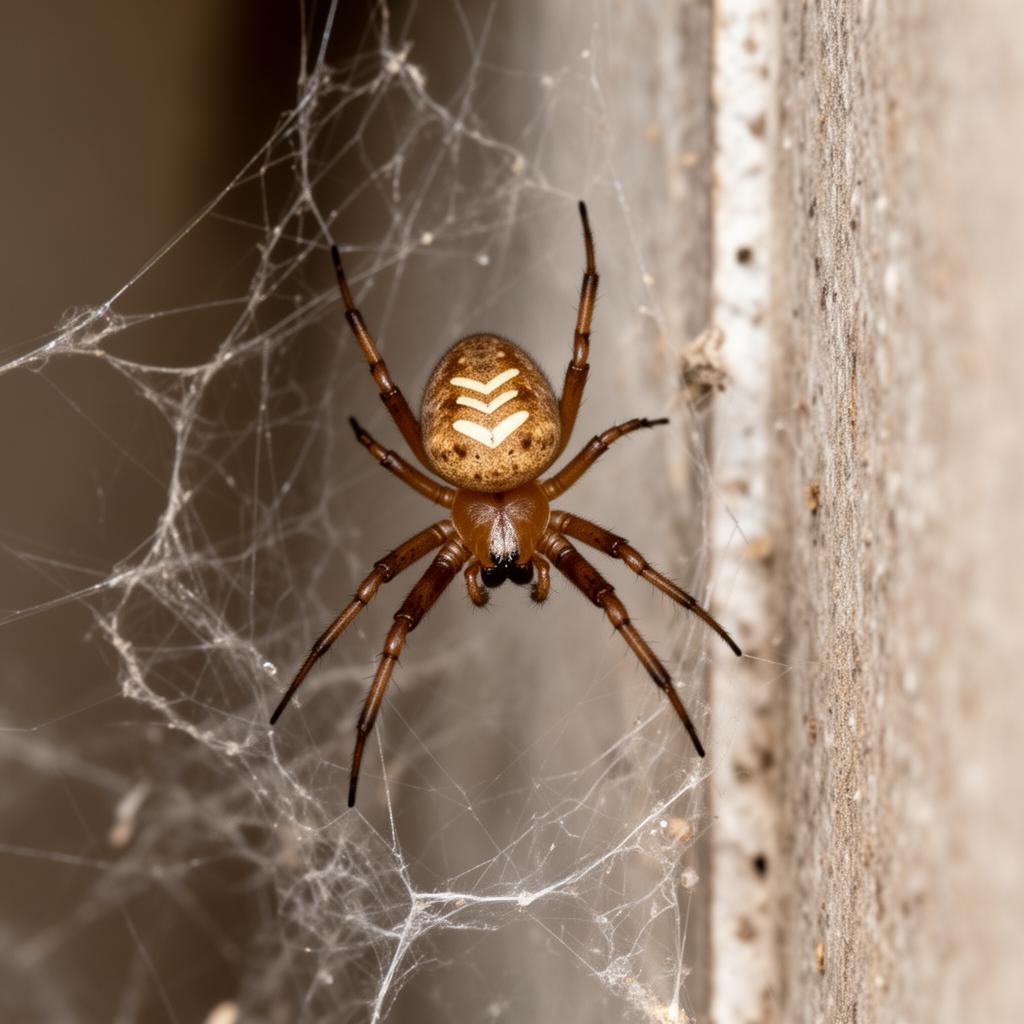
Parasteatoda tepidariorum, commonly known as the common house spider, belongs to the family Theridiidae, true cobweb weavers. Adults measure 4–8 mm in body length, typically exhibiting mottled brown, grey, or black colorations on a distinctly globose abdomen, often with a subtle white or yellowish chevron pattern. Its lifecycle comprises egg, multiple instars (spiderlings), and adult stages, with females producing up to 17 spherical egg sacs over their 12–24 month lifespan, each containing 100–400 eggs, often suspended within the web. Development from egg to adult takes approximately 3–4 months under optimal indoor conditions (20–25°C, 60–80% RH), with males generally being smaller and having shorter lifespans. Distinguishing features include proportionally long, slender legs, the lack of a strong carapace, and the characteristic messy, three-dimensional cobweb.
Behaviour
This species exhibits primarily nocturnal activity, constructing and maintaining its irregular, tangled three-dimensional cobwebs in undisturbed areas. Individual spiders are solitary, with no complex social structures, and communicate primarily through tactile cues on the web and potentially through contact pheromones during mating. Their feeding ecology is generalist and opportunistic, encompassing a wide range of crawling and flying insects such as flies, mosquitoes, ants, and even other spiders, captured by entanglement in the non-sticky portions of their web followed by venom injection. While capable of biting, P. tepidariorum is non-aggressive; bites to humans are rare, usually occurring only when the spider is severely provoked or accidentally pressed against skin, delivering a venom that causes only localized, mild irritation akin to a bee sting, posing no significant public health risk.
Habits
Common house spiders prefer harborage in dark, secluded, and undisturbed locations, particularly structural corners, eaves, window frames, storage areas, garages, basements, and crawl spaces, both indoors and in sheltered outdoor areas. They exhibit a sit-and-wait foraging strategy, remaining largely sedentary within their webs, monitoring for vibrations indicating entangled prey. Seasonal movements are minimal, as they are typically synanthropic, thriving year-round in human structures where stable temperatures and humidity are maintained. Conducive conditions for heavy infestations include cluttered environments, abundant insect prey populations, and structural integrity issues providing ample entry points and harborage. Signs of infestation include the characteristic irregular, silken cobwebs, often containing insect cadavers and sometimes desiccated spider molts, primarily observed in low-traffic, undisturbed zones.
Control methods
- 1Vacuum webs, egg sacs and spiders weekly
- 2Reduce indoor insect prey (lights, flies, gnats)
- 3Switch exterior bulbs to yellow / sodium to cut prey attraction
- 4Seal cracks around windows, vents and siding
- 5Apply residual spray at eaves, soffits and basement perimeters
- 6Sticky monitors in garages and storage rooms to track activity
Tailored to Common House Spider
IPM Procedure Checklist
Inspection
- Inspect undisturbed corners, voids and stored items
- Identify webs, egg sacs and prey debris
- Note conducive insect prey populations
Identification
- Confirm Common House Spider (Parasteatoda tepidariorum) — not a look-alike
- Note life stage and risk level: Low
- Capture clear photos and samples for the record
Action Thresholds
- Tolerate low-level activity outside sensitive zones
- Act if activity moves indoors or near food
- Review threshold seasonally with the client
Prevention
- Reduce clutter and seal cracks around the structure
- Switch exterior lights to yellow / sodium to reduce prey
- Install door sweeps and screen vents
Control Methods
- Vacuum webs, egg sacs and spiders weekly
- Reduce indoor insect prey (lights, flies, gnats)
- Switch exterior bulbs to yellow / sodium to cut prey attraction
- Seal cracks around windows, vents and siding
Monitoring & Evaluation
- Service monitors on schedule and trend captures
- Re-inspect for Common House Spider activity at follow-up
- Adjust tactics based on data; report findings to client