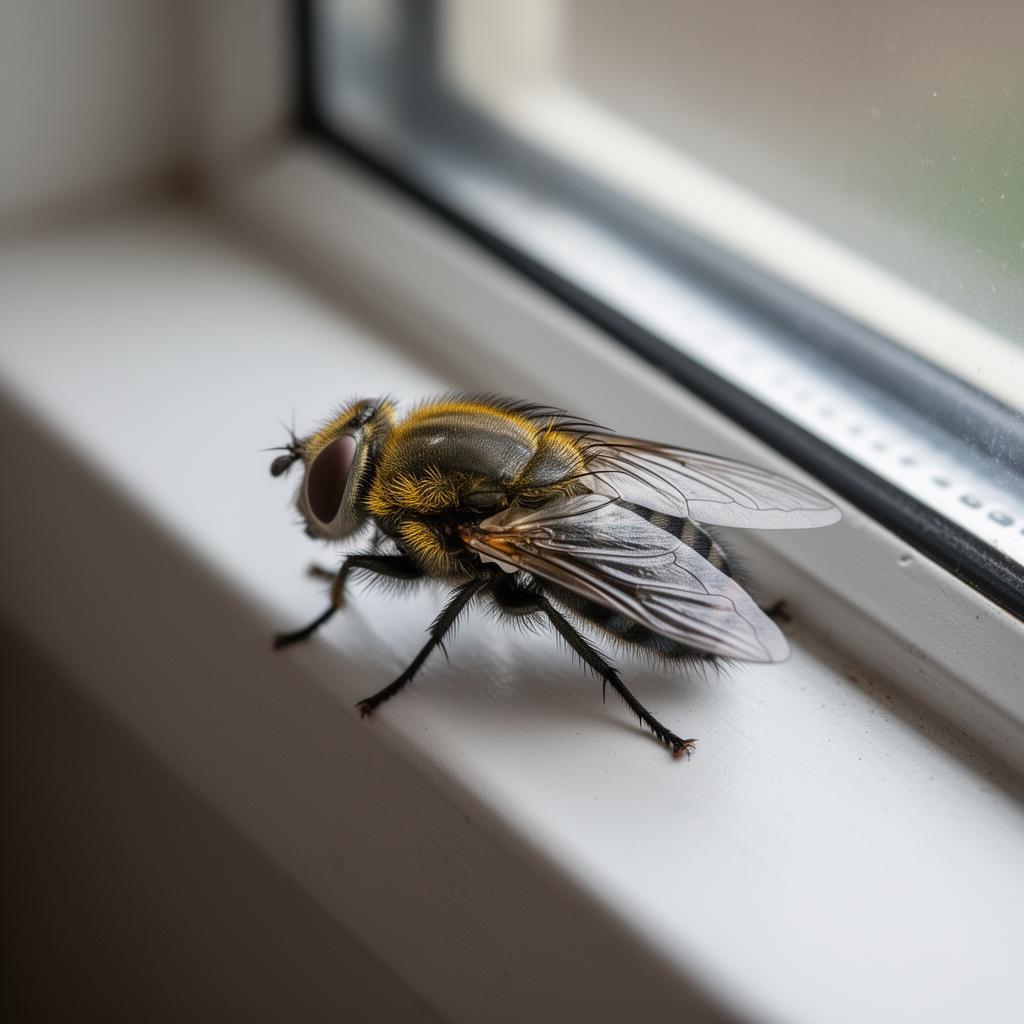
Fly
Cluster Fly
Pollenia rudis
Biology
The cluster fly, *Pollenia rudis*, is a non-biting muscid fly, distinguished by its larger size (8–10 mm) compared to the common house fly and the characteristic crinkled, golden-yellow hairs on its thorax, giving it a somewhat ‘fuzzy’ appearance. Its wings overlap noticeably at rest, another key identification feature. The lifecycle involves four stages: egg, larva, pupa, and adult. Eggs are laid in soil and hatch into larvae that are obligate endoparasites of earthworms, particularly species within the family Lumbricidae. Larval development within the earthworm typically takes 13–22 days, followed by a pupal stage of 11–14 days in the soil. There can be up to three generations per year, with adult longevity ranging from a few weeks to several months, especially for overwintering individuals.
Behaviour
Adult *Pollenia rudis* exhibit diurnal activity, primarily foraging for nectar and decaying organic matter in outdoor environments during warmer months. Their most notable behavior is the distinctive pre-overwintering aggregation, where thousands of individuals will congregate on the sunny, leeward sides of structures in late summer and early autumn as temperatures begin to drop below 10°C. While generally non-aggressive, their sheer numbers can be disturbing. They do not feed or reproduce indoors, but their sluggish movements and tendency to fly towards windows on warm days can be a nuisance. Impact on public health is minimal as they are not implicated in disease transmission, but their presence can cause staining from fecal spots on surfaces and an unpleasant odor when large numbers die within voids.
Habits
Cluster flies seek protected harborage for overwintering as ambient temperatures decline, typically entering structures through cracks, crevices around utility penetrations, unscreened vents, and gaps under eaves. Preferred overwintering sites are undisturbed, well-insulated areas like attics, wall voids, and seldom-used upper-story rooms, particularly those with a southern or western exposure that retains warmth. Foraging for host earthworms by the larvae necessitates moist soil conditions, making irrigated lawns and pastureland ideal breeding grounds. In autumn, adults perform an oriented flight to structures, aggregating in clusters on exterior walls before ingress. In spring, as temperatures rise, they emerge from overwintering sites, often moving sluggishly towards light sources like windows, signaling the end of their diapause.
Control methods
- 1Seal exterior gaps in late summer before flies enter
- 2Treat south- and west-facing walls with residual in August
- 3Vacuum overwintering clusters in attics and voids
- 4Install screens on attic vents, soffits and chimneys
- 5Use UV light traps in attic spaces during peak emergence
- 6Avoid killing inside voids in numbers — attracts dermestids
Tailored to Cluster Fly
IPM Procedure Checklist
Inspection
- Locate breeding sites: drains, decaying matter, moist organics
- Use tape-over-drain tests and UV/light traps to confirm
- Map dumpster, grease and floor-drain hot-spots
Identification
- Confirm Cluster Fly (Pollenia rudis) — not a look-alike
- Note life stage and risk level: Low
- Capture clear photos and samples for the record
Action Thresholds
- Tolerate low-level activity outside sensitive zones
- Act if activity moves indoors or near food
- Review threshold seasonally with the client
Prevention
- Clean drains with enzymatic foam to remove biofilm
- Manage trash, recycling and grease daily
- Screen windows, doors and air curtains at entries
Control Methods
- Seal exterior gaps in late summer before flies enter
- Treat south- and west-facing walls with residual in August
- Vacuum overwintering clusters in attics and voids
- Install screens on attic vents, soffits and chimneys
Monitoring & Evaluation
- Service monitors on schedule and trend captures
- Re-inspect for Cluster Fly activity at follow-up
- Adjust tactics based on data; report findings to client