Arachnid
Clover Mite
Bryobia praetiosa
Biology
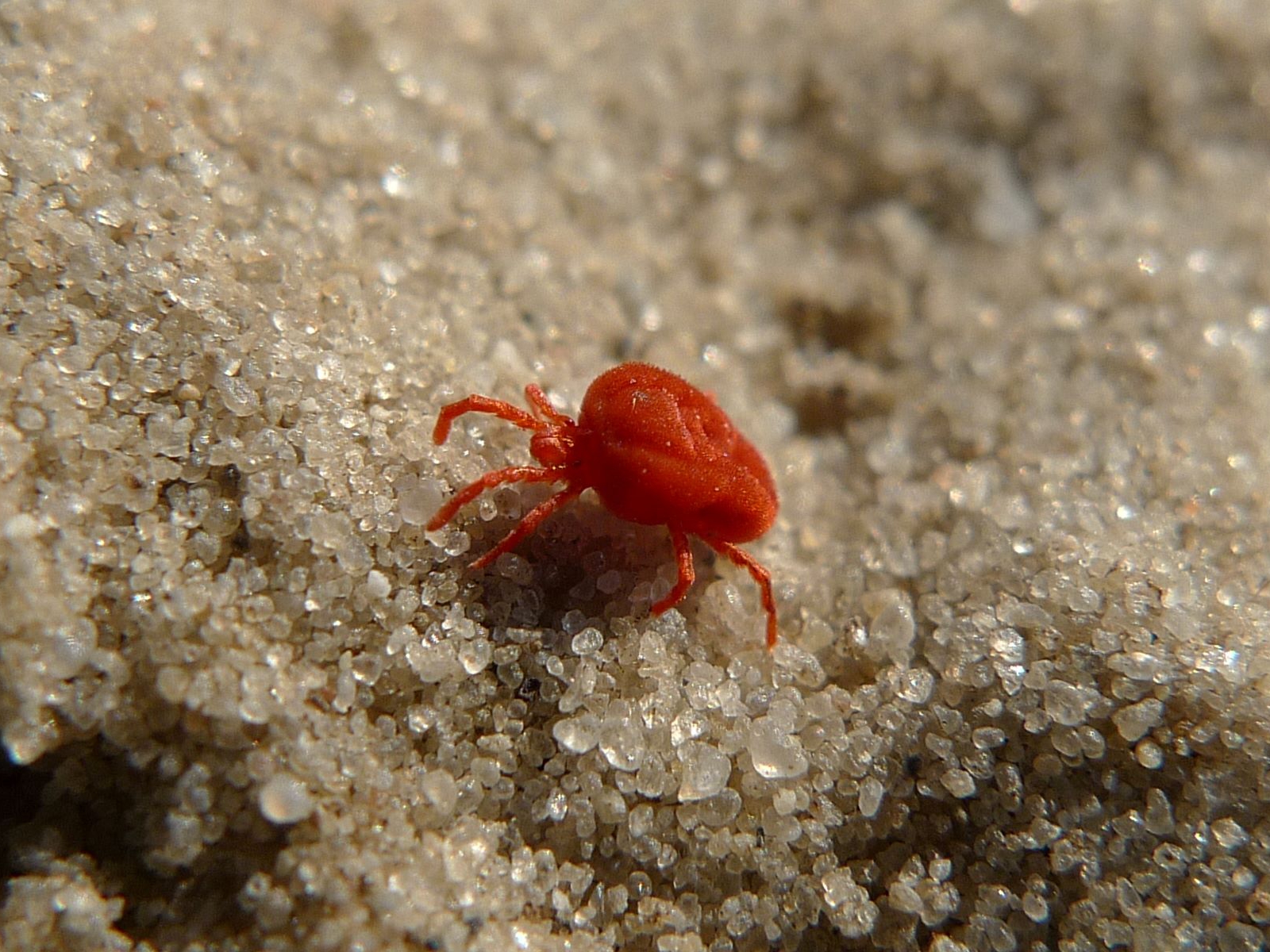
The clover mite, Bryobia praetiosa, belongs to the Acarina order and Tetranychidae family, making it an acarid, not a true insect. Adults are minute, approximately 0.75 mm long, oval-bodied, and reddish-brown to dark red, distinguished by exceptionally long, forward-pointing front legs that are twice the length of the second pair. Reproduction is primarily parthenogenetic, with females laying overwintering, bright red, spherical eggs in sheltered crevices, often on tree bark, fence posts, or building foundations. These eggs hatch in early spring when temperatures consistently exceed 7–10°C, with up to six generations occurring annually under optimal conditions (18-24°C, 50-70% RH). Longevity of adults is usually 2-4 weeks, with the entire life cycle from egg to adult completed in roughly 15-20 days during warm periods.
Behaviour
Clover mites are primarily diurnal, actively feeding during the day, though their visible indoor infestations often seem more pronounced during mid-morning to late afternoon. They are solitary feeders, extracting plant sap from a wide range of grasses and clovers, impacting turf health, particularly in monoculture lawns. Their dispersal occurs primarily through ambulation, but wind can carry them short distances, aiding in wider distribution. While not producing alarm pheromones in the manner of social insects, their mass migrations indicate a density-dependent response to environmental cues. When crushed, the hemolymph (not blood) leaves a characteristic reddish-brown stain on surfaces, a public-health nuisance due to cosmetic damage, though they do not bite, transmit diseases, or cause structural damage. Their rapid movements across surfaces are characteristic, often described as scurrying.
Habits
Clover mites predominantly harbor outdoors in dense turfgrass, clover patches, and weedy areas, especially those receiving abundant direct sunlight. Foraging patterns are driven by temperature and moisture; they are highly sensitive to desiccation and extreme heat, which precipitates their movement towards cooler, shaded areas or structural perimeters. Seasonal movements involve mass incursions into structures during early spring (March-April) and late fall (September-November) as outdoor temperatures fluctuate or host plants decline. Conducive conditions for indoor infestations include dense, well-fertilized lawns immediately adjacent to foundations, particularly on sun-exposed (south- and west-facing) walls. Technicians should look for reddish-brown streaking on windowsills, curtains, walls, and light-colored furniture, often accompanied by live mite activity along window frames, baseboards, and around electrical outlets.
Control methods
- 1Maintain a 18–24 in. plant-free band around foundation
- 2Reduce lawn fertilizer next to walls
- 3Vacuum — never crush — to avoid staining
- 4Seal window and door gaps with weatherstripping
- 5Spot treat foundation with miticide in spring
- 6Caulk cracks where eggs over-summer
Tailored to Clover Mite
IPM Procedure Checklist
Inspection
- Survey interior and exterior for evidence and conducive conditions
- Document findings with photos and a site map
- Place monitors to confirm activity
Identification
- Confirm Clover Mite (Bryobia praetiosa) — not a look-alike
- Note life stage and risk level: Low
- Capture clear photos and samples for the record
Action Thresholds
- Tolerate low-level activity outside sensitive zones
- Act if activity moves indoors or near food
- Review threshold seasonally with the client
Prevention
- Exclude entry points and harborage
- Improve sanitation and moisture control
- Modify habitat around the structure
Control Methods
- Maintain a 18–24 in. plant-free band around foundation
- Reduce lawn fertilizer next to walls
- Vacuum — never crush — to avoid staining
- Seal window and door gaps with weatherstripping
Monitoring & Evaluation
- Service monitors on schedule and trend captures
- Re-inspect for Clover Mite activity at follow-up
- Adjust tactics based on data; report findings to client