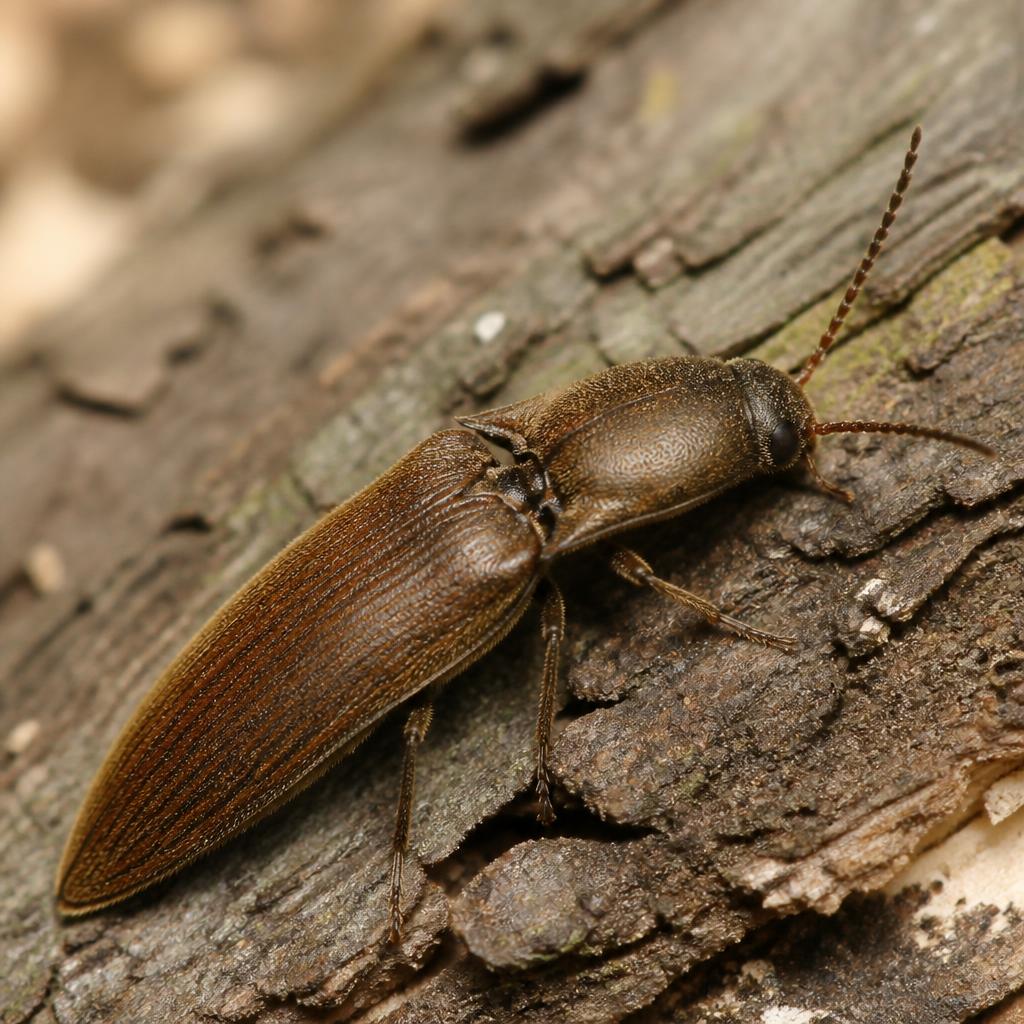
Insect
Click Beetle
Elateridae
Biology
Click beetles are a diverse family of insects, Elateridae, characterized by their unique ability to 'click' and flip themselves into the air. This family contains over 10,000 species worldwide. Adults are typically elongate, flattened, and range in size from a few millimeters to several centimeters, often dark-colored. Their most distinctive feature is a hinged joint between the prothorax and mesothorax. Females lay eggs in soil or decaying wood. Larvae, known as wireworms, are slender, cylindrical, hard-bodied, and yellowish to brown, often segmented. The larval stage can last from one to five years, with pupation occurring in the soil. Development is influenced by soil temperature and moisture.
Behaviour
Adult click beetles are largely nocturnal or crepuscular, with many species attracted to lights. Their most notable behavior is the 'clicking' mechanism used to right themselves when overturned, or to escape predators; this involves rapidly flexing the prothorax against the mesothorax. Females seek out suitable substrates—often soil or rotting wood—for oviposition. Wireworm larvae are subterranean, moving through the soil in search of food. They are known for their slow, deliberate movement. Some species are predaceous, but most are phytophagous.
Habits
The impact of click beetles is primarily due to their larval stage, wireworms. Wireworms are notorious pests of agricultural crops, including corn, potatoes, small grains, and various vegetables, feeding on seeds, roots, and tubers. The damage can lead to significant crop losses, particularly in newly planted fields or those following sod. Adult click beetles are generally not considered pests, feeding on pollen, nectar, or exhibiting no feeding at all. Harborage for wireworms is entirely within the soil. Conducive conditions include poorly drained, organic-rich soils, and fields previously in pasture or sod, which provide abundant food sources for the larvae.
Control methods
- 1Rotate crops to disrupt life cycle.
- 2Implement good field sanitation.
- 3Use insecticide-treated seeds.
- 4Monitor soil for wireworm presence.
- 5Improve soil drainage and aeration.
- 6Apply soil insecticides pre-planting.
Tailored to Click Beetle
IPM Procedure Checklist
Inspection
- Inspect harborage near food, water and warmth
- Check cracks, voids and appliance interiors
- Place sticky monitors at suspected hot-spots
Identification
- Confirm Click Beetle (Elateridae) — not a look-alike
- Note life stage and risk level: Low
- Capture clear photos and samples for the record
Action Thresholds
- Tolerate low-level activity outside sensitive zones
- Act if activity moves indoors or near food
- Review threshold seasonally with the client
Prevention
- Seal cracks, plumbing penetrations and wall voids
- Eliminate moisture sources and standing water
- Improve sanitation: sealed food storage, grease removal
Control Methods
- Rotate crops to disrupt life cycle.
- Implement good field sanitation.
- Use insecticide-treated seeds.
- Monitor soil for wireworm presence.
Monitoring & Evaluation
- Service monitors on schedule and trend captures
- Re-inspect for Click Beetle activity at follow-up
- Adjust tactics based on data; report findings to client