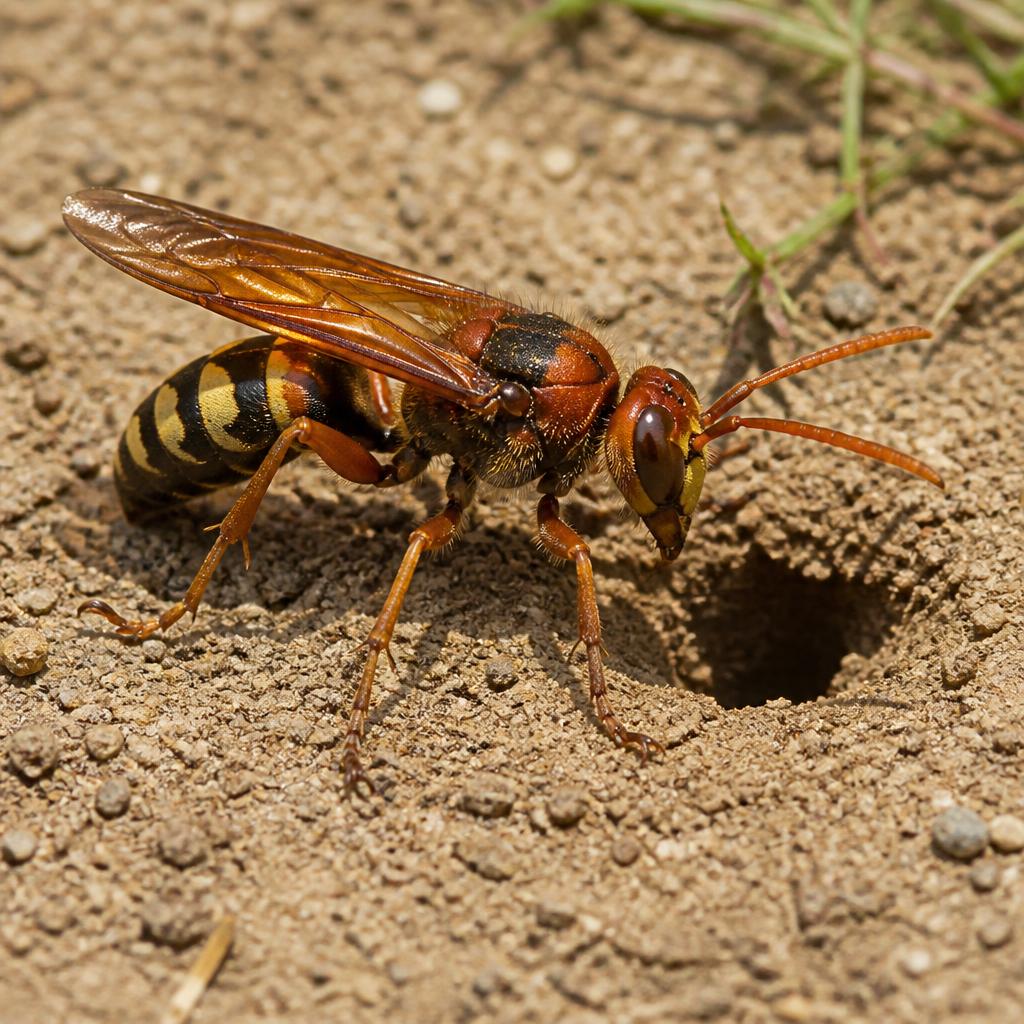
Stinging Insect
Cicada Killer Wasp
Sphecius speciosus
Biology
The Eastern Cicada Killer Wasp, _Sphecius speciosus_, is the largest wasp in North America, belonging to the family Crabronidae. Females measure 38-50 mm, while males are slightly smaller at 15-40 mm. Their integument is predominantly black with striking yellow bands on the abdominal tergites and reddish-brown, semi-transparent wings with dark venation. Developmental stages include egg, larva (five instars), prepupa, and pupa, with a full lifecycle from egg to adult typically completed within one year. Adults, primarily univoltine, generally emerge from July to September, with larval diapause occurring over winter as a prepupa in an earthen cell.
Behaviour
Cicada killers are diurnal, highly active during the day, especially in warm, sunny conditions. Females actively hunt and paralyze large cicadas, primarily from the genus _Tibicen_, using a venomous sting to the cicada's ventral nerve ganglia; a single sting is sufficient to immobilize, not kill. This paralyzed prey is then transported, often in arduous flight or by dragging, back to her burrow. Males are territorial, patrolling large airspace to intercept females and deter rival males, exhibiting aggressive-looking but harmless dive-bombing toward intruders. While males do not possess a stinger, females, despite their formidable size and venom capability, are remarkably non-aggressive towards humans unless directly threatened or mishandled, with stings being rare and generally mild, localized reactions.
Habits
These solitary wasps prefer to construct their nesting burrows in light, well-drained, sandy or loamy soils, often in sun-exposed areas such as lawns, golf courses, flower beds, and unpaved pathways. Each female excavates multiple burrows, typically 15-25 cm deep, each ending in several oval-shaped cells, and provisions each cell with one to three paralyzed cicadas. Foraging activities are concentrated on deciduous trees where cicadas are abundant. Signs of infestation for a technician include conical piles of excavated soil outside burrow entrances, observed females carrying large cicadas, and the distinctive buzz and aerial chases of territorial males, particularly from mid-summer through early fall.
Control methods
- 1Tolerate where possible — solitary and beneficial
- 2Re-establish dense turf to discourage burrows
- 3Apply dust treatment into active burrows at dusk
- 4Water and aerate dry sandy patches
- 5Mulch bare areas around walks and patios
- 6Avoid swatting — provokes defensive sting
Tailored to Cicada Killer Wasp
IPM Procedure Checklist
Inspection
- Survey interior and exterior for evidence and conducive conditions
- Document findings with photos and a site map
- Place monitors to confirm activity
Identification
- Confirm Cicada Killer Wasp (Sphecius speciosus) — not a look-alike
- Note life stage and risk level: Low
- Capture clear photos and samples for the record
Action Thresholds
- Tolerate low-level activity outside sensitive zones
- Act if activity moves indoors or near food
- Review threshold seasonally with the client
Prevention
- Exclude entry points and harborage
- Improve sanitation and moisture control
- Modify habitat around the structure
Control Methods
- Tolerate where possible — solitary and beneficial
- Re-establish dense turf to discourage burrows
- Apply dust treatment into active burrows at dusk
- Water and aerate dry sandy patches
Monitoring & Evaluation
- Service monitors on schedule and trend captures
- Re-inspect for Cicada Killer Wasp activity at follow-up
- Adjust tactics based on data; report findings to client