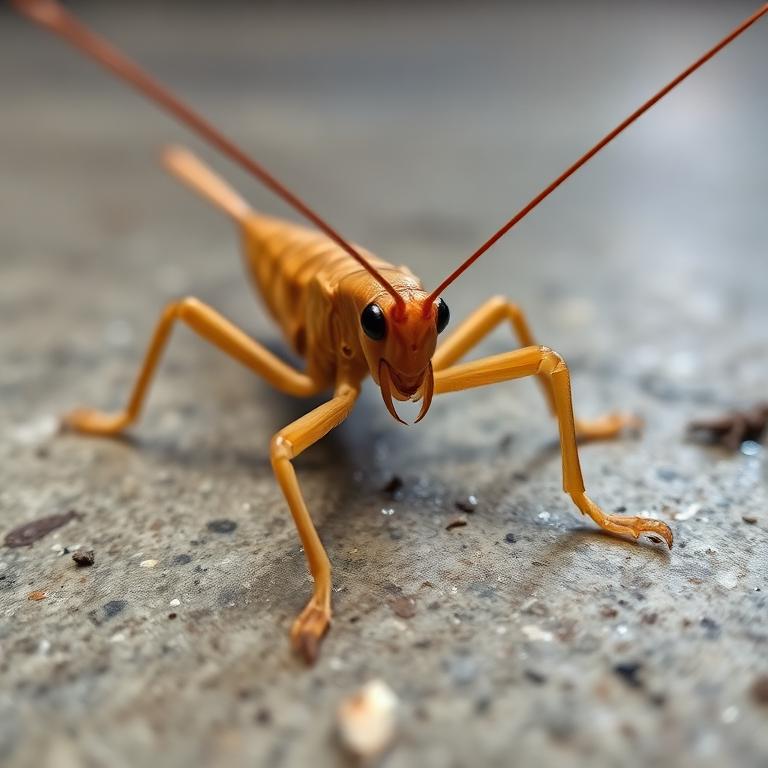
Occasional Invader
Camel Cricket
Diestrammena asynamora
Biology
Camel crickets (Rhaphidophoridae) are wingless, humpbacked orthopterans 13–33 mm long, tan to mottled brown, with extremely long antennae — often twice body length — and greatly enlarged hind femora. Lacking wings, they neither fly nor stridulate, so infestations are silent. Development is hemimetabolous: females insert eggs into moist substrate in late summer or autumn using a long, sword-like ovipositor, and nymphs pass through roughly 8–10 instars over several months. Most populations complete one generation per year, with nymphs and adults overwintering in stable, humid microclimates. Adults live several months; the greenhouse camel cricket (D. asynamora), an Asian introduction, now dominates many North American structural populations.
Behaviour
They are strictly nocturnal and negatively phototactic, retreating from light into dark voids by day. When disturbed they jump erratically and often toward the disturbance — a startle defense that unsettles occupants but carries no bite risk or venom. Camel crickets have no aggregation pheromone in the wasp or cockroach sense, yet they cluster wherever humidity and harborage are ideal, so counts in a single crawlspace can reach hundreds. Feeding is scavenging and omnivorous: fungi, plant debris, dead insects, fabrics, paper, and cardboard. Populations can damage stored textiles, boxes, and insulation facing, and heavy die-offs leave carcasses that feed dermestid beetles and other secondary pests.
Habits
Harborage is defined by moisture: crawlspaces, unfinished basements, sump pits, drainage tiles, utility tunnels, wells, greenhouses, and the underside of mulch, stone, railroad ties, and firewood against foundations. They enter through foundation cracks, unscreened crawlspace vents, gaps under exterior doors, and utility penetrations, most often in late summer drought or after heavy rain floods outdoor harborage. Conducive conditions include relative humidity above 60% in the crawlspace, exposed soil without a vapor barrier, leaking hose bibs and condensate lines, and heavy mulch or leaf litter banked against the structure. Technicians should look for shed skins, dark fecal specks on foundation walls, chewed cardboard, and live specimens on glueboards placed along crawlspace piers.
Control methods
- 1Install a sealed vapour barrier and dehumidify crawlspaces below 60% RH
- 2Correct grading, downspouts and leaking plumbing to dry the perimeter
- 3Seal foundation cracks, vent screens and utility penetrations
- 4Pull mulch, leaf litter and firewood back 300 mm from the foundation
- 5Place glueboard monitors along crawlspace piers and sill plates
- 6Apply a targeted perimeter residual band where monitoring shows pressure
Tailored to Camel Cricket
IPM Procedure Checklist
Inspection
- Inspect exterior perimeter for entry pathways
- Note moisture, mulch and ground-cover near foundation
- Identify aggregation sites on warm walls
Identification
- Confirm Camel Cricket (Diestrammena asynamora) — not a look-alike
- Note life stage and risk level: Low
- Capture clear photos and samples for the record
Action Thresholds
- Tolerate low-level activity outside sensitive zones
- Act if activity moves indoors or near food
- Review threshold seasonally with the client
Prevention
- Seal foundation cracks, weep holes and utility penetrations
- Pull mulch and vegetation back from the structure
- Improve drainage and reduce exterior moisture
Control Methods
- Install a sealed vapour barrier and dehumidify crawlspaces below 60% RH
- Correct grading, downspouts and leaking plumbing to dry the perimeter
- Seal foundation cracks, vent screens and utility penetrations
- Pull mulch, leaf litter and firewood back 300 mm from the foundation
Monitoring & Evaluation
- Service monitors on schedule and trend captures
- Re-inspect for Camel Cricket activity at follow-up
- Adjust tactics based on data; report findings to client