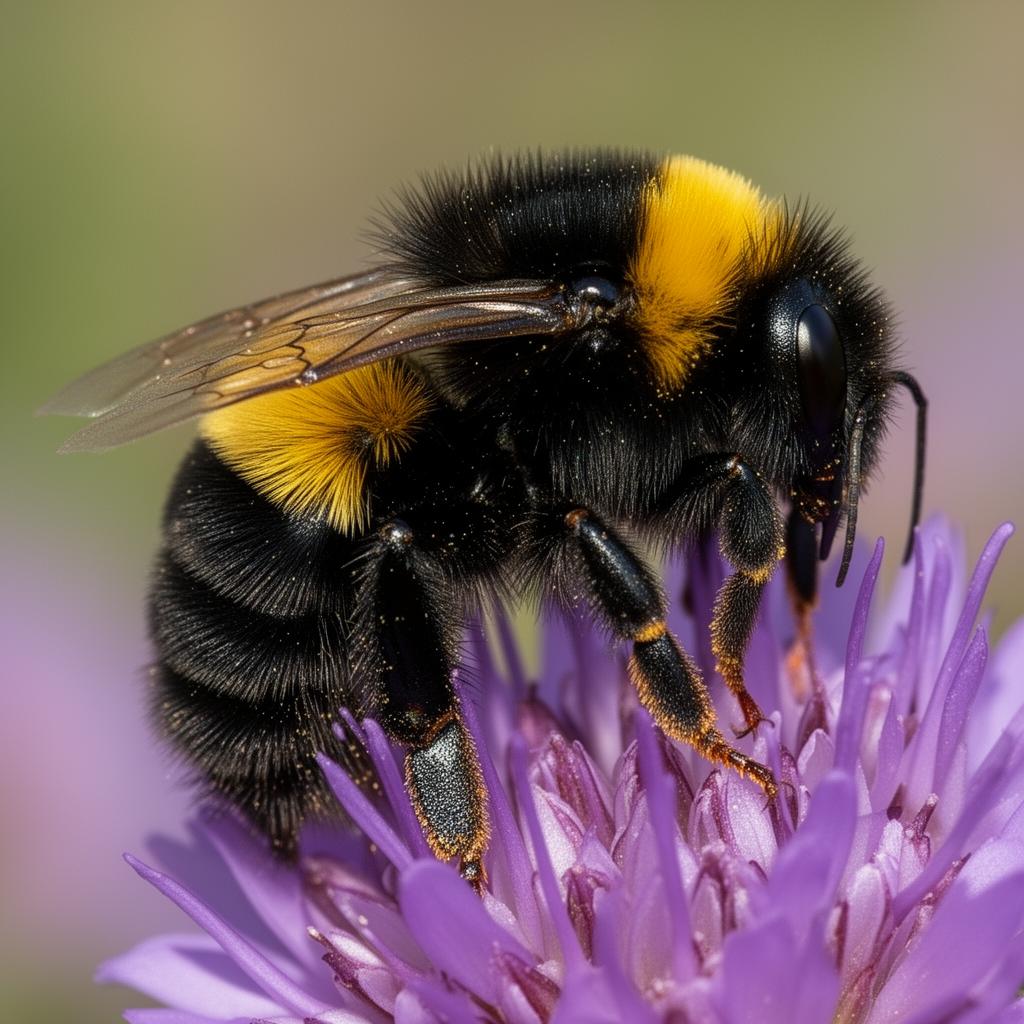
Stinging Insect
Bumble Bee
Bombus spp.
Biology
Bumble bees (Bombus spp.) belong to the family Apidae, order Hymenoptera, and are characterized by their robust, hairy bodies, often striped with black and yellow or orange. Queens are typically larger than workers and males. Their lifecycle is annual, beginning with a queen emerging from hibernation in spring to establish a nest and lay eggs. Larvae develop through several instars within wax cells, pupating before emerging as adult workers. Reproduction involves the queen producing both fertile eggs (females/workers/new queens) and unfertilized eggs (males); new queens and males emerge later in the season to mate, perpetuating the species. Bumble bee colonies are much smaller than honey bee colonies, usually numbering in the hundreds, and they exhibit moderate cold tolerance due to their thermoregulatory capabilities, including shivering to warm up.
Behaviour
Bumble bees are primarily diurnal, actively foraging for nectar and pollen during daylight hours, although some species may extend activity into twilight. They exhibit a form of social structure, with a queen, sterile female workers, and male drones, but their social organization is less complex than that of honey bees; workers share foraging duties and nest maintenance. Communication within the colony mainly involves chemical cues for nest protection and location of resources, along with tactile interactions. Their feeding habits are essential for pollination, as they collect nectar for energy and pollen as a protein source for larval development. Public health impact is generally low; stings are painful but typically not life-threatening unless an individual is allergic, and structural impact is negligible as they do not consume wood or damage buildings.
Habits
Bumble bees typically establish nests in various harborage sites, including abandoned rodent burrows, dense tussocks of grass, compost piles, or cavities under sheds and porches; some species may utilize tree cavities or bird nests. Foraging activities involve visiting a wide variety of flowering plants to collect nectar and pollen, often showing a preference for certain floral types based on tongue length and efficiency. Seasonally, nests are initiated in the spring by a solitary queen, grow through the summer, and decline in early autumn as new queens and males emerge; only mated queens overwinter. Conducive conditions for bumble bee activity include the presence of abundant flowering vegetation in close proximity to suitable nesting sites. Signs of infestation are usually limited to visible worker bees foraging near the nest entrance and the occasional observation of the nest itself, which may be characterized by a buzzing sound and the comings and goings of bees.
Control methods
- 1Leave nests in remote areas — colonies die out by fall
- 2Mark nest locations and reroute foot traffic
- 3Treat dust into entrance at dusk only when relocation impossible
- 4Seal void entries after the colony has died off
- 5Wear PPE and treat at night for in-structure colonies
- 6Plant pollinator habitat away from high-traffic zones
Tailored to Bumble Bee
IPM Procedure Checklist
Inspection
- Survey interior and exterior for evidence and conducive conditions
- Document findings with photos and a site map
- Place monitors to confirm activity
Identification
- Confirm Bumble Bee (Bombus spp.) — not a look-alike
- Note life stage and risk level: Low
- Capture clear photos and samples for the record
Action Thresholds
- Tolerate low-level activity outside sensitive zones
- Act if activity moves indoors or near food
- Review threshold seasonally with the client
Prevention
- Exclude entry points and harborage
- Improve sanitation and moisture control
- Modify habitat around the structure
Control Methods
- Leave nests in remote areas — colonies die out by fall
- Mark nest locations and reroute foot traffic
- Treat dust into entrance at dusk only when relocation impossible
- Seal void entries after the colony has died off
Monitoring & Evaluation
- Service monitors on schedule and trend captures
- Re-inspect for Bumble Bee activity at follow-up
- Adjust tactics based on data; report findings to client